


Best AI Writing Tools
AI writing tools have improved so much in a short time, but unfortunately there seem to be three distinct lanes they fall into: general-purpose chat models people repurpose for writing (ChatGPT, Claude), dedicated marketing-copy platforms built on top of these models (Jasper, Copy.ai, Writesonic, Rytr, Anyword), and specialist tools built for one specific job (like Surfer, Frase, Sudowrite, Grammarly, Wordtune). None of them do all three well, and most of the frustration people have comes from trying to use one tool to cover a job it wasn’t built for. We compared twelve of the most-used platforms across output quality, pricing, and what they’re actually best suited for, rather than which one wins a generic head-to-head.
How We Tested The Best AI Writing Tools
Rather than judging each tool on marketing claims or single sample output, we ran every platform through the same core set of writing tasks and evaluated them side by side. That included a blog-post introduction, a short marketing email, a product description, and, where the tool supported it, a fiction scene continuation. That way, tools with a narrow specialty weren’t judged on tasks they weren’t built for. We also checked each tool’s current pricing page, free-tier limits, and any editing or “humanizing” features directly rather than relying on marketing copy.
Methodology
Quality: We looked at how usable the first draft was without heavy rewriting, including coherence over the full length of the piece, whether the tool stayed on topic, and whether the prose read as specific as opposed to generic filler.
Control: We evaluated how much the tool let us shape the output, including brand voice or style settings, adjustable tone and length, and whether regenerating a section actually produced a meaningfully different result rather than a reshuffled version of the same draft.
Detection: Where relevant, we ran outputs through commonly used AI detectors (Originality.ai and GPTZero) to see how they scored before any manual editing, and noted where a tool’s built-in “humanizer” or rewrite feature changed that result.
Price: We reviewed cost at the entry tier that would cover regular use, not a stripped-down free trial, weighed against what that tier unlocks compared to competitors at a similar price point.
Scores in the table below reflect this hands-on testing combined with current published pricing and user feedback, not a single standardized lab benchmark. Given how often these platforms update pricing and features, treat the scores as directional and double-check specifics before subscribing.
Best AI Writing Tools At A Glance
| Tool | Best for | Free trial | Price (entry) | Output quality score* |
| Jasper | Brand-consistent marketing campaigns | Yes, limited | ~$49–69/ mo/seat | 8.5/10 |
| Copy.ai | Free-tier copywriting, GTM workflows | Yes, limited | Free / $29+/mo | 7.5/10 |
| Writesonic | SEO-first blog content | Yes, limited | ~$39–79/mo | 7.5/10 |
| Rytr | Budget short-form copy | Yes, free tier | $7.50–9/mo | 6.5/10 |
| Sudowrite | Fiction and novel drafting | Yes, ~10,000 credits | $10–59/mo | 8/10 (fiction only) |
| ChatGPT | General-purpose drafting, versatility | Yes, free tier | Free / $20/mo (Plus) | 8.5/10 |
| Claude | Long-form writing, nuance, editing | Yes, free tier | Free / $20/mo (Pro) | 9/10 |
| Grammarly | Grammar, clarity, tone editing | Yes, free tier | Free / ~$12–15/mo | 8/10 (editing, not drafting) |
| Surfer SEO | Live on-page SEO scoring | Limited (paid plans only) | $49–99+/mo | 7/10 (SEO tool, not a writer) |
| Frase | SEO content briefs and drafts on a budget | Yes, limited | $45/mo | 7/10 |
| Anyword | Ad copy with predictive performance scoring | Yes, limited | ~$49/mo | 7.5/10 |
| Wordtune | Sentence-level rewriting and tone | Yes, free tier | Free / ~$10–15/mo | 7/10 (rewriting, not drafting) |
The 12 Best AI Writing Tools Reviewed
Jasper
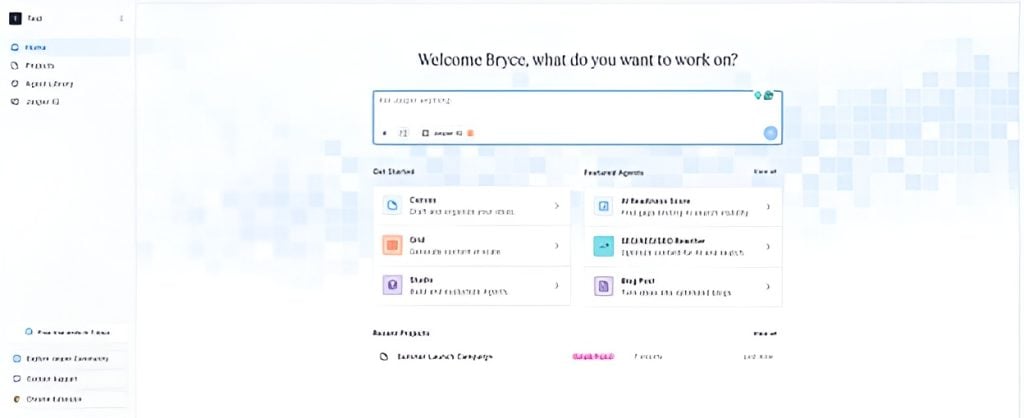
Jasper is the enterprise-leaning pick for marketing teams that need brand voice consistency across many writers and channels. Its Brand Voice engine can be trained on existing content so different writers on a team produce copy that reads consistently, and campaign templates cover everything from Facebook ads to full email sequences without starting from a blank prompt every time. Business-tier plans add API access, SSO, and workflow automation aimed at agencies managing multiple client accounts, plus native image generation for pairing visuals with copy inside the same platform.
The tradeoff is price, with entry plans running at $49-$69 per seat per month, well above most competitors on this list. And that’s before Business-tier features push the costs into five- or six-figure annual contracts for larger teams. Output quality is strong for structured marketing formats but still needs a real editing pass. Left unedited, Jasper-generated blog posts tend to have a recognizable rhythm that shows up across many brands using the tool. It’s also overkill for solo writers without a multi-brand need.
Pros: strong brand-voice consistency across writers, deep template library, image generation built in, solid enterprise support (SSO, API), 7-day free trial
Cons: highest entry price in this list, output needs editing to avoid a generic “AI voice,” steep for solo users
Verdict: worth it if you’re managing brand voice across a team; overkill for a solo writer.
Copy.AI
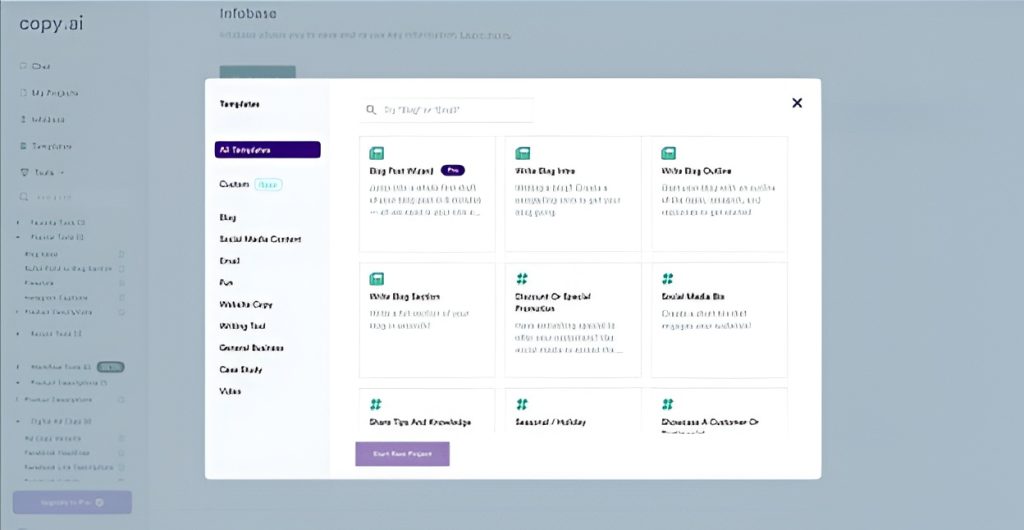
Copy.ai built its reputation as the friendliest on-ramp into AI copywriting, but has since repositioned itself as a broader go-to-market platform aimed at sales and marketing teams, not just writers. While that repositioning has made it harder to get started (a free demo isn’t quite what it used to be), the writing engine that won people over is still there. The platform pumps out punchy, short-form copy with a “First Draft Wizard” that several reviewers single out for creating solid copy, not just filler. It’s strongest for emails, ad variations, production descriptions, and social captions, the kind of short, high-volume copy that benefits from multiple options and picking the best one.
Long-form content is serviceable but clearly not the tool’s focus. It lacks SEO scoring and structural guidance other platforms on this list offer. The paid tier starts at $29/month, making it a lower entry price than Jasper.
Pros: strong for short-form and high-volume copy variations, low learning curve
Cons: long-form content is weaker than dedicated blog tools, has drifted toward broader GTM features that some writers won’t need
Verdict: solid choice for short-form, high-volume copy on a budget.
Writesonic
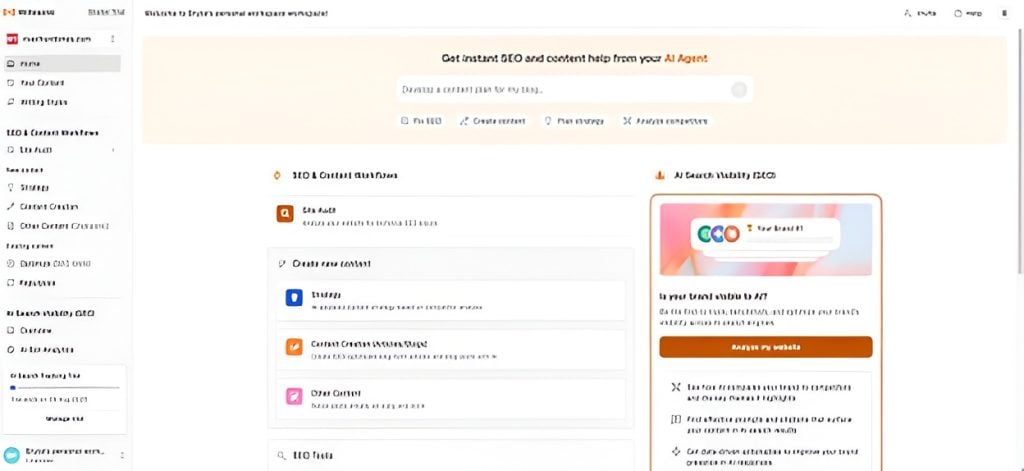
Writesonic leans hardest into SEO-first content, with built-in optimization scoring and a workflow explicitly aimed at bloggers and content agencies who need to publish at volume. It pulls in real-time web data for some article types, which helps with topics where current information matters, and its Brand Voice control lets teams maintain some consistency across writers, though reviewers generally rate this feature behind Jasper’s implementation.
Output quality is solid for structured how-to and listicle content (clearly what the platform is optimized for) but less so for anything requiring a distinct argument or original point of view. Ask it for a “best of” roundup, and you’ll get great results. An opinion piece? Not so much. Pricing starts around $39/month for light use and climbs to $79/month and beyond for higher-volume plans.
Pros: strong SEO-content workflow, real-time data integration for some content types, competitive mid-tier pricing
Cons: less capable on opinion or argument-driven writing, Brand Voice weaker than Jasper’s
Verdict: a strong pick if organic search traffic is the whole goal and you’re publishing regularly
Rytr
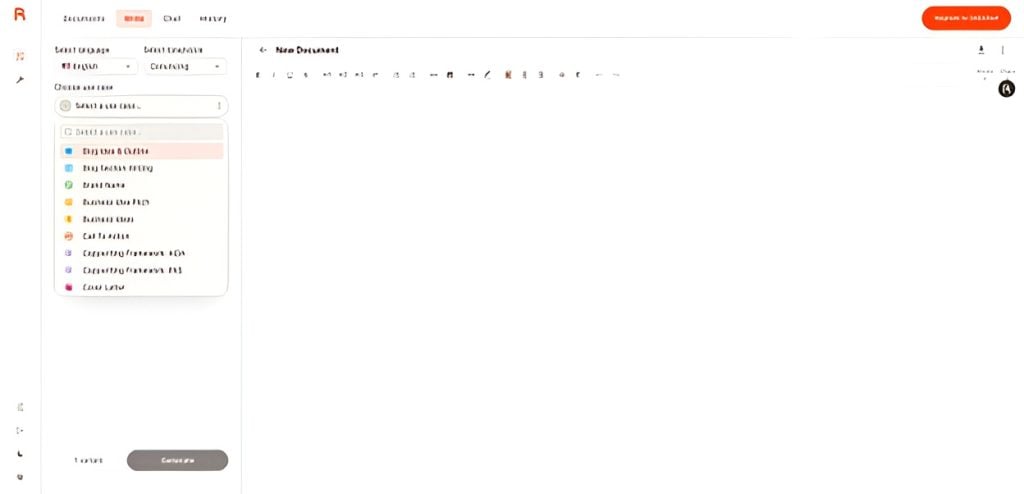
Rytr is the budget option, and it’s their selling point at $7.50-$9/month for unlimited generation, 40-plus use-case templates covering everything from product descriptions to interview questions, support for 30-plus languages, and a built-in plagiarism checker most competitors charge extra for. For short-form content like social captions, product blurbs, and short emails, it holds up reasonably well against tools charging way more.
But it doesn’t do as well for longer content. Articles past 800 words tend to lose coherence, repeat ideas, or drift off the original brief. To get a longer article, you’ll need to generate in smaller sections and stitch them together manually. There’s also no meaningful SEO integration, no brand-voice engine for maintaining consistency across a team, and no workflow automation. It’s a straightforward generation tool, not a content platform.
Pros: lowest price in this list for unlimited generation, wide language support, built-in plagiarism checker
Cons: long-form content needs heavy manual assembly, no SEO or brand-voice features, no team workflow tools
Verdict: fine for short-form content on a tight budget; not built for long-form work
Sudowrite
Sudowrite is the only tool on this list specifically for fiction, and it shows. Story Engine can take a concept, characters, and settings and generate a full chapter-by-chapter beat sheet, then draft chapters against those beats. It’s truly useful as a fast first-draft generator to react to and revise, rather than a ghostwriter who nails the final version. Describe expands sensory detail in a scene without the generic “purple prose” feel some general tools produce, and Rewrite offers style variations that preserve a writer’s established voice rather than flattening it toward a generic AI register, a common complaint about using ChatGPT or Jasper for creative work.
Pricing is credit-based rather than flat rate, running around $10-$59 a month across Hobby, Professional, and Max tiers, which can feel unpredictable for heavy users who burn through credits faster than expected. Only the top Max tier allows for credit rollover. It also doesn’t export to EPUB, DOCX, or other publishing-ready formats, has no cover design or audiobook tooling, so novelists will need a separate tool for steps after drafting. Quality can also vary by chapter within the Story Engine output. Some sections land the tone immediately, while others need a lot of rewriting.
Pros: genuinely fiction-specific tooling (Story Engine, Describe, Rewrite), strong voice consistency, generous free trial
Cons: credit-based pricing can feel unpredictable, no export formats or publishing tools, inconsistent quality within longer generated sections
Verdict: the strongest drafting assistant for novelists specifically; not built for anything else
ChatGPT
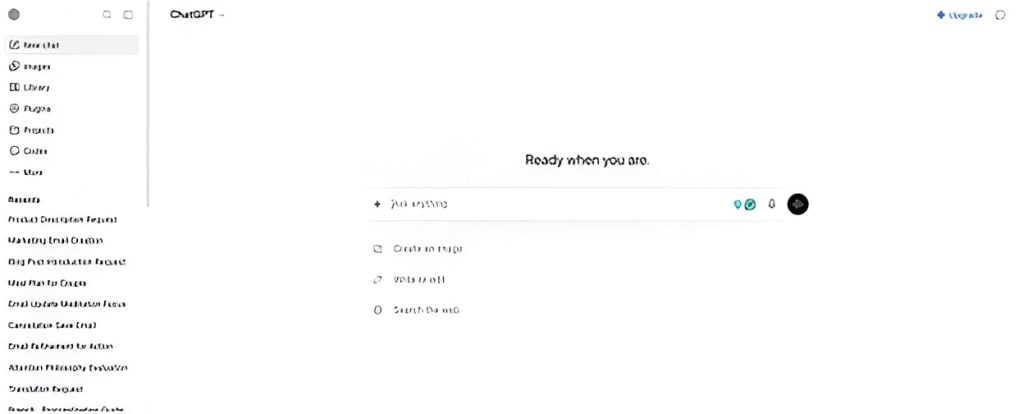
ChatGPT’s biggest strength is its flexibility. It can draft an email, outline a blog post, punch up ad copy, or brainstorm fiction premises without needing a specialized template for each, and its familiarity means most writers already know roughly how to prompt it effectively. The generality is also the downside, because it has no built-in SEO scoring, no brand-voice memory that persists cleanly across separate projects the way Jasper’s does, and no fiction-specific tooling as Sudowrite offers. Instead, everything runs through the same general-purpose conversational interface regardless of the writing task.
The free tier is totally usable for casual writing and short projects. Plus, at $20/month, adds longer context windows, priority access during high-demand periods, and access to more capable underlying models. For teams that need multiple writers working from a shared style guide, ChatGPT requires more manual prompt engineering to maintain consistency than a purpose-built marketing tool would.
Pros: highly flexible across writing types, familiar interface, strong value at $20/month for general use
Cons: no dedicated SEO, brand-voice, or fiction tooling, consistency across a team takes more manual prompting than specialized tools
Verdict: the best all-purpose starting point if you don’t want to commit to a specialized tool yet
Claude
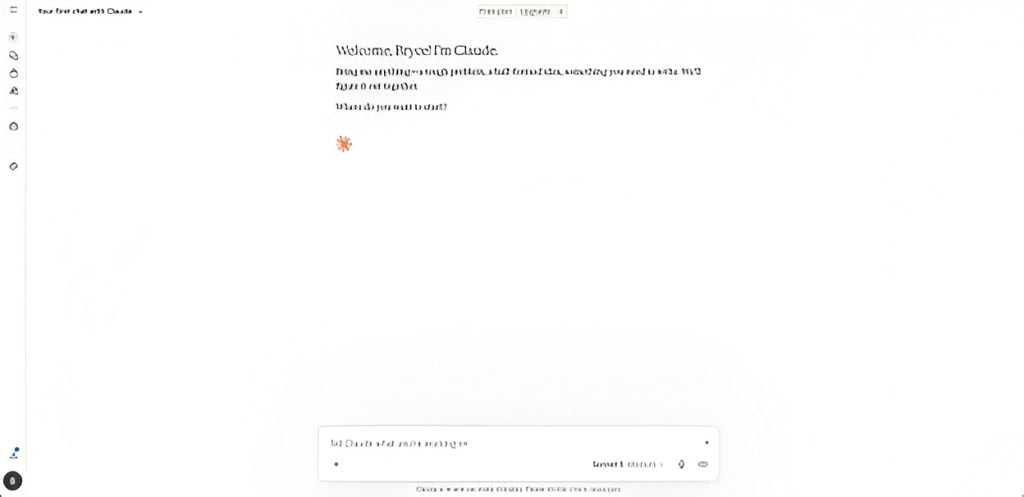
Claude tends to edge out ChatGPT on longer-form writing tasks like essays, reports, and detailed edits when maintaining a consistent argument and voice across thousands of words matters more than quick turnaround on short copy. It’s also a strong editor. Feeding it a full draft and asking for a structural pass or line edit tends to produce more specific, actionable feedback than generic “make this better” prompt returns from other tools, and it holds context well across long documents without losing track of earlier details or arguments.
Like ChatGPT, it has no dedicated SEO scoring, brand-voice memory system, or fiction-specific set, since it is a general-purpose writing and editing partner, not a specific platform. Teams that need structured campaign workflows or SEO briefs will still want to pair it with a tool that offers that. The free tier is limited but functional for everyday writing and editing tasks. Pro runs $20/month and adds higher usage limits and access to more capable models for longer or more complex writing projects.
Pros: strong on long-form coherence and editing feedback, holds context well across long documents, competitive $20/month price
Cons: no dedicated SEO or marketing-campaign tooling, no fiction-specific feature set like Sudowrite’s
Verdict: no dedicated SEO or marketing-campaign tooling, no fiction-specific feature set like Sudowrite’s
Grammarly
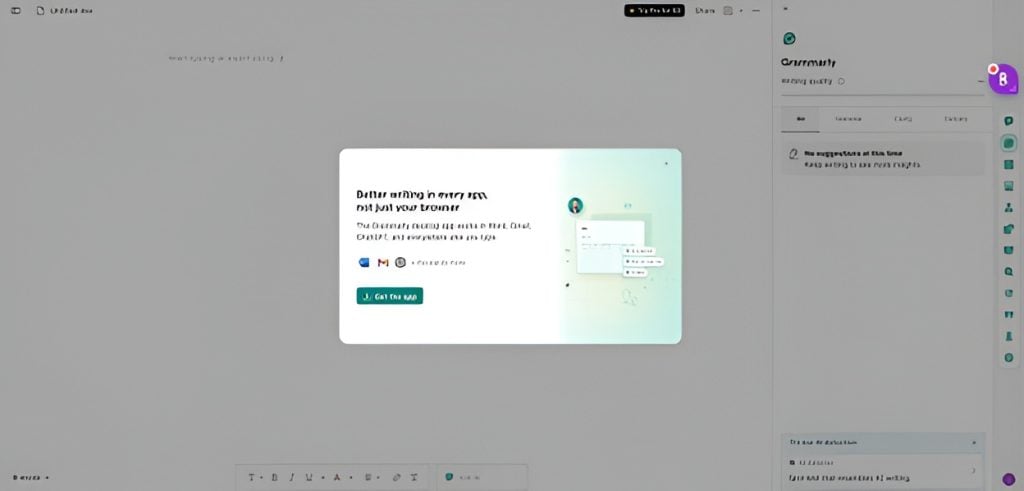
Grammarly isn’t a drafting tool, so we didn’t evaluate it as one. However, it is often an important tool for writers, which is why we included it in this list. It’s an editing layer that sits on top of whatever you (or your AI tool) has already written, catching grammar, spelling, and punctuation issues as a baseline, with tone detection and an AI-assisted rewrite feature (Grammarly Go) for punching up specific sentences or adjusting formality. It integrates directly into browsers, Google Docs, Microsoft Word, and most places that people write, making it more of a background utility than a destination tool you open to start a project.
The free tier covers basic grammar and spelling correction, which is useful on its own. The paid tier at $12-$15/month adds fuller tone detection, more substantial rewrite suggestions, and plagiarism checking on higher tiers. It won’t help with structure, argument, or original ideas the way a drafting tool will. Grammarly’s whole job is to polish text that already exists, not create new text.
Pros: works inside the apps people already write in, strong at catching mechanical errors, useful free tier
Cons: not a drafting tool, limited usefulness for structural or content-level feedback
Verdict: the standard final-pass tool regardless of which drafting tool you use upstream
Surfer SEO
Surfer’s core product is its live Content Score, a real-time sidebar that scores a draft against what’s actually ranking for a target keyword, covering a target word count, heading structure, paragraph distribution, and a ranked list of keywords and related terms with target frequency ranges. Independent correlation studies give Surfer’s scoring a meaningfully stronger relationship to Google rankings than some competitors, which is a real edge for teams treating SEO as a numbers-driven discipline. A 2026 AI Tracker addition covers visibility across ChatGPT, Google AI Overviews, Perplexity, and Gemini, letting teams see where they’re being cited or missed in AI-generated answers, not just traditional search results.
It’s a strong optimization tool, but it’s built to score and structure content, not write it from scratch with a distinct voice. The optimization can also nudge output toward what is already ranking, which won’t return original angles. Entry pricing starts around $49/mont, but that tier excludes AI-visibility tracking entirely. The tier most teams will want runs closer to $99/month, and higher tiers climb to $219/month or more for full AI Search Optimization features.
Pros: strong ranking correlation on its Content Score, AI-visibility tracking across major AI search platforms, real-time feedback while writing
Cons: not a drafting tool on its own, meaningful features gated behind higher tiers, can nudge content toward conformity
Verdict: worth adding once you have a drafting workflow in place, not a starting point on its own
Frase
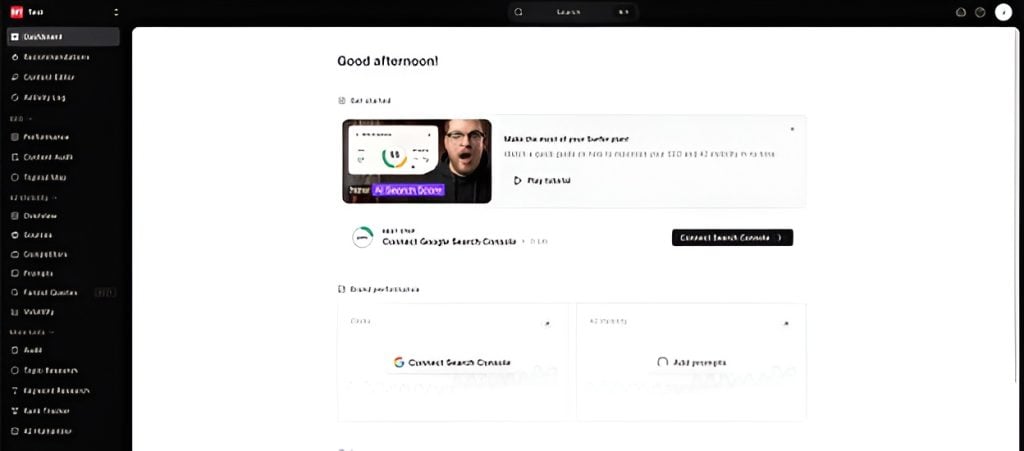
Similar to Surfer, Frase offers content briefs, SERP analysis, and on-page scoring at a lower entry price of $45/month, and with AI search visibility (Frase calls it “GEO” scoring) built into more of its tiers rather than gated behind the most expensive plan. Its content-score correlation with actual rankings tests somewhat lower than Surfer’s in independent comparisons, but its research and brief-generation tools are frequently rated as strong (or stronger). That’s important for teams that spend most of their time on research and structure rather than fine-grained keyword-frequency optimization.
Frase also includes featured-snippet and answer-engine optimization features aimed at winning the short, direct-answer boxes that sit above organic results, plus site-audit and content-decay tools for identifying older articles that need updating. For freelancers and small teams with a tight budget, it’s a more accessible entry point to the SEO-content-tool category than Surfer without giving up most of the core functionality.
Pros: lower entry price than Surfer, strong research and brief-generation tools, AI-search features available on more tiers
Cons: content-score-to-ranking correlation tests slightly behind Surfer’s in independent studies
Verdict: the better budget pick between the two SEO-scoring tools here
Anyword
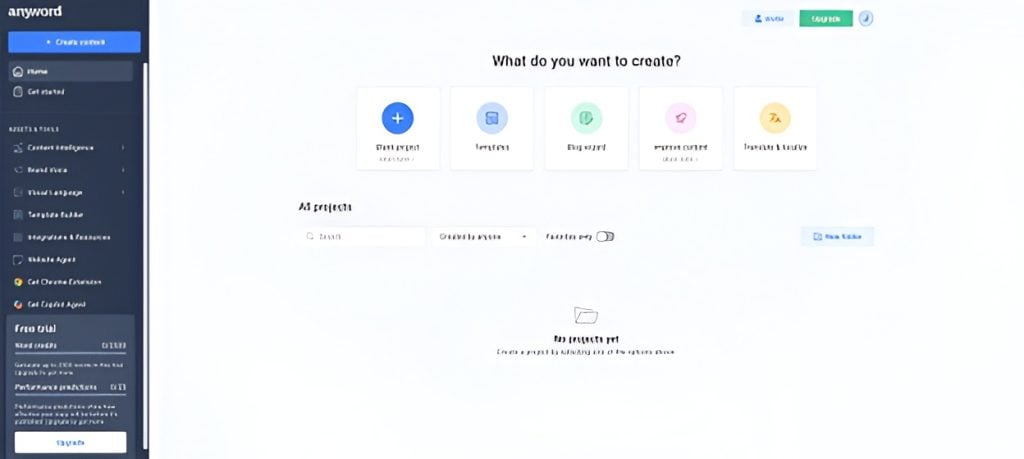
Anyword’s differentiator is predictive performance scoring. Before you spend a cent running an ad, it estimates how different headlines or copy variants are likely to perform based on patterns from prior campaigns, which is a real value proposition compared to some tools that simply generate variations and leave you to decide which to try. That scoring can plug into ad platforms and marketing analytics to refine predictions over time as it sees actual performance data from a specific account.
It’s built for paid-ad and marketing teams running high volumes of copy tests on things like landing pages, ad headlines, and email subject lines as opposed to long-form content. At $49 a month, it’s in line with the mid-tier marketing-copy tools on this list, with higher tiers adding more predictive analytics depth and integrations.
Pros: predictive performance scoring is a genuine differentiator, strong integrations with ad platforms
Cons: narrow focus on short-form ad and marketing copy, not useful for long-form content
Verdict: worth it specifically if you’re running ad campaigns and need to prioritize which variants to test
Wordtune
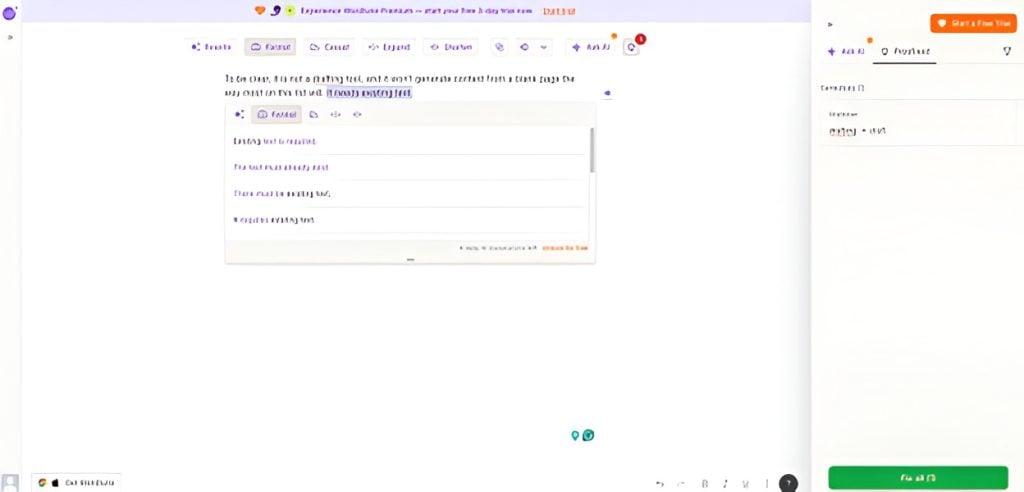
Wordtune’s job is narrower than most tools here. This isn’t a general-purpose tool, or even for short-form content. It’s simply for making existing work better. Take a sentence or paragraph you’ve already written, and it will rephrase it for clarity, tone, or length, offering several alternative phrasings to choose from rather than a single rewrite. It’s amazing at that one job: tightening a clunky sentence, shifting formality up or down for a different audience, or expanding a terse point into a fuller one. The suggestions tend to preserve the meaning better than blunt “reword this” prompts to a general-purpose chatbot.
To be clear, it is not a drafting tool, and it won’t generate content from a blank page the way most on this list will. It needs existing text. The free tier covers a limited number of basic rewrites per day. The paid plan runs roughly $10-$15 a month and adds more rewrite options per selection and longer input length per request.
Pros: genuinely strong at sentence-level rewriting and tone adjustment, low learning curve, useful free tier
Cons: requires existing text — no blank-page drafting, limited scope beyond rewriting
Verdict: a useful add-on for polishing a draft, not a replacement for a drafting tool
Best AI Writing Tool For Blog Posts & Seo
Writesonic and Frase are the strongest picks for teams publishing SEO content regularly. Writesonic is best for built-in optimization inside the drafting flow, while Frase is for a lower-cost brief-and-score workflow. If you already have a drafting tool you like, Surfer is the stronger pure-optimization layer to pair with it, provided the higher price fits your budget.
Best AI Writing Tool For Marketing Copy
Jasper remains the top pick for teams managing brand voice across multiple writers and channels, despite the higher price. For solo marketers or smaller budgets, Copy.ai covers most of the same short-form use cases with a real free tier, and Anyword is worth adding specifically for ad copy where performance prediction matters.
Best AI Writing Tool For Fiction / Authors
Sudowrite is purpose-built for this, and it shows in the output with better pacing, voice consistency, and character continuity than any general-purpose tool tested here. Claude is the stronger pick for long-form non-fiction or manuscript-length work where a large context window matters more than fiction-specific tooling.
Best free AI writing tool
Copy.ai’s free tier is the most usable for short-form marketing copy without a time limit forcing an upgrade. For general drafting and editing, both ChatGPT and Claude offer functional free tiers that cover most everyday writing tasks without a subscription.
Do AI Writing Tools Get Flagged By AI Detectors?
Yes, though the answer varies a lot by which detector and which tool you’re talking about. Independent testing on tools that market built-in “humanizer” features found wide swings in reliability. One widely used SEO platform’s humanizer dropped detection scores on GTPZero significantly, but left content flagged as 100% AI-generated on Originality.ai, one of the detectors commonly used by publishers and content agencies for pre-publish review. That gap is massive, so keep in mind that just because AI-generated text passes one detector doesn’t mean it will pass another.
If you’re specifically worried about detection, here’s what you need to know. AI detectors themselves have real, documented false-positive and false-negative results. They’re matching patterns, and results can vary even when run on the same text. However, heavily templated output from any AI writing tool tends to trigger flags more than text that has been substantially rewritten, restructured, or blended in with original reporting, quotes, and other specific details that an AI model wouldn’t generate on its own. One specific tool won’t ensure your content doesn’t get flagged, but doing substantial rewrites and adding in additional details will help.
FAQ
What are the best AI writing tools for marketing?
Jasper is the best option for brand-consistent campaigns across a team. Copy.ai offers a free-tier-friendly option on short-form copy, and Anyword is specifically for ad copy where predictive performance scoring matters.
Which AI tool is best for writing?
It depends on the type of writing you need. Claude and ChatGPT are the strongest for general-purpose options for long-form drafting and editing. Sudowrite is the best choice for fiction, while Jasper and Copy.ai lead for marketing copy. For SEO-optimized content, try Surfer or Frase.
What is the best free AI writing tool?
Copy.AI has the most usable free tier for short-form marketing copy. Both ChatGPT and Claude offer functional free tiers for general drafting and editing without a subscription, but usage is limited.
Do AI writing tools get detected?
Yes, they are often detected, though the results vary by detector and on how heavily the output has been edited. Built-in “humanizer” features in several popular tools have shown inconsistent results across different detectors during independent testing. One piece of content could pass one and fail the other. Substantial editing, added original detail, and a distinct voice reduce detection risk more reliably than any single tool’s bypass claims.