
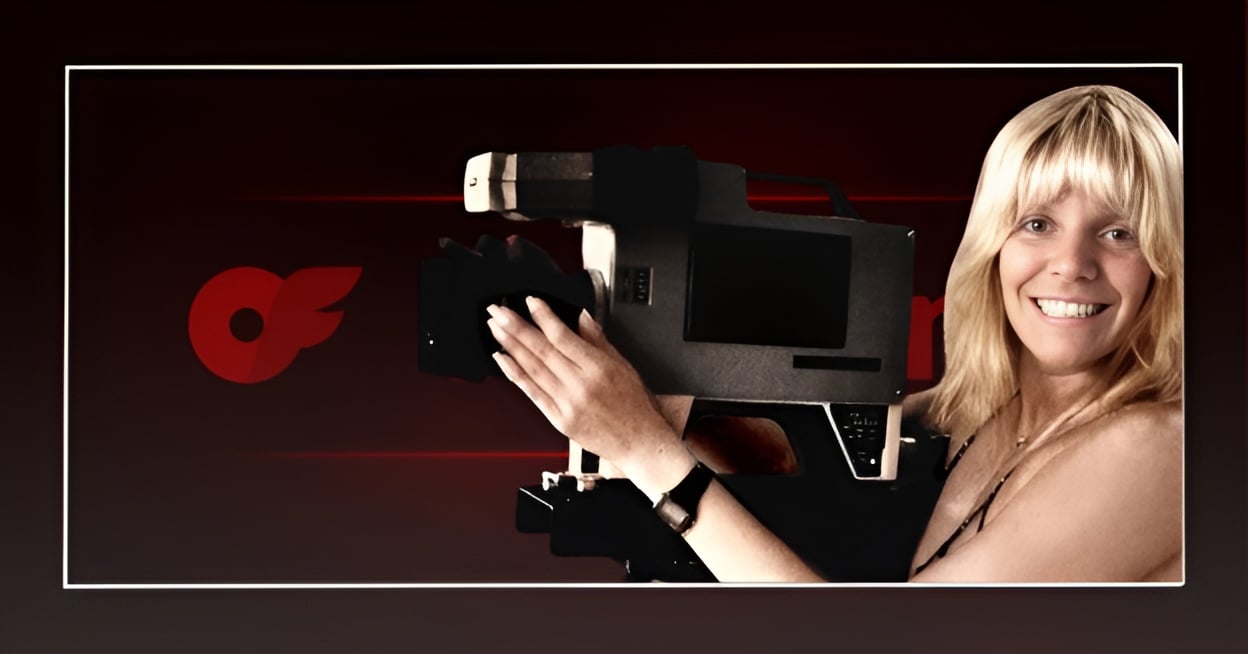
Before subscription models and pay-per-view content and Linktree workarounds, there was a woman in a crochet bikini on Manhattan Cable Television’s Channel J, asking porn stars about their lives, demonstrating condom use with a big ol’ grin, and telling her viewer (her “Byrd Watchers”) that she was there for them. It was a parasocial relationship before they existed.
In a time before the creator economy had a name or venture capital support, Robin Byrd created her own business model for content creation. She just didn’t have the internet to scale it.
The Robin Byrd Show ran from 1977 to 1998 on New York public access television. It was a thirty-minute show that ran late at night. Full frontal nudity was more the rule than the exception as Byrd hosted, produced, took viewer calls, interviewed adult performers, strippers, escorts, and queer people of every variety. And she did it all with the energy of someone who genuinely could not understand why sex was supposed to be a source of shame. She also ran phone sex lines (gay, straight, transgender), which created a direct monetization from audience to creator with no corporate middleman setting the terms.
“OnlyFans is phone sex lines with video,” Byrd, now 71, says with the matter-of-fact clarity of someone who has been watching the world catch up to her for fifty years. “People are lonely out there. We have OnlyFans and whatever because I’m not on the air anymore.”
A new HBO Documentary, Bang My Box: The Robin Byrd Story, produced by Sarah Jessica Parker, makes the full case for Byrd’s place in history. It premiered last night (June 30), but it was long overdue.
Because what Byrd did in that crochet bikini was not just entertainment. She built a community infrastructure for people who had none. Gay men in the AIDS crisis, queer people before “queer” was a reclaimed word, sex workers before “sex worker” had any dignity attached. Byrd preached safer sex not with stigma and wagging fingers but with warmth and the same sex-positive casualness she brought to everything else. When the Reagan administration and Time Warner Cable tried to restrict or scramble adult content on public access, she sued them both. And in 1995, the Supreme Court ruled in her favor, protecting public access from censorship. She didn’t set out to be an activist, but she refused to be stopped.
“I am whatever your fantasy made me to be,” Byrd says in the documentary. “Some people thought, ‘Oh, that porn channel.’ Even people that never saw the show had perceived visions of what I was.”
Every OnlyFans creator knows what she means. The perception precedes the person. The assumption that the work is the whole of the human being. The way “sex worker” functions as a period at the end of a sentence rather than a descriptor among many. Byrd was fighting that reductiveness before most of today’s creators were born, and she fought it not through apology or explanation but rather through sheer relentless visibility.
The structural parallels between what Byrd built and what OnlyFans creators are building now aren’t subtle. Direct creator-to-audience relationship? Check. Subscription and pay-per-interaction monetization? Check. Content suppressed or restricted by institutions controlling distribution? Check. Byrd beat back censorship attempts through the courts. Toady’s creators are fighting similar battles through payment processor negotiations, platform appeals, and the indignity of watching their reach disappear without explanation from the algorithm with no explanation.
What Byrd had that current creators are still fighting for is something harder to quantify: a platform that was genuinely hers. Public access television, for all its limitations, had no Stripe threatening to pull her funding. No shadowbans or trafficking warnings. The distribution was local, and production value was low-budget, but the relationship was between Byrd and her audience in a completely unmediated way. It’s what OnlyFans promises but only partly delivers.
So why is Sarah Jessica Parker producing Byrd’s documentary? Apart from Parker’s long association with the cable network, she explained that she grew up in New York and understands the vital importance of what Byrd did. Parker described Byrd as “completely in possession of herself.” And that’s what the documentary captures, as well as what current creators are reaching for: ownership. Ownership of their work, of the narrative, and of the terms on which they are seen.
“I’m the one that took the arrows for the roads that you are settled into,” Byrd says in the film. “It’s the settlers that get the land, but it’s the pioneers that get the arrows.”
She’s not wrong. Every creator who has normalized adult content online, every platform that treats sex work as legitimate, every conversation that extends basic human dignity to people who monetize intimacy is walking on roads that Byrd and those around her built. The credit rarely flows backward, but it should. And Bang My Box is working to do just that.
The documentary won’t undo fifty years of reductive framing or retroactively pay Byrd what her cultural contribution was worth, but it will put the story on the record. And with a producer like Parker, on a network like HBO, perhaps Byrd will finally get the respect she deserves. And it couldn’t have come at a better time. The conversation about what sex workers deserve is finally happening in public.
Robin Byrd has been ahead of that conversation since 1977, while the rest of us are still catching up. But we’re here now.