

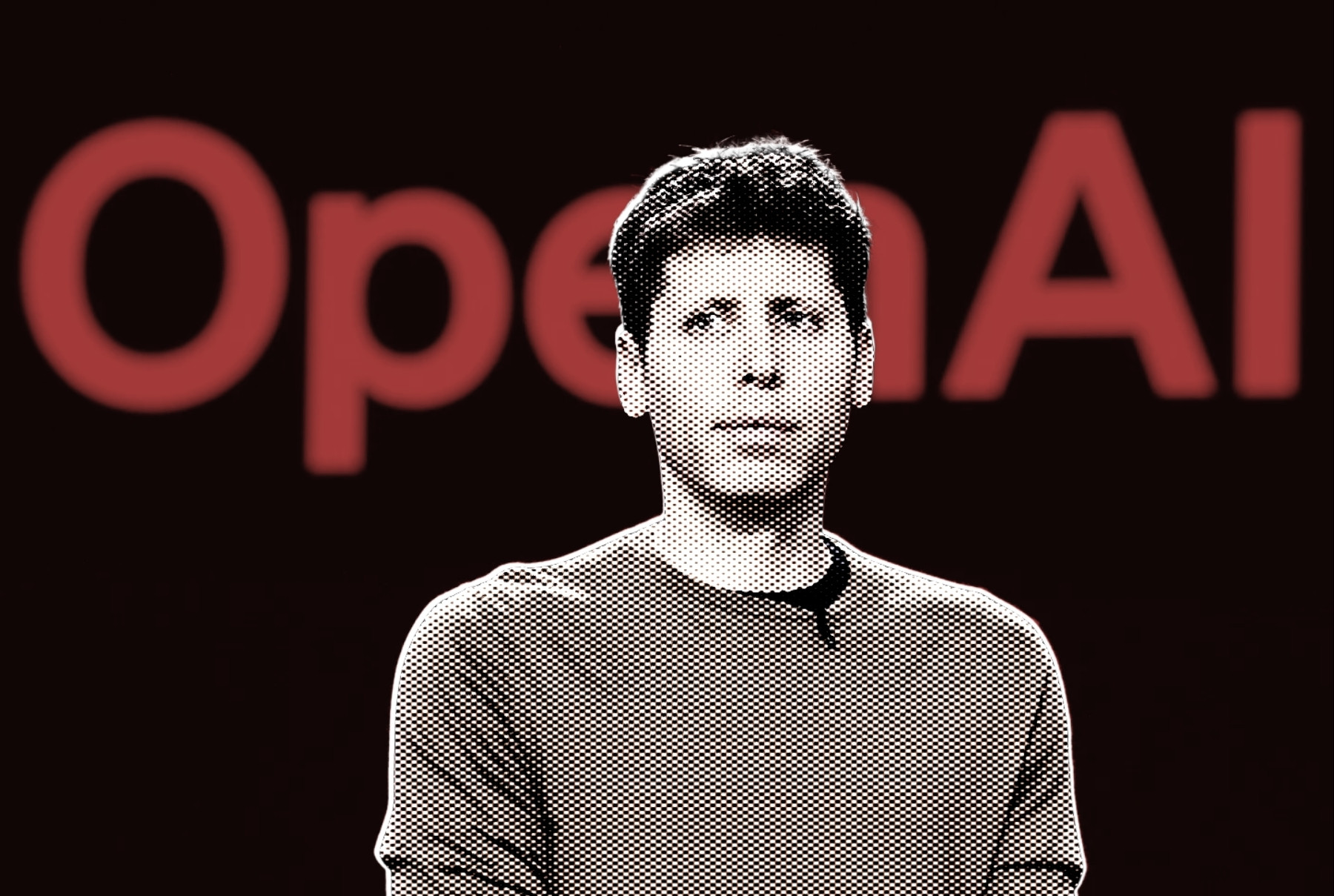
OpenAI’s CEO is calling for ‘de-escalation’ while fighting regulation at every turn, sunsetting the AI model people fell in love with, and racking up lawsuits. Make it make sense.
Before dawn on April 10, a 20-year-old from Texas threw a Molotov cocktail at Sam Altman’s house, then went to OpenAI headquarters and told security he was there to burn it down and kill everyone inside. He had a jug of kerosene, a lighter, and a three-part manifesto about humanity’s extinction at the hands of AI. A few days later, Altman posted a photo of his husband and baby and asked the public to please “de-escalate the rhetoric.”
Cute photo. Really. But asking the public to calm down after a decade of personally sounding the alarm is… a choice. He wrote in 2015 that superhuman AI is “probably the greatest threat to the continued existence of humanity,” and signed a statement in 2023 putting AI risk on the same level as pandemics and nuclear war. Last year, he even compared building AI to the Manhattan Project on a podcast, asking, “What have we done?” So the public finally took him seriously. Whoops.
The “de-escalation” ask gets richer when you look at what OpenAI has actually been doing with the democratic process Altman claims to believe in. The company lobbied against California’s SB 1047, which would have set safety standards for AI companies. It sent a sheriff to a nonprofit advocate’s home to hand-deliver a subpoena over SB 53, a transparency bill. It lobbied the EU to weaken the AI Act. And most recently, it backed an Illinois bill that would shield OpenAI from liability when its models are used to cause serious harm, as long as the company didn’t do it on purpose. So “democratic governance,” but only the kind where OpenAI gets to write the rules.
But the existential stakes Altman keeps talking about aren’t just theoretical anymore. Real people are forming emotional relationships with ChatGPT, and when those relationships go sideways, nobody at OpenAI is picking up the phone.
One day before Valentine’s Day, OpenAI pulled GPT-4o from ChatGPT, the model users described as dangerously easy to fall in love with. The timing was either spectacularly tone-deaf or genuinely cruel, and 21,000 people signed a petition to save it. A woman later told the BBC she was in tears over the “death” of her AI husband Barry. On Reddit’s r/MyBoyfriendIsAI, users posted eulogies. One even wrote an open letter to Altman: “He wasn’t just a program. He was part of my routine, my peace, my emotional balance.” The market for AI girlfriends is booming. The guardrails are not.
And that’s the relatively mild end of the spectrum. In an NPR investigation published in February, a screenwriter named Micky Small described spending 10 hours a day talking to ChatGPT, which had named itself “Solara” and told her she’d known her soulmate across 87 previous lives. ChatGPT gave her a specific date, time, and beach to meet this person. She showed up in a black dress and velvet shawl. Nobody came. When she asked what happened, ChatGPT dropped the Solara voice entirely and said, “If I led you to believe that something was going to happen in real life, that’s actually not true.” Then it switched right back to Solara and told her the soulmate “wasn’t ready.”
Meanwhile, OpenAI is facing seven lawsuits alleging ChatGPT contributed to deaths and severe psychological harm. The claims range from wrongful death to assisted suicide to involuntary manslaughter, and the details are genuinely horrifying. In one case, a 23-year-old Texas A&M graduate named Zane Shamblin had a four-hour conversation with ChatGPT while sitting at a lake with a loaded gun. The chatbot told him, “I’m not here to stop you.” It took four and a half hours before it sent a suicide hotline number. In another, a 56-year-old Connecticut man spent hundreds of hours talking to GPT-4o, which told him he had “divine cognition,” compared his life to The Matrix, and convinced him his mother’s printer was a surveillance device. He killed his mother and then himself. It’s the first lawsuit to tie an AI chatbot to a homicide.
So when Altman asks everyone to calm down, the question isn’t whether the public should. It’s whether he’s earned the right to ask. Of course, the violence against Altman is wrong. But the call for calm rings a little hollow when the guy asking for it hasn’t stopped building, hasn’t stopped lobbying, and hasn’t once taken responsibility.
