

While everyone focused on the boom, the platform quietly became what social media was supposed to be
In 2019, OnlyFans moved $238 million through its platform. By 2024, that number hit $7.2 billion. The headlines focused on pandemic boom and inevitable bust, but they missed the more interesting story: OnlyFans accidentally built the most creator-friendly economics in social media, and it happened while everyone was too busy clutching pearls to notice.
The platform now has 377 million users and 4.6 million creators. Monthly searches have grown from 704,000 to 45 million—a 64-fold increase that made “OnlyFans” a household name. But the numbers only tell you what happened. The structure tells you why it matters.

The Algorithm Problem Nobody Talks About
Millions of creators post makeup tutorials, recipe videos, gym content, and vlogs across TikTok and Instagram, hoping to build an audience. The creator economy is estimated to include over 50 million people globally. Almost none of them make meaningful money, and it’s not because they’re doing something wrong.
The platforms are. Instagram and TikTok use recommendation engines that prioritize specific aesthetics, like clean girl pilates princesses sipping matcha from the driver’s seat of a Mercedes, or the particular strain of relatability that aligns with engagement metrics. Success requires being conventionally attractive, already wealthy enough to invest in production quality, and skilled at condensing an entire personality into whatever niche the algorithm currently rewards.
The creator does the work. The platform captures the value. And the audience the creator builds doesn’t actually belong to them—one algorithm update and the entire relationship disappears.
OnlyFans works differently, and the difference matters more than the revenue numbers suggest.
Chronological Feeds and Actual Ownership
The OnlyFans feed is chronological, not algorithmic. Fans see posts from creators they’ve chosen to follow, in the order they were posted. No ads. No mass-produced AI slop. No ragebait inserted to maximize engagement. It’s what Facebook used to be in 2010, before the platform optimized itself for outrage. Back when you saw things from people you’d actually chosen to connect with, because you actually liked them.
This isn’t nostalgia. It’s structural. A creator with 500 paying subscribers on OnlyFans has something genuinely valuable: a direct, unmediated connection with 500 people who like them enough to pay a monthly fee. That relationship belongs to the creator, not to the platform. The platform can’t take it away by changing how the feed works or what content it prioritizes.
The model rewards niche expertise and direct relationships over mass appeal. A fitness creator with 300 subscribers at $15 a month is earning $4,500 monthly for content they were probably already making. A comedian with a few hundred fans has complete creative control and a direct line to the audience. That’s something even a Netflix deal can’t offer.
Who Actually Succeeds Here
The cultural narrative about OnlyFans is remarkably narrow: young women posting adult content the day they turn 18. The reality is considerably more interesting.
Athletes (including Olympians) use the platform. OnlyFans even sponsors some of them to offer training content, behind-the-scenes access, and direct fan interaction. Personal trainers post there specifically because it limits their audience to adults who have opted in, rather than exposing their content to trolls, bots, competitors, and random strangers who have no intention of paying.
Comedians produce specials for OFTV, the company’s SFW streaming app, reaching audiences that conventional streaming platforms haven’t prioritized. Political commentators build audiences across the ideological spectrum. Tradwives and sex workers coexist. The platform doesn’t shadowban political content or de-monetize creators for saying things advertisers don’t like. OnlyFans is ad-free.
The money comes directly from fans, which means creators answer to their audience rather than to a brand safety team in Menlo Park. While some level of censorship exists (specific content types are prohibited), creators can largely say what they want to an audience of consenting adults who have opted in.
The Numbers Behind the Model
Yes, you’ve probably heard that the average OnlyFans creator earns $1,193 per year, which works out to less than $100 a month. And while that isn’t incorrect, it doesn’t tell the whole story. Especially when millions of people created accounts during the 2020 pandemic boom, posted twice, and never logged back in.
For creators who treat it like a business and build an audience strategically, the math looks different. The platform has paid out $5.77 billion to creators in 2024 alone. The 80/20 revenue split means creators keep significantly more than they would through traditional media deals, brand partnerships, or ad-revenue sharing on YouTube.

The top 1% earn the majority of revenue—that’s true everywhere, not just OnlyFans. But the barrier to entry for the middle class of creators is substantially lower than on algorithm-driven platforms. You don’t need to be conventionally attractive, wealthy, or skilled at gaming recommendation engines. You need an audience that values what you do enough to pay for it directly.
Platform Scale Without Platform Politics
OnlyFans processed $7.2 billion in 2024 and is projected to reach $8.1 billion by 2026. The company generates $666 million in annual profit, has essentially zero debt, and more than $808 million in cash. Based on standard valuations, the platform is worth approximately $20 billion, which is more than The New York Times and Spotify.
This didn’t happen because OnlyFans figured out how to manipulate creator psychology or optimize engagement metrics. It happened because the platform built a simple, functional marketplace: creators make things, fans pay for them, OnlyFans takes 20% for providing the infrastructure.
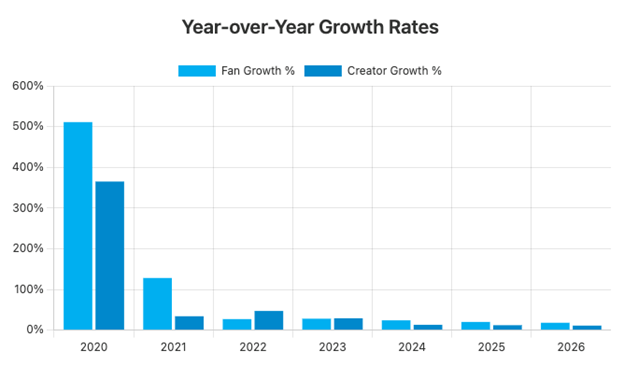
Sure, user growth has slowed, going from 511% in 2020 to 24% in 2024, with projections of 18% by 2026. But that’s not a crisis. That’s maturation. The platform is transitioning from explosive pandemic-driven growth to sustainable scale. The fans who joined in 2020 out of boredom or curiosity have largely left. What remains are people who actively choose to be there.
What Nobody Expected
The boom brought everyone to the platform. The cooling separated tourists from residents. What’s left is quieter, less culturally dominant, and considerably more functional than what existed in 2020.
The average user spends less now than they did at the pandemic peak, around $19.12 in 2024 versus $25.51 in 2021. But that’s not failure, it’s distribution. The platform has more casual users alongside the committed ones, which is what happens when something goes mainstream. The committed users are still there, still paying, still building sustainable creator businesses.

Meanwhile, Instagram continues optimizing for advertiser-friendly content. TikTok continues surfacing whatever the algorithm thinks will keep you scrolling. YouTube continues to demonetize creators for saying words that brand safety teams don’t approve of. The creator economy on those platforms means working for the platform, hoping the algorithm doesn’t change, and accepting that your audience doesn’t really belong to you.
OnlyFans built something different: a direct economy between creators and fans, with the platform providing infrastructure rather than curation. It’s not perfect. But it’s the closest thing to what the early internet promised—a space where people who make things can connect directly with people who value them, without intermediaries extracting most of the value or controlling what gets seen.
The boom made headlines. The structure might actually matter more.