Editor’s note:As a condition to reporting this story, Riverfront Times agreed to change the names of the actors interviewed and depicted on the following pages. The story also contains descriptions of sex that some readers might find offensive.
Jenny can’t believe what she’s about to do. It feels too surreal to be actually happening. But that other-worldliness is what spurs the nineteen-year-old to get out of her car and walk into Utopia Studios in south St. Louis.
Inside the noise is deafening. Several rock bands are practicing behind closed doors in rented rehearsal rooms. Jenny looks around the lobby for direction, but there’s no sign, no assistant holding a clipboard — just a mishmash of arcade games and vintage advertisements that look as if they were dug up from a hip thrift shop. It doesn’t seem like a place where pornos are filmed, whatever that might look like, so Jenny takes out her cell phone and calls Sam Arcobasso, the budding porn producer she met online.
“I’m here,” she shouts over the din.
“I’m running a little late,” Sam responds. “But Corey’s there. I’ll call him and tell him to come meet you.”
Dressed in a sweater jacket that seems too heavy for the balmy, 80-degree weather outside, Jenny waits with her phone clutched tightly in her hand. A few minutes later, Corey, a stocky 24-year-old photographer in ripped-up jeans and a Pantera T-shirt, emerges from one of the studio rooms and introduces himself to the first-timer.
“Come in and meet the others,” he says.
Sitting on a couch in a windowless room are two other aspiring porn actors who, like Jenny, responded to an ad on Craiglist titled “STL actors needed for porno.” They are Kelly, a 31-year-old whose slight body almost makes her look like a teenager, and Rory, a middle-aged blond with a farmer’s tan. None has ever appeared in an adult film before, but in just a few minutes the three are supposed to engage in a ménage à trois in front of a camera. As Corey sets up the lights for the shoot, the three awkwardly make their introductions. Jenny asks Rory his age.
“I’m 43. You?”
“I’m nineteen.”
“Oh, really? That’s around my kids’ ages.”
Jenny can’t hide her unease. She excuses herself and asks Corey to have a word outside.
“I wasn’t told the guy was gonna be in his forties!” she angrily whispers.
Just then Sam arrives. A bit more businesslike in his appearance than Corey, he’s dressed in khakis and an oversized dress shirt. Apprised of the dilemma, the porno producer with about ten amateur films under his belt adroitly offers a solution.
“Are you comfortable having sex with just the girl?” he asks Jenny in his calm, monotone voice.
“Yeah. I can do that,” she says.
Sam turns to Corey. “So how about if we do one girl-on-girl scene, and then we do a guy-on-girl with the other two?” he says, motioning toward Kelly and Rory.
Corey likes the idea. Although it would take more time to do two films, he and his business partner could potentially make a little more money for their fledgling startup, STL Adult Films LLC.
“Let’s do it,” says Corey, and they all go back into the room. But first there are some quick business matters to address.
Berry and his family would live here for two short years before moving again.
In the late 1950s Chuck Berry purchased a 35-acre plot in rural St. Charles County where he dreamed of creating a lavish property to rival those of the segregated country clubs he’d seen growing up in St. Louis. The result was “Berry Park,” a sprawling compound complete with guest cottages, a nightclub and guitar-shaped swimming pool. Today the 17,000-square-foot mansion he built at Berry Park remains the rock & roll legend’s primary residence. He also keeps a second home in the affluent suburb of Ladue.
Click on the pin drops for a tour of Berry’s early homes and businesses.
For the first 30 years of his life (minus a short stint in prison), Berry lived in essentially the same black, working-class neighborhood of north St. Louis. Here is a look at those first St. Louis properties owned or occupied by Chuck Berry — before all those music royalties came rolling in.
Up first: The site of Chuck Berry’s birth — the home where he got his first taste of music.
Chris Naffziger
Homer G. Phillips Hospital now sits on the site of Chuck Berry’s birthplace.
2520 Goode Avenue
Chuck Berry was born October 18, 1926, at 6:59 a.m. inside a small home at 2520 Goode Avenue, now known as Annie Malone Drive. The family moved a few years after Berry’s birth, and the home was soon torn down for construction of Homer G. Phillips Hospital, which served for decades as the city’s only medical center for blacks. Although his time at the Goode home was short, it was here that a young Chuck Berry was first introduced to music. As he writes in his autobiography:
Mother and daddy were of the Baptist faith and sang in the Antioch Church choir. The choir rehearsed in our home around the upright piano in the front room. My very first memories, while still in my baby crib, are of musical sounds — the assembled pure harmonies of the Baptist hymns, dominated by my mother’s soprano and supported by my father’s bass blending with the stirring rhythms of true Baptist soul. I was always trying to crawl out of my crib and into the front room to where the rhythm came from. Long before I learned to walk I was patting my foot to those Baptist beats, rocked by the rhythm of the deacons’ feet focused on the tempo of the times. Oh! But the feeling it generated still stirs my memory of back when. Hallelujah!
Next: The Berrys move to a home with modern luxuries such as a telephone.
Chris Naffziger
Berry and his family would live here for two short years before moving again.
4420 Cottage Avenue
After briefly moving to a home across the street from Berry’s birthplace on Goode Avenue, the Berry family settled at 4420 Cottage Avenue, also in the Ville neighborhood. They would stay at this location for just about two years. Recalls Berry of the 4420 Cottage home:
Late in the second grade our family moved again. Daddy found a five-room brick bungalow with full bath, full basement, central heating, and a front and backyard just two blocks away at 4420 Cottage Avenue. We thought it was a palace to have closets and front and back porches. The rent was $25 a month. Mother dug in her savings and added new pieces of furniture that included a new Whirlpool washing machine and a pedal Singer sewing machine that (to my delight) I was invited to pedal while mother sewed. Daddy had some white people install a telephone which brought a million questions from me about its function.
Next: The Berrys move to a home that Chuck will return to time and time again as a teen and young adult.
Chris Naffziger
The empty lot to the left is all that remains of the Berry property on Labadie Avenue.
4319 Labadie
While Berry was in fourth grade, his family moved again to a duplex on Labadie Street. The Berry family (which in addition to Chuck included his parents, Henry and Martha, and five siblings) would stay at this home for years with Berry returning to the home at the age of 21 (after serving four years in a juvenile center for a carjacking) and, again, a few years later with his new bride, Themetta. The Labadie home has since been torn down, but the property is still owned by Chuck Berry. In his autobiography Berry recalls that the duplex had four rooms with bath and basement and a second floor with the same number of rooms. And it was at this home that Berry first developed his infamous kink. He writes:
One evening I came through the gangway of home and heard water running in the bathroom on the second floor next door. The light from the window was casting down on the roof of our porch. Temptation told me I might finally see a girl’s parts, so I hurried to the room and creeped toward the open window to redeem my dream. There, through six inches of raised shade, I saw — for the first time in my life — the bare buttocks of a woman about to step into the bathtub. I froze, instantly excited, and crouched stunned and amazed at my long-awaited view of the opposite sex. She even turned around momentarily and allowed a direct view of the front part as she came over to pull the down the shade.
Next: Chuck Berry and his young wife, Themetta, get their first place on Delmar Boulevard.
Chris Naffziger
This former boarding house, once owned by Berry’s uncle, served as the first home to a newly married Chuck and Themetta.
4352 Delmar Boulevard
Chuck and Themetta Berry have been married now for 66 years. But in early 1949 the couple was newly hitched and looking for a place to call their own. They found that first spot in a rooming house owned by Berry’s maternal uncle at 4352 Delmar. The couple would stay there for less than a year — eventually moving back in with Berry’s family at 4319 Labadie. Still for a short while, the happy newlyweds had a place of their own and felt that they were really making it — even if they were not. During this time, Berry was earning $80 a week at an auto assembly plant and another $35 a week doing handyman work with his father. Themetta, meanwhile, brought in another $20 a week working at a cleaners. Writes Berry of their short stint at 4352 Delmar:
We had a 1941 Buick, a refrigerator and were on our way to riches. We were living like the best of the white folks until one evening we were dressed in our “Sunday clothes” on our way to a movie. All the tenants were on the porch chatting as we noticed our parking space. There was no ’41 Buick parked where we’d left it at the curb. I boasted about calling the police but knew it had been repossessed by the finance company.
Up next: Berry moves to the home where he’d pen his greatest hits. The now-vacant building was recently placed on the National Register of Historic Places.
Chris Neff: If I could rearrange the alphabet I’d stick my dick in your mouth.
Smooth talking the opposite sex is a mysterious art form deserving of a master class. Still, any idiot knows that cheesy pick-up lines are never the way to go. We’ve all heard them, laughed at them, and if one of them actually worked for you, well…more power to your genitals.
The general rule when it comes to the “pick-up line” is to actually treat it as an icebreaker that will make the other person smile which, if you’re lucky, will lead to conversation. And if you are really, really lucky, it’ll lead to you sealing the deal.
We’ve heard some pretty cheesetastic pick-up lines ourselves over the years such as, “Girl, I’d eat you like a Denny’s Grand Slam. For breakfast, lunch, and dinner.” (FYI-it did NOT work) so we decided to compile a list filled with “do not even try” lines just for you. We went straight to the some of the funniest standups we know for some of the corniest lines they have ever heard (or in some cases, even said themselves).
Brandon “Gooch” Hahn: Did my brain just put its dick in your mouth because you just blew my mind!
Brad Williams: You remind me of a bottle of Snapple because you’re made from the best stuff on earth.
Virginia Collins: Oh you like 2 Chainz? I’m his manager.
Colin Quinn: Hey miss. Sit on my face and I’ll guess your weight.
Mark Gonzales: You’re like my iPhone, I want to rub my cock all over it.
Suli McCullough: “Are you religious? Because seeing you is a come to Jesus moment!” Also there is always the classic, “You must be a fan of martial arts because Jean-Claude Van Dammmmmn you’re fine!”
Keith Robinson: What I used to when I was driving was, when I was stopped at a light and I’d see a good looking lady, I’d beep and when they’d roll their window down I’d say, “I’m little lost. Do you happen to have directions to your heart?”
Mariya Alexander: Damn boy, are you my parents approval? Because I’m starving for you.
Jen Murphy: Can you make like baby Jessica and fall into my hole?
Chris Neff: If I could rearrange the alphabet I’d stick my dick in your mouth.
Shaun Latham: I just drop a sugar packet and then say, “Hey. You dropped your name tag.” Then I pick up the sugar packet and give it to her.
Rich Vos: Do you know what I can do to you before I smash you in the head with a shovel?
Grant Cotter: If we went on a date I’d eat mothballs before I picked you up because I know you’d be giving me butterflies in my stomach.
Dear Mexican:If dark-skinned people are so “undesirable,” unwelcome and put down by you gringos, how come you bake in the sun like zopilotes to get dark? Summer is fantasy time for all of you, when you can actually get some color in that white skin of yours. Maybe the whole deal about racists is that they hate being white. I would too! Maybe white angry males are actually latent homosexuals attracted to dark-skinned men! I know for a fact, that white women at one point or another fantasize about a dark man, and that many more actually convert that fantasy into reality with guys like me. Who wants to go to bed with a pale guy? I don’t think being brown or black is bad after all. Comments? Tall, Handsome, and Dark
Dear Wab: You won’t hear any arguments from me about this, but since I’m not versed in the gabacho ways, I threw the question to the Mexican’s Mexican, William Nericcio of San Diego State and the scabrous Tex(t)-Mex: Seductive Hallucinations of the “Mexican” In America. In addition to dissecting the semiotics of Mexican imagery, Profe Nericcio also has insight into the American obsession with image (check out his upcoming Eyegiene: Permutations of Subjectivity in the Televisual Age of Sex and Race). Take it, Nericcio!
“This is the age-old sexual conundrum that is actually easy to explain — we all covet something ‘strange’ from time to time; or, to use other words, the ‘exotic’ is erotic, the other beckons with an erotic electricity that can be blinding and impossible to overcome. Let’s pause here a second and throw racism and sexuality into the proverbial conceptual blender: racism is an extension of sex when you think about it — the racist’s hate of the visually different other stems from an anxiety (at the level of DNA) for ‘the same.’ The tribal backstory of homo sapiens evolution (whether or not you buy into the frisky intersexual intrigues that just had to be going down with Neanderthals) is a tale of a species that ‘feels safe’ when making the beast with two backs within the tribe, but that benefits in terms of evolution when philandering outside the tribe. Evolutionary anthropologists call this exogamy — basically the species (or the tribe) thrives when you stop sleeping with your familia, second-cousin lovers be damned!
“So enjoy all the love you’re getting and sharing with pale chicas lusting after your swarthy goodness. While you might feel muy guapo with all the attention, know also that these melatonin-challenged mujeres are merely following basic laws of attraction that owe more to Darwin than your own inner-Papi-chulo!”
Dear Mexican:I read your column some time ago about why Mexicans go swimming in their undershirts. But I think you missed something. All us Mexican guys are terribly un-tanned. Lift up my sleeve, and it looks like someone dipped my arm in the deep fryer, at least after the shirt ends. How do I fix this? Prieto but Not That Prieto
Dear Dark but Not That Dark Wab: You want to be darker? Um, okay, but the Mexican always loves to shock gabacho audiences by rolling up his sleeves to show a natural skin color even lighter than their lace-curtain Irish auntie. Besides, there’s no better way to get into a gabacha’s chonis is by asking them if they want to see your naturally tanned verga…or not.
¡ASK A MEXICAN! VIDEOS ARE BACK!: Gentle cabrones: after a years-long hiatus, I’ve relaunched the video version of this columna. Follow my weekly rants on Twitter by clicking the hashtag #askamexican and ask away. Enjoy!
Ask the Mexican at [email protected], be his fan on Facebook, follow him on Twitter @gustavoarellano or follow him on Instagram @gustavo_arellano!
Except as indicated, all photos by Chris Naffziger
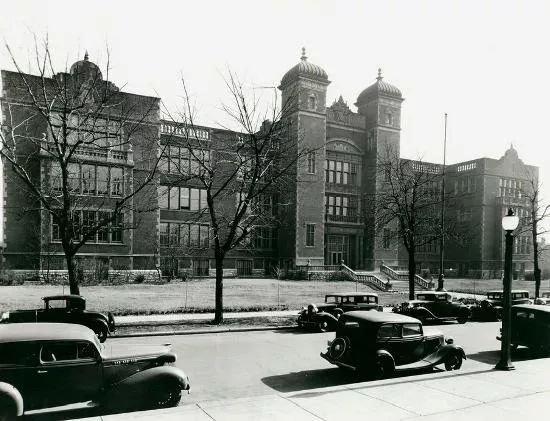
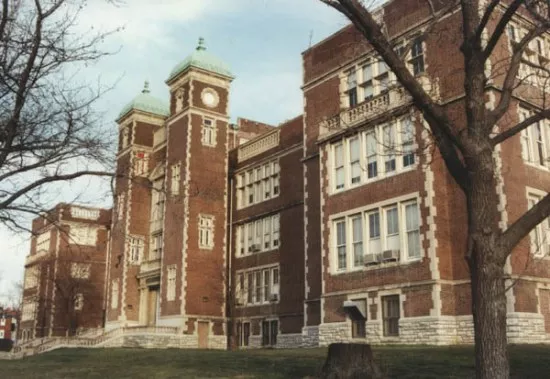
Central High School, at the corner of Garrison and Natural Bridge.
Central High School has seen better days in its 100-year-old history. Boarded up since 2004, the building at the corner of North Garrison and Natural Bridge avenues now shows the signs of almost a decade of abandonment. While many of the vacant schools in the St. Louis Public School District have fallen victim to scavengers, Central High seems to have suffered far more than others with vandals destroying or walking off with its exterior stonework and copper.
One can only wonder how much damage vandals have committed inside the shuttered building. Meanwhile, neighbors and those with a connection to the school can only watch the building’s slow-motion destruction.
“It was — and still is — a fine building, so on a practical level I’m disheartened that it isn’t being put to some use,” says Kara Clark, a graphic-design professor who attended the school back in the 1990s.
It wasn’t always like this. At one time the St. Louis public schools were the envy of educators across the nation, thanks to its grand buildings designed by architects William B. Ittner and Rockwell M. Milligan. Drawing inspiration from the great private educational institutions of Great Britain, Ittner and Milligan created veritable castles of learning over several decades, including Central High School.
Photo courtesy of Missouri History Society
Central High School in its heyday.
Originally named Yeatman High School, the building was to fill the need for additional classrooms in the rapidly expanding city of St. Louis. By 1900 the city’s population was nearing 600,000, and yet it had only one public high school, the former Central High School on Grand Boulevard. The school district turned to Ittner for two new high schools: Yeatman and McKinley High School on the south side. McKinley opened in 1902, Yeatman opened in 1904. Three years later, Yeatman added two new wings to accommodate its ever-growing student body. In 1927 a tornado destroyed Central High School, bringing even more students to Yeatman, which changed its name to Central High School. The building last housed the Central Visual and Performing Arts High School, which moved out in 2004.
Central High School in 2002, before its closure in 2004.
St. Louis Public Schools has suffered declining enrollment since it peaked in 1967 at more than 100,000 students. One by one, the district has closed its buildings to keep in line with its shrinking student body and to save on maintenance and other costs. Every so many years parents hold their breath, hoping their child’s school will survive the next round of closings. Currently, St. Louis owns several dozen empty schools, in varying degrees of repair.
Don’t worry, workers didn’t find the body in the spot where the IKEA store will go.
Construction workers had to stop bulldozing and call in homicide detectives after finding human bones near the site of St. Louis’ future IKEA store.
Luckily, there wasn’t any foul play. Rather, the human remains were most likely buried when the land was still the old Rock Springs Cemetery back in the mid-1800s.
Officials will x-ray the land to check for more graves, says Maggie Crane, spokeswoman for Mayor Francis Slay, to the St. Louis Post-Dispatch.
It’s not immediately clear whether the newly found dead body will delay or otherwise affect construction on the IKEA store, which is scheduled to open in fall 2015.
Crews dug up the human remains and will rebury them at Calvary Cemetery, which has its own section for bodies discovered in the old Rock Springs Cemetery, the St. Louis Archdiocese tells the Post-Dispatch. The archdiocese says it likely won’t be able to identify the remains since records don’t reach that far back.
For those of you worried about IKEA being haunted by the ghost of the unearthed body, there’s no need to fear. Crews unearthed the remains a block away from the official store site while bulldozing to create roads for construction on land owned by Metro, according to the Post-Dispatch.
Dear Mexican:While vacationing in Mexico, a couple of times I have had vendors or waiters address me as chica. I didn’t think much about it at the time, but while relating a conversation with one of these guys to a Mexican friend of mine back in the U.S., he insisted that chica is WAY too familiar, and that these guys were insulting me by addressing me in this way. I was a little surprised to hear that, since I think I’m a very respectful person, and wouldn’t have given anyone a reason to disrespect me. What do you think? Were they just being friendly, or taking advantage of my ignorance? Any advice for the next time I get chica-ed? La Chica Blanca
Dear Gabacha: While chica isn’t the most formal of expressions (it translates as “girl” in Spanish), it’s also hardly the most insulting Mexican Spanish term a male stranger usually use to get a woman’s attention. The starting lineup, in devolving order, are doña (ma’am), señora/señorita (missus/miss), mujer (lady), querida (darling), linda, (pretty), chica (girl), chula (honey), mamacita (cutie), pendeja (“dumb” by itself; “bitch” when modified by), bruja (witch), mamona (cocksucker), puta (whore), piruja (slut) and Thalia.
Dear Mexican:I’m wondering what’s going on with Mexicans and their seeming discomfort when presented with a handshake as a greeting. Most of the brown guys that I have been around seem like they don’t know what’s going on when it’s time to shake hands. They are slow in taking the hand that is offered, and when they finally do raise their hand for the shake, they don’t look you in the eyes. The worst thing about it is their grip — limp wrist and fingertips only. It’s like you have a wet noodle in your hand. Do guys in Mexico not shake hands at all, or do they just do it differently than Americans? Should I stop trying to shake hands with these guys? What’s up? Not Shook Up
Dear Gabacho: Two types of handshakes exist for Mexican hombres — the firm, look-you-in-the-eye one, and the chokala, which is where the men exchange a light handshake, cock their manos upwards and grip each other’s thumbs, do another mini-handshake involving just the fingers, and finally end with a fistbump (sometimes, it’s reduced to just three steps, with the fingers part dropped). The firm handshake is the hallmark of the older generation and chúntaros; the latter is practiced by the younger generations. You do get the occasional aversion of the eyes, but that’s just a vestige from the Spaniards who took anyone looking at them directly in the ojos as a sign of disrespect, but fuck Spanish traditions. But Mexicans, limp wrists? Are you sure you weren’t shaking hands with Puerto Ricans?
¡ASK A MEXICAN! VIDEOS ARE BACK!: Gentle cabrones: after a years-long hiatus, I’ve relaunched the video version of this columna. Follow my weekly rants on Twitter by clicking the hashtag #askamexican and ask away. Enjoy!
Ask the Mexican at [email protected], be his fan on Facebook, follow him on Twitter @gustavoarellano or follow him on Instagram @gustavo_arellano!
Dear Mexican:I’m a pocha and my husband is a gabacho (by the way, we loved your explanation in your book on why Mexicans and Irish get along so well — it really explained a lot about our marriage). We had the rehearsal dinner for our wedding catered by one of our favorite Mexican restaurants. Two guests from Santa Fe thought our choice of caterer was hysterical because the restaurant is called Sancho’s. They explained to us that in Santa Fe, a sancho is a “back door man.” I had never heard this before. Is sancho a term just in Santa Fe, or among all Mexicans (except for, apparently, me)? Don’t Need No Sanchos
Dear Pocha: Sancho as a euphemism for anal sex? That’s a new one for me — and I know all the pervert sexual euphemisms out there, from the infamous Dirty Sanchez to even the Angry Dragon. I’m more familiar with sancho as Mexican Spanish slang for the other man in a relationship — in other words, the man that a husband or boyfriend knows his mujer is cheating with when said husband or boyfriend isn’t around (the female equivalent is sancha). The palabra comes from a Mexican Spanish farming term for a “male animal raised by a female animal that isn’t its mother,” according to the definition offered by the Real Academia Española (RAE), the world’s much-fabled custodians of Cervantes (they’ve yet, for instance, recognized the term chúntaro to describe country bumpkins). It’s a perfect description of a cheater: after all, the woman is taking care of someone that’s not theirs. The mystery for the Mexican, though, is why sancho — which is also a proper name ala Sancho Panza — took on such a strange meaning. The RAE only says it comes from sanch, which they say is the call used to round up pigs. The Mexican thinks the researcher who wrote that etymology had his sancha underneath his desk when brushing up THAT entry…
Dear Mexican:I’m a white middle-class guy from a part of the country that very obviously used to be Mexico — and might again someday, if some people there get their way. I don’t think it was any accident that my forebears ended up where they did — I’m proudly told we have a long pattern of being less-white white people. But that does not mean that people in my family do not grow up to wear American Eagle and name their children things like Harper, Logan, and Madison. They are also white in other ways: stuck up! When I moved to Denver, I called my second cousin to hang out. I was very friendly with most of that side and our dads grew up together in New Mexico. Well, we did not hang out because she thought I was calling up to date her.
Mexican, I am sad. Not sad that my stuck-up cousin won’t hang out with or date me, but that we went from being so interesting to so sterile. I understand white people who wish they were ethnic, but I don’t know that I’m qualified to get a tattoo of the Virgin. Some white people shave half their head and join other white people who want to be more “real” or more “gutter” or something, but I may not join them because most of them are also named Logan and Harper. What can a white guy do to take a stand for decency and hang on to whatever is left? White Guy
Dear Gabacho: Who says you’re not ethnic? Trying to mack on your second cousin is a VERY Mexican thing to do! Mexicans encourages gabachos to be proud of their ethnic heritage, whether you’re a mick, honky, limey, goombah, squarehead, armo, ruski, or whatever chingada slur is used against Croats. That’s different than expressing general “white pride,” a term loaded with supremacist overtones, undertones, and every tone except sense.
Ask the Mexican at [email protected], be his fan on Facebook, follow him on Twitter @gustavoarellano or follow him on Instagram @gustavo_arellano!
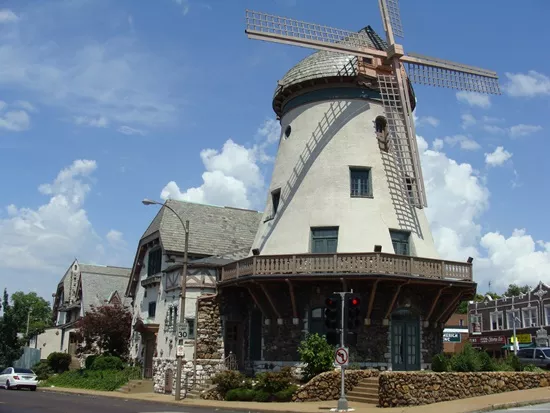
The Bevo Mill, along with other Anheuser-Busch restaurants, tried to make drinking family-friendly.
Anheuser-Busch faced a new threat at the dawn of the twentieth century. For decades, the venerable brewery on Pestalozzi Street had battled rival brewers such as the Lemps, but its new enemy didn’t brew beer. Quite to the contrary, the Temperance movement sought the annihilation of beer in St. Louis and the entire country. August Busch correctly predicted that the goal of the anti-alcohol zealots, Prohibition, would prove to be the greatest existential threat to the future of his brewery.
The half-timber construction popular with A-B restaurants.
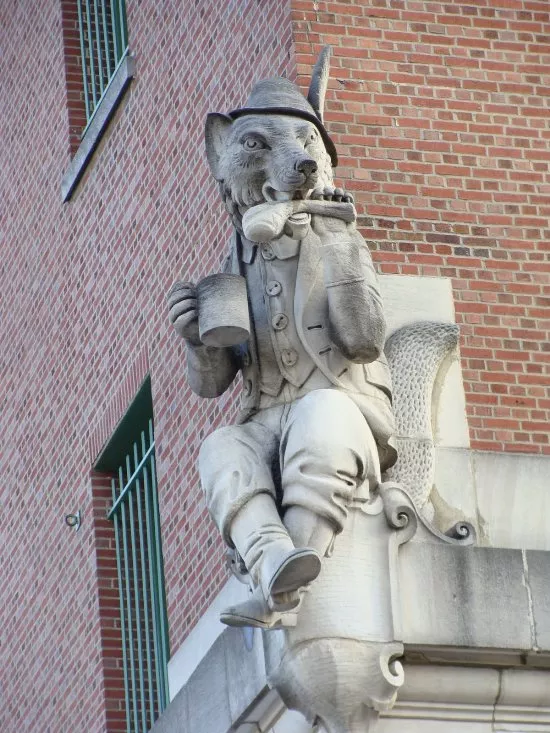
For most of the history of America, drinking alcohol in public remained a strictly male pastime. Saloons served as gathering places for men supposedly neglecting their familial duties after work. Busch realized the consumption of alcohol in St. Louis needed a public-relations makeover; ever the hustler, he tackled the challenge with the Busch characteristic need for innovation. First, he began to promote the corporate icon of the Feasting Fox, or Bevo, from traditional German myth. Likewise, also looking back to the Old Country, Anheuser-Busch sought to redefine public drinking in America with a series of “family-friendly” drinking establishments.
Borrowing from German half-timber construction, or fachwerk, the new restaurants sought to not only to project a more wholesome image, but also to embrace Busch’s European heritage. The new restaurants abandoned the dark interiors of saloons, substituting them with bright, light-filled interiors and hearty German meals. Placed in strategic locations throughout the rapidly expanding Dutchtown and Bevo neighborhoods, the heart of German St. Louis, Anheuser-Busch began its most daring experiment in community relations.
The Feasting Fox on the side of the Anheuser-Busch Brewery.
Continue to read more about Busch’s new restaurants.
“OK, here’s the deal: I’m not prep, I’m not punk, I’m not grunge, I’m not emo. The only label I go by is my name, which happens to be Angel — even though it doesn’t make sense when you compare it to my character.” –Angel Olsen’s STLPunk.com profile, circa January 2003.
On April 27, Angel Olsen comes to town in support of her second and latest album, Burn Your Fire for No Witness . It’s a phenomenal record: sprawling and emotional in its scope, dramatic and understated at turns, with strong melodies and nuanced vocals at its core. As it happens, Olsen is a St. Louis native. Between roughly 2003 and 2007, she quietly developed her songwriting and performing skills around town before departing for Chicago and eventually Asheville, North Carolina.
We interviewed Olsen in February, shortly after Burn Your Fire… came out. We also tracked down some friends, colleagues and collaborators from her St. Louis years, who provided further insight into her growth as a musician during that time.
Angel Olsen: I was born in the city and raised in Richmond Heights. I went to Tower Grove Christian High School. I always wrote little songs and stuff growing up. I guess the first real one was at age twelve or thirteen. I thought I would be a dancer/performer at one point. I wanted to dance, perform, act — do all of it. But I changed quite a bit in high school. Before I even played with a band, I’d get a guitar and play outside with all the wannabe-hippie kids in front of Vintage Vinyl.
Josh Levi (former RFT contributor): I used to see her play outside of Vintage Vinyl. I always thought she was such a strong player, but her voice has really developed into a force of its own.
Olsen: In high school, I got really involved in this band called Goodfight. We played jam-rock.
Ben Majchrzak (ex-Goodfight member): Angel and I met in high school. A close friend of mine in middle school went to the same high school as her and introduced us. I was in bands and had some recording equipment, and Angel was looking to record some solo material she had written.
Olsen: We played at the Creepy Crawl, the old location downtown.
Majchrzak: We also played the Hi-Pointe and some battles of the bands at local schools and churches. Angel’s lyrical style for our group was pretty dark. It was fitting for our style. Her solo stuff that we had worked on was much closer to the sound she has developed now.
Olsen: At the time, a lot of people were hearing about shows through STLPunk.com. Do you remember that website? I met a lot of people from the suburbs and all over St. Louis because of it. I would make friends that were totally different than the ones at school. It opened up my perspective of what the world was like, what it meant to interact with different kinds of musicians and people.
Majchrzak: Angel and I actually were dating for most of the time she was in the group. She broke up with me and sort of pulled herself out of the band as well. There was no bad blood.
After Goodfight, Olsen got involved in the music scene centered on the Lemp Neighborhood Arts Center. According to lemp-arts.org, she played there three times between 2004 and 2007.
Olsen: I was young, and I feel like a lot of girls weren’t really playing there. At the same time, it was important to put myself out there at a young age and just get used to it. I was surrounded by friends. I knew the people from Floating City pretty well for a little while.
Gareth Schumacher (ex-Floating City member): I remember that her voice was really amazing right from the beginning, and by the time I met her she’d already written some really good songs. I don’t think I ever saw her give a weak performance.
Olsen: They encouraged me to continue writing. I remember hanging out with those guys, sort of growing up with them. When we all heard of a new record that we all liked, we’d go to each other’s houses, just sit down and listen to it and talk about it. We would also play each other’s songs and talk about that. It was kind of a constructive-criticism circle.
Schumacher: We would joke about starting a folk collective. At least a couple of us were living together at any given time, so naturally we would find ourselves hanging out at someone’s place, talking about music and trying out new songs. I’m a sucker for weird prettiness in music, so that aspect of her songwriting got me right away. All her melodies were great, very eerie and beautiful. And she was writing better lyrics than almost anyone else I knew.
Continue to page two.
Grace Woodard (ex-KDHX host): Angel and I met sometime in early 2006. We were both dating guys who were in the same band. We bonded while writing notes back and forth across a table at Joe’s Cafe one night. I believe we were nineteen and twenty, respectively. The guy and I broke up later that evening, but Angel and I only grew closer from that point on. The first time I saw her play was while we were all hanging out in the living room of her Maplewood apartment. Someone handed her the guitar, she started singing and everyone fell quiet. She had some songs on MySpace, and hearing those songs was really what made me start to appreciate her songwriting.
Olsen: Grace interviewed me once on her show [ Nomadic Reverie , in 2009]. It was funny being interviewed by someone who was a friend — it was like, “Are we cheating?”
Woodard: She was actually already living in Chicago by the time she played on my show. I think she was cultivating some fans through her MySpace page while she was in St. Louis. I seem to recall a story about her corresponding with [singer-songwriter] Bill Callahan that way, but she’s never been the type to actively pursue “industry contacts.” Luckily, she’s the type of artist who doesn’t need to aggressively self-promote, because her talent speaks for itself.
Olsen: I moved to Chicago in 2007. I was at a place where I didn’t know what I was going to do. I didn’t want to be in St. Louis any longer. I wanted something else to happen. It just seemed like the easiest thing to do and still be away.
Woodard: I had actually considered moving to Chicago with her, but I wasn’t ready to leave St. Louis. We frequently e-mailed and talked on the phone, and saw each other whenever we were in the same city at the same time. Sometimes she would send me new songs when she was experimenting with a new style and wanted feedback. I was a huge fangirl during that whole time.
Olsen: I’m really psyched that [my band and I] are allowed to do this for this period of time. You never know, when you’re making art, how long it’s going to last. Majchrzak: Angel was way more mature than her age at the time. She had seemingly been through more life experiences than myself and was shaped by them quite a bit. I always thought of her as an old soul.
Woodard: I’ve loved seeing Angel evolve over the years. I’m proud of her because she’s my friend, and I want good things to happen for her, as with all my friends, but also because I’ve seen her grow into a confident artist and an assertive, independent gal who inspires me on the regular.
Levi: I last saw her in Washington, D.C., last fall. She blew everyone away, and it was really cute to see a teenager get really nervous about asking if she could take some pictures. She’s really knocking it out of the park.
RFT MUSIC’S GREATEST HITS
The 15 Most Ridiculous Band Promo Photos Ever This Incredible Make-A-Wish Teenager Went to the Gathering of the Juggalos, Got a Lap Dance (NSFW) Crotching Whiskey at the Justin Bieber Concert and Getting Thrown Out: A Review The Top Ten Ways to Piss Off Your Bartender at a Music Venue
Editor’s note: It has come to our attention that some of the language in the recommendations below was excerpted from previous Riverfront Times’ articles without giving proper credit to the writer who originally reviewed the restaurant. RFT is working on correcting this oversight and ensuring that it won’t happen again.
In recent years, a spate of Vietnamese restaurants have popped up, bringing delicious Pho, a spice-filled broth served with noodles, to the masses. And we couldn’t be happier. Lemongrass and ginger, rice and noodles, all fresh and remarkably healthy — here are seven of our favorite spots to grab authentic Vietnamese cuisine.
Pho Long (8629 Olive Boulevard, University City; 314-997-1218)
The pho broth at this U. City spot is so deeply flavored with the generous addition of basil and lime that you’ll pause for a moment just to take in the aroma. You don’t need much more than a bowl of good pho for a fast, satisfying meal: thin rice noodles, onions and scallions in beef broth, customized with your choice of meats — eye round steak or flank steak are a solid option; oxtail or beef meatballs offer a heartier, earthier flavor. Best of all, pho is good for breakfast, lunch or dinner, in hot weather or cold.
Mai Lee (8396 Musick Memorial Drive, Brentwood; 314-645-2835)
Mai Lee is St. Louis’ first Vietnamese restaurant, bringing in the crowds and introducing our city to this sumptuous cuisine. Though somewhat strangely located on the ground floor of a parking garage in Brentwood — sandwiched between the Best Buy/Sports Authority colossus and the South Hanley Road Home Depot — Mai Lee thrives, its dining room seemingly packed at every lunch and dinner. The menu is massive — more than 200 dishes. Order any of them with confidence, from simple goi cuon (fresh summer rolls) to exotic ech xao lan (a stir-fry with lemongrass, curry and frogs’ legs).
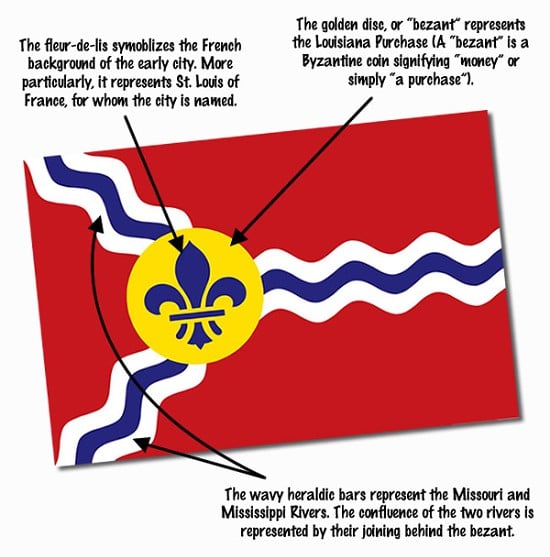
Distilled History — Cameron Collins breaks down the history behind St. Louis’ flag.
Distilled History — The 1916 flag design approved in 1946.
The St. Louis city flag turns 50 years old today.
The flag with a red field, a fleur-de-lis and blue waves representing the confluence of the Mississippi and Missouri rivers has been flying atop city buildings and flag poles for half a century now. The flag’s birthday is only a couple weeks before St. Louis’. The city turns 250 on Valentine’s Day weekend.
The St. Louis flag is beloved by its city, unlike the Missouri flag, which got a makeover last year from a design firm in the Northeast.
“St. Louis pride runs deep in this town, so it makes sense that many fly the flag. I share that pride, but I believe there’s another reason the flag is so popular: It looks really, really good,” says Cameron Collins, the author behind Distilled History , a blog that mixes history and cocktails (and won the 2013 Riverfront Times web award .)
“Unless you live in the United Kingdom or maybe Bhutan, I think the St. Louis flag is better than yours.”
See also: Washington University Physicists Fly The St. Louis Flag…In Antarctica (VIDEO)
St. Louisans aren’t the only ones who like it. The flag won fifth place in a 2004 poll of the best flags in the world .
St. Louis needed a new flag 50 years ago when city officials realized they’d made a big oversight. After choosing a different design everyone agreed was ugly-but-good-enough, officials took a Mississippi riverboat cruise to celebrate — and forgot to make their chosen flag official, Collins says .
Thirty years later, city hall caught the mistake and passed an ordinance to fix it, but the cat was out of the bag: No one really liked the newly official flag design. Famous St. Louis architect Charles Nagel called the striped flag with St. Louis on his horse “wretchedly bad in heraldic design.” Even the St. Louis Post-Dispatch got behind the idea of a new flag in a 1957 editorial.
Nagel called on Theodore Sizer, who’d been an art professor at Yale University, and he designed the flag St. Louisans know and love today.
See also: St. Louis Flag Flies Flaccidly Hangs Over D.C. City Hall
Here’s the official city description of the flag’s symbols: The flag with a solid red background has two broad heraldic wavy bars, colored blue and white, extending from the left top and bottom corners toward left center where they join and continue as one to the center right edge. This symbolizes the confluence of the Missouri and Mississippi rivers. Over the point of confluence a round golden disk upon which is the fleur-de-lis of France (blue) calling attention to the French background of the early city and more particularly to St. Louis of France for whom the City is named. The golden disk represents the City and/or the Louisiana Purchase. (Heraldically, the disk is a “bezant” or Byzantine coin signifying, money or simply purchase.) The flag’s colors recall those of Spain (red and yellow or gold), Bourbon France (white and gold), Napoleonic and Republican France (blue, white and red), and the United States of America (red, white, and blue).
So happy birthday to the St. Louis flag, even all the way down at the bottom of the world:
Follow Lindsay Toler on Twitter at @StLouisLindsay . E-mail the author at [email protected] .


![Chuck Berry’s St. Louis Homes and Properties Before He Was Rich and Famous [Photos]](https://www.riverfronttimes.com/wp-content/uploads/2025/04/4420cottage.webp)