Tag: News Feature

  • Eric Nepute Is Being Sued for Spreading COVID Misinformation — 10 Million Times

    Eric Nepute Is Being Sued for Spreading COVID Misinformation — 10 Million Times

    Screengrab

    Eric Nepute says that he’s just trying to keep people healthy and sell vitamins. The FTC says that he’s made more than 10 million misleading claims about COVID-19.

    Talk radio is not known for its brevity, and the teaser for Eric Nepute’s radio show is no exception.

    “Even before all the COVID craziness, Dr. Eric Nepute has been a fighter for truth, health and freedom,” it begins. “And he is respected not only in the St. Louis area, but worldwide. Now he’s inviting his like-minded colleagues and friends to help. The so-called government health experts are putting their agenda before your health and well-being and Dr. Eric and friends are debunking the evil …”

    No one should be surprised to learn Nepute broadcasts on a conservative radio station, in this case Real Talk 93.3 FM. He comes on air introduced as “the Rock Doc” while Europe’s “Final Countdown” plays in the background.

    He typically starts the show by giving a rundown of the day’s headlines most likely to alarm and outrage his listeners. A recent episode in January was no exception: Another young athlete had mysteriously dropped dead; the United Kingdom announced there had been 1,000 more deaths of young people per week in 2022 than in previous years; the debt-ceiling limit would soon be reached; millions of taxpayer dollars were going to “transgender training of trout and other weird animals in the Middle East.”

    “You’re not going to believe some of this stuff because you’re not seeing it in the mainstream media,” Nepute told his listeners.

    As with many things on Real Talk with Dr. Eric Nepute and Friends, there is some key information missing. While it is true that both the U.K. and the U.S. have seen upticks in deaths of young people, it has not been at a rate of 1,000 per week in the U.K. and most experts place the blame for the excess deaths on COVID-19 and other pandemic-related knock-on effects and not, as Nepute would later imply, the COVID-19 vaccine. Numerous Google searches for different combinations of “transgender”a and “trout” failed to turn up any results.

    “You need to listen to people who are free thinking, who have common sense and rational logic,” Nepute said. Then he gave a shout out to his chief nemeses. “Good morning, FTC; good morning, DOJ. Hope you guys are having a blessed day. That’s right folks, they literally listen to every word we say because we are in a police state. Our Constitution is literally being trampled upon, ripped up and quite honestly urinated on by these crazy left-leaning — I don’t even know what to call them — lunatics. They’re just lunatics.”

    While this may sound like right-wing paranoia, Nepute was actually spot on about one thing. The Federal Trade Commission and Department of Justice were almost certainly listening in.


    Eric Nepute operates two wellness centers, including this one in South County.

    RYAN KRULL

    Eric Nepute operates two wellness centers, including this one in South County.

    Nepute says that he was raised by a pig farmer in central Illinois and that his parents taught him to “stand up against tyranny.” Growing up, he wanted to be a doctor and says he was enrolled in medical school at Northwestern when he suffered a football injury. The pain from the injury lingered until he visited a chiropractor who helped, inspiring Nepute to become a chiropractor himself.

    After studying chiropractic medicine at Missouri’s Logan University, he earned a Ph.D. in natural medicine from Honolulu’s Quantum University, a “self paced, online learning university.” He followed that with a certification from the Carrick Institute in quantum neurology, a chiropractic practice described in one Medscape article as “word salad” pseudoscience.

    In addition to hosting his morning radio show, Nepute operates wellness centers in Creve Coeur and south county where patients can get an infusion of vitamins or a spinal decompression.

    Nepute also owns Wellness Warrior, a company that sells vitamins and supplements, as well as a “Thyroid Masterclass” workshop and books such as The Parasite Cleanse. He has said numerous times on his show that his company is giving away a million bottles of vitamin D and zinc for free.

    Nepute is a natural broadcaster with a keen ability to deliver a message with urgency, an energy that can’t be easy to sustain for a two-hour broadcast. A prolific user of social media, he often shoots livestreams wearing dark-colored scrubs branded with the Nepute Wellness logo, a medical chart of some sort behind him.

    In December, Nepute was in different attire in a slightly different setting. He wore a suit at the federal courthouse in St. Louis, where he waited in a 10th floor lobby in front of a window overlooking Busch Stadium. He is bald, clean-shaven and broad-shouldered and still has the build of guy who played football in college. One room over, Nepute’s lawyers were conferring with lawyers from the DOJ, hashing out an agreement to avoid Nepute being held in contempt of court. Despite what was going on in the next room, Nepute came across as affable.

    Nepute holds the distinction of being the first person to be sued by the Federal Trade Commission under the COVID-19 Consumer Protection Act, a law that took effect in December 2020. It regulates how products can be advertised in relation to COVID-19. The goal is to prevent unsubstantiated claims that certain products can cure or prevent COVID-19. Whether Nepute’s rhetoric merely tests the bounds of this law or tramples it will be decided later this year by a jury of Nepute’s peers.

    Since getting sued, Nepute has been telling anyone who will listen that he’s a victim of tyrannical government. When asked, he said that he couldn’t talk about the status of his case, explaining that he didn’t want to incur the wrath of his attorneys by talking to the media (though he regularly pops up on right-wing media to talk about it). Instead, he mentions his website, fightwitheric.com. (He might have thought twice about that URL.) The website’s landing page features a graphic of Nepute standing in front of a pair of jack-booted thugs, a strip of duct tape over his mouth, censored and silenced.

    On a recent podcast, Nepute referred to the COVID-19 Consumer Protection Act, the law he’s allegedly run afoul of, as “a brand-new law that nobody knew about until I was sued for half a trillion dollars.”

    Nepute says that the government is trying to bankrupt him just for merely suggesting people take vitamins to stay healthy.

    But suggesting people take vitamins is only part of the story.


    Eric Nepute would live stream medical advice on Facebook before he got his radio show. He also has YouTube videos about wellness.

    Eric Nepute would live stream medical advice on Facebook before he got his radio show. He also has YouTube videos about wellness.

    In December 2018, prior to becoming an FM radio host, Nepute live streamed via his public-figure Facebook page. Many of these live streams have since been deleted, but by 2020, if not sooner, he was interspersing his monologues on health, wellness and nutrition with advertisements encouraging his listeners to buy vitamins from Wellness Warrior, the company he owns.

    Even those dubious about his credentials or the underlying science of some of his claims would be hard-pressed to question his sincerity. He says he gathered his information from years of working as a chiropractor. He only occasionally veers into the overheated bombast that right-wing talk radio is known for, and in such cases it is almost always the topic of the FTC lawsuit that brought him there.

    The FTC is tasked with enforcing laws against deceptive advertising and other fraudulent business practices. It couldn’t care less what Nepute thinks about vitamins or anything else. But it cares a great deal how Wellness Warrior advertises its products. In hawking his vitamins, the FTC says, Nepute disseminated misinformation and exploited fears in the midst of a pandemic.

    In March 2020, the vaccine-to-be-skeptical-of was a long way away. But Nepute was dubious of the need for lockdowns, saying that the pandemic shouldn’t even qualify as a pandemic. The virus, he said, would be nothing to worry about so long as people took their high-dose infusions of vitamin C and saw a good chiropractor.

    “You don’t need to be sitting at home right now scared that you’re going to die from some virus,” he added. “You know what you need to do? Get yourself adjusted. Get yourself your vitamins.”

    In May of 2020, the FTC, which issues regulations specifically focused on advertising on social media, sent Nepute a letter warning him that he was making “unsubstantiated claims” on his show.

    Nepute ignored the warning and kept live streaming.

    Then in April 2021, the FTC again contacted Nepute, this time in the form of a lawsuit.

    Crucially, in between the warning letter and the lawsuit, Donald Trump had signed the COVID-19 Consumer Protection Act into law, making it illegal “to engage in a deceptive act or practice in or affecting commerce associated with the treatment, cure, prevention, mitigation, or diagnosis of COVID–19.”

    The FTC said Nepute had violated the then-five-month-old law, alleging that he said vitamins “are more effective than the available COVID-19 vaccines.”

    Nepute has very publicly disputed the FTC’s claims, saying numerous times that he’s never told anyone not to get the vaccine and that he’s never made statements like that in conjunction with advertising his Wellness Warrior products.

    “They took my words and lied about them. They said that I told people if you take vitamin D you don’t need a vaccine. I never said that,” he said in a video.

    Anyone listening to Nepute’s radio show or live streams has heard him say something to the effect of, “if you want a shot, get a shot.” But he’s also said that the COVID-19 vaccine is “a genetic-modification therapeutic tool.” He has claimed that the mRNA vaccine killed all the cats, ferrets and monkeys unlucky enough to be its test subjects.

    Suzanne Alexander, the bureau chief for St. Louis’ Communicable Disease Division, tells the RFT that the mRNA vaccine is not altering anyone’s DNA. To explain how that vaccine works, she used the analogy of a car engine.

    “Let’s call the DNA your actual engine. Your mRNA is going to be your fluids that go into your engine, like your oil, your transmission fluid, your brake fluid, all that good stuff. The way you maintain your fluids in your car engine is going to impact the way your engine works, but it will not fundamentally change your engine,” she says.

    Nepute has also told his listeners that “the vaccine is going to make spike proteins in the brain cells and the lungs, in the testicles, in every tissue in your body. So it’s pretty crazy. We need to stop those spike proteins from being attached and sticking to the cells. Vitamin D stops that. So that’s why I’m such a big fan of vitamin D and zinc.”

    Nepute is not totally wrong. The spike protein is a feature of the coronavirus, and the mRNA does create spike proteins in your body. But this is precisely why the vaccine works, according to the CDC. Over the course of a few weeks, your immune system learns how to destroy these spike proteins so that if the COVID-19 virus shows up in your body, your immune system will know how to destroy it.

    The FTC says that Nepute is free to express whatever he wants about spike proteins, mRNA, vitamins and the vaccine as a journalist, a chiropractor or just a regular person with opinions. But he’s not free to make these statements in the context of advertising.

    In the same broadcast in which he talked about spike proteins going into your testicles and the ferrets who died from the mRNA tests, he also encouraged listeners 11 times to go to freevitamindeals.com.

    Nepute’s attorneys have said in court filings that they believe the case is government overreach overly reliant on selective snippets of videos and audio taken from broadcasts that sometimes ran for two hours.

    Nepute’s attorneys also cite mainstream medical experts talking about the benefits of vitamins during the pandemic. One filing quotes Dr. Anthony Fauci, Trump’s former chief medical advisor, who said during a September 2020 Instagram Live event that, “If you are deficient in vitamin D, that does have an impact on your susceptibility to infection. So I would not mind recommending, and I do it myself, taking vitamin D supplements.”

    Filings also reference the National Institutes of Health’s website, which says, “Your immune system needs vitamin D to fight off invading bacteria and viruses.”

    When the FTC filed its lawsuit in April 2021, it asked the judge to issue a preliminary injunction against Nepute. To avoid this, Nepute agreed to a consent order in which he didn’t concede any wrongdoing but did agree he wouldn’t broadcast certain claims in connection to Wellness Warrior ads, particularly that vitamins could be used to “cure, mitigate, treat or prevent COVID-19.”

    Both parties signed onto those terms on May 5, 2021. Nepute subsequently moved his broadcast to terrestrial radio, and the government says that over those FM airwaves he violated his end of the agreement.

    On February 4, 2022, Nepute acknowledged on his radio show that the government was taking action against him and then said, “Here’s a big old up your nose with a rubber hose, federal government. Have a listen to this. Brand-new study confirms that vitamin D significantly, significantly reduces the risk of dying from COVID-19.”

    That same broadcast Nepute said that vitamin D is “a hell of a lot more beneficial than these shots that people are taking.” He added: “Federal government asked me not to do this anymore and so, here’s what I’m going to say to them. Uh, go to freevitamindeals.com. That’s freevitamindeals.com.”

    Dr. Erik Dubberke, a professor at Washington University School of Medicine, has evaluated Nepute’s claims on behalf of the government, and he’s written that Nepute’s on-air statements are often based on single studies, which Nepute ignores many key aspects of while mischaracterizing their results.

    In addition to being an MD, Dubberke is an epidemiologist as well as the medical director of infection prevention and control at Missouri Baptist Medical Center. In court filings, he went through many of Nepute’s statements about vitamins and COVID-19, again and again labeling them as misleading.

    According to Dubberke, Nepute commonly takes a study that has found an interesting correlation — for instance, between vitamin D levels and a person’s likelihood of catching COVID-19 — and communicates it to his audience as if it has proved a causation.

    Like Dubberke, Suzanne Alexander with the city’s Communicable Disease Division is significantly less bullish on vitamin D than Nepute is. She points out that COVID-19 tends to hit worse in the winter when people are inside, so it makes sense that patients hospitalized with COVID-19 after those winter waves would have low vitamin D. Also, she says, taking vitamin megadoses comes with its own risks.

    “There is a problem called hypercalcemia,” she says, referring to a buildup of calcium in the blood, caused by taking too much vitamin D, which can potentially lead to severe kidney issues.

    “If you have someone who is saying, ‘Take megadoses of vitamins,’ and that person has not done their due diligence by having blood tests taken first, you’ve got someone who is essentially saying, ‘I don’t know what your biochemistry is, but here, take this drug,’” Alexander says.


    Over the past year, Nepute has become something of a cause célèbre in corners of the internet where people are skeptical of the federal government’s response to COVID-19. He’s appeared on numerous conservative podcasts and radio shows, saying he’s a victim of censorship and that the government is afraid to go to trial so instead is trying to bankrupt him through legal fees.

    He’s spent $3.5 million on his legal defense so far, he says, and expects to spend a million more. Donations can be made to his website, he adds.

    Many fringe media outlets have run headlines about how the federal government is suing Nepute for half a trillion dollars. That figure, which is about 2 percent of the country’s entire GDP for last year, seems absurd on its face. But as is often the case with Nepute, there is a soupçon of truth in the statement.

    The FTC charged Nepute with more than 10 million violations of the COVID-19 Consumer Protection Act — 10,175,234, to be exact — and wouldn’t reveal how it arrived at this exact number.

    Court filings from the FTC state that the maximum penalty for each violation is $43,792.

    Put those two numbers together and, purely in theory, Nepute could be on the hook for something like half a trillion dollars.

    In actuality, that’s not going to happen. The FTC says that when it assesses how much an individual defendant should pay, it takes into account the amount of money fraud victims were taken for as well as what would be appropriate punitive fines.

    The biggest fine in FTC history is $5 billion against Facebook. Nepute will not be coughing up 100 times more than Mark Zuckerberg and company did. Fines in the dietary supplement area tend to be in the hundreds of thousands, and the figures are typically lower in cases where the defendant is an individual and not a behemoth corporation.

    But all that hasn’t stopped Nepute from saying, in the third person, “Here’s what the government of the United States of America told us: ‘We drew our sword against Dr. Nepute. We’re not putting our sword away until there’s blood on it.’”

    The martyrdom and federal prosecution could be lending Nepute legitimacy. Real Talk with Dr. Nepute airs on a station with shows from former Fox News anchor Bill O’Reilly, Trump lawyer Rudy Guiliani, and the man who is believed to have originated the idea that Biden’s electoral victory was made possible by fake ballots printed on Chinese bamboo paper. Among this crowd, there is no greater imprimatur of street cred than having the screws put to you by the feds.


    In many ways, Nepute’s case isn’t that different from typical FTC lawsuits.

    In 2013, the agency went after the makers of POM Wonderful for claims the company made about the juice curing prostate cancer. The FTC prevailed and the juice makers had to pay a fine.

    In 2019, the agency sued the makers of a jellyfish extract supplement, arguing their advertisements claimed the capsules cured dementia. That one was dismissed by the judge before trial.

    However, assuming Nepute’s case makes it to trial, it will be wholly unlike most FTC cases because pomegranate juice and jellyfish pills haven’t become politically polarized in the same way the vaccine has.

    It’s going to be very difficult to find jurors who don’t have strongly held beliefs about the pandemic. Poll after poll has found that someone’s beliefs about the danger of COVID-19, the efficacy and safety of the vaccine and the government’s response to the pandemic depend in large part on what political party the person prefers.

    Alicia Campbell, an attorney who studies juries and who has argued many cases in federal court, says that it’s up to the judge to determine what questions can be asked of potential jurors during jury selection.

    “This is a really interesting case because it does implicate jurors a little more personally,” she says. “You’ve either affirmatively chosen to get a vaccine or you have affirmatively chosen not to. And that’s very personal. It’s not like deciding a case over a car wreck.”

    She says that attorneys would likely want to know a potential juror’s vaccine status, but there’s a good chance the judge wouldn’t allow such a question to be asked.

    Campbell also adds that even though this isn’t technically a First Amendment case, “I would think, for people who are anti-vaxxers, it could seem like it is.”

    Court filings suggest that the government may call Dubberke, the Washington University professor of medicine, as an expert witness, but he likely won’t be the only medical doctor to testify.

    One name that Nepute’s attorneys will likely bring up in the courtroom is that of Boston University researcher Michael Holick.

    One of the statements Nepute made that the FTC sited in its suit was, “Boston University’s Dr. Michael Holick found … that people who have enough vitamin D are 54 percent less likely to catch coronavirus in the first place.”

    The complaint against Nepute says that he was telling his audience the study found a causation between vitamin D and not catching COVID-19 when in fact the study’s only finding was that it established “further rationale to explore” a possible causal relationship.

    However, Holick’s own comments to his hometown newspaper seem to be not at all that different from what Nepute is being taken to court for saying.

    “The higher your vitamin D status, [the] lower was your risk,” Holick told the Boston Herald in September 2020. “I think that the message is that everyone should consider improving their vitamin D status — especially in the era of COVID, by taking a vitamin D supplement,” Holick said to another Boston news radio station around that same time.

    An important distinction is that Holick isn’t saying those statements in the context of advertising. But still, it’s not hard to imagine what that will look like to a jury of Nepute’s Missouri peers.

    We welcome tips and feedback. Email the author at [email protected] or follow on Twitter at @RyanWKrull.

    Coming soon: Riverfront Times Daily newsletter. We’ll send you a handful of interesting St. Louis stories every morning. Subscribe now to not miss a thing.

    Follow us: Google News | NewsBreak | Reddit | Instagram | Facebook | Twitter

  • Remembering Mississippi Nights, St. Louis’ Most Iconic Nightclub

    Remembering Mississippi Nights, St. Louis’ Most Iconic Nightclub

    SEAN DERRICK

    Alanis Morissette at Mississippi Nights on September 1, 1995.

    Editor’s Note: Garrett and Stacy Enloe love music and actually met at a concert at the now-shuttered American Theater (they were seeing Jackyl). Marriage followed in 2000, and then in 2016, they won a piece of St. Louis music history: a portion of the Mississippi Nights awning. That spurred Garrett to make a Mississippi Nights fan page on Facebook for the venue that opened in 1976 and shuttered in 2007.

    The page soon had 2,000 members recalling working at, playing or attending concerts at the venue. That energetic fan base inspired the book Mississippi Nights: A History of the Music Club in St. Louis, which came out in October. Part scrapbook, part oral history, the book also features a comprehensive list of every band that ever played the venue. It shares photos, ticket stubs, concert fliers, setlists and band photos, as well as stories like the one about the time Hole performed and Courtney Love said she was sick and fell over, or that time Nirvana nearly started a riot. It also highlights the characters of Mississippi Nights, including the Cookie Lady and Beatle Bob.

    Below are excerpts from the book that capture what made the all-ages venue an iconic part of St. Louis for 30 years.

    Welcome to Mississippi Nights


    Mississippi Nights on Laclede's Landing was an all-ages concert venue.

    PAUL HILCOFF

    Mississippi Nights on Laclede’s Landing was an all-ages concert venue.

    Los Angeles had the Whiskey a Go Go, Troubadour and the Roxy Theater.

    New York City had CBGB, Studio 54 and the Palladium.

    St. Louis had Mississippi Nights.

    Mississippi Nights, appropriately promoted as “The Music Club of St. Louis,” operated from 1976 until 2007 and was located in the historic Laclede’s Landing section of downtown St. Louis at 914 North First Street.

    To get to Mississippi Nights, you drove past the Gateway Arch grounds, under the ornate arches of the Eads Bridge, over several blocks of cobblestone streets and past century-old buildings that once housed fur traders, slaughterhouses and dry-goods warehouses. The old, weathered brick building had character with its arched doorways and windows. The color variation in the bricks suggested that once there were more windows and doors, removed for unknown reasons. The Eads Bridge, spanning the mighty Mississippi River, could be seen from the parking lot on the south side of the building.

    Upon entering the wooden door on the right, you were in a vestibule surrounded by signed 8×10 band photographs in black frames. To the left, past the second door, were a couple of video games; a pinball machine; a cigarette machine; some round, white-topped tables with black, wooden chairs; a small bar in the corner; and another set of doors that sometimes opened to accommodate large crowds. It was a short walk forward to have your ID checked, hand stamped and ticket torn.

    To the right was the bar with wood paneling up the back wall, neon beer signs and open shelves of liquor and glasses. Following a sloped walk down past two tiers of additional tables and chairs on the left (the first tier also housed the sound mixer), the walkway opened, revealing restrooms and the underage section (the raised area often referred to as the “kiddie corral”) on the right, and to the left was the dance floor and stage.

    The stage was covered with parquet flooring and elevated about three and a half feet off the floor. A small walkway to the right of the stage led to the back door and, behind the building, steep metal steps where the bands loaded out their equipment at the end of the night. (Fortunately for the crew, they were able to load in through the front door into the empty venue in the morning.) Sometimes, metal barricades blocked the front of the stage, but often you could press yourself right up against this platform in front of your favorite band.

    Chuck McPherson* Remembers…
    “What was special about Mississippi Nights? The people. The atmosphere. The smell. The experience. You could not only see a good show but meet the artist. It was seeing up-and-coming bands before everyone else, as well as bands on the way down. It was all-ages shows in a bar atmosphere. I was underage and limited to the floor and the side of the stage for much of my time there, but it didn’t matter. To borrow the phrase, it was the most magical place on Earth. Mississippi Nights was one of the places where I spent much of my mid-teens to early adult years. I made friends at the club that I still have to this day. It’s a place I will never, ever forget. No other club can compare. 914 North First Street will be in my heart until the day I die.”

    *Mississippi Nights patron

    Several factors contributed to the longevity and popularity of Mississippi Nights. [The venue] did an excellent job of booking shows and showcased a variety of music genres, unlike many clubs that catered to one genre. The sound system was incredible, appealing to the audiences and the musicians. The staff was welcoming and made the club feel like a second home to many. Finally, you were able to get up close and personal with the bands — in front of the stage as they played, at the bar while they drank, or outside as they came and went.

    Being the best place to experience music in St. Louis for so many years, countless people forged new relationships and memories at Mississippi Nights. Many concertgoers developed friendships that would last a lifetime with the staff or fellow patrons. Some went to the club on first dates or even met their spouse there. The memories run the gamut from meeting bands, the friendly staff, amazing performances and crazy incidents (some involving liquor).

    Mississippi Nights was a treasure in St. Louis. Unfortunately, as time passes, memories fade. … So, we preserve those memories and the music that Mississippi Nights produced for 30 years with this book.

    Angela Prada* Remembers…

    “Mississippi Nights was lightning in a bottle. Having worked there, I have to say everyone felt they were part of the show, not just watching it. There was a true sense of community and a love of music between patrons, staff and the bands. No one complained about it being hot, crowded, smoky or that they were eating popcorn out of a trash can. They were there to see the show.”

    *Mississippi Nights server

    1867: Pork Packers

    Although the building may date as early as the 1830s, the first confirmed business in the Mississippi Nights building does not appear in records until 1868. James Reilley & Co. Pork Packers may have lasted for less than a decade, but the business is responsible for one of the signature features of the club, the floor that began to slope as you passed the ticket window.

    Documents from 1868 declare the building was owned by James Reilley, David A. Spellen and Michael McEnnis. The 1874 book St. Louis: The Commercial Metropolis of the Mississippi Valley contains an advertisement for James Reilley & Co. Pork Packers, located at 914, 916 and 918 North Main Street. “Pork Packers” is a euphemism for a slaughterhouse or meat processing facility. The building’s signature slanted floor, eventually bordered by the bar and the over-21 seating section, was designed to drain blood from animal carcasses.

    Becoming Mississippi Nights*


    Joe Haynes, Michael Stipe, Jim Warchol, and Buddy Weber of Stipe’s pre-REM band Bad Habits, November 13, 1978.

    JOHN KORST

    Joe Haynes, Michael Stipe, Jim Warchol, and Buddy Weber of Stipe’s pre-REM band Bad Habits, November 13, 1978.

    Steve Duebelbeis started Mississippi Nights after attending live concerts at clubs in Springfield, Missouri. He appreciated how the clubs featured more than just cover bands. Duebelbeis looked at the space, which was previously a nightclub called On the Rox, and bought the building on August 30, 1976.

    Duebelbeis sold the venue to real estate investor Rich Frame in 1979. He owned it until it closed in 2007.

    *Editor’s note

    1983: The Grandmother of Rock & Roll

    Pat Lacey’s name is connected with Mississippi Nights more than anyone who worked there in the club’s 30-year history. She began her association with the club by taking her daughter Sarah and her friends to concerts at Mississippi Nights.

    On the night of the X show, October 24, 1983, [owner] Rich Frame asked Lacey if she knew of anyone who would want an office job at the club. Frame knew she worked as a nurse, so he was surprised when she responded, “Yes, me!”

    With her husband laid off and their daughter Susan in college, Lacey needed another job to make ends meet.

    Lacey admits she did a terrible job in her interview with Frame. She kept reinforcing that she didn’t have any experience and was uncertain she could do the job. However, with his knack for reading people, Frame had the confidence in Lacey that she lacked, and he hired her on the spot.

    Frame speaks of Lacey with reverence. “She did everything,” he asserts. She juggled nursing and rock & roll for four years before leaving her nursing job to dedicate her time to the club.

    Lacey broke down her duties. “I wrote the checks, sold tickets, did the inventory and the ordering. I did the pouring costs, which was how much we spent on alcohol and whether we made a profit or not, and I did the same thing with shows. When [manager] Patrick [Hagin] left [in 1990], I stepped in and took on a lot more. I was doing everything that he did: doing the contracts, going to the bank, making sure the shows were advanced, so that we knew what time bands were coming in and what time they wanted to be fed, etcetera,” Lacey says. “I was the den mother there. I took care of the bands. A lot of them became my friends.”


    Danny, Mike (holding their RFT Slammie Award) and Steve of New World Spirits, and Brandi Welti, December 3, 1996.

    ANDY MAYBERRY

    Danny, Mike (holding their RFT Slammie Award) and Steve of New World Spirits, and Brandi Welti, December 3, 1996.

    “Lacey had many jobs,” says manager Tim Weber (1998- 2007), “but arguably her most important job was to advance the shows.”

    She organized hospitality events for bands and their crews, including solving problems before they arrived.

    Jason Voigt* Remembers…

    The only event I attended at Mississippi Nights was Joan Jett & the Blackhearts on October 27, 2006. Eagles of Death Metal opened. They rocked the house, but there were other things on people’s minds that night; that was the same night the St. Louis Cardinals won their first World Series since ’82. There were no TVs on, and this was before smartphones. Suddenly, people were yelling right in the middle of a song. Everyone knew it happened. I left the concert early and joined in on the fun outside as people were happily shouting and cheering on the Landing.

    *Mississippi Nights patron

    “She’d call up and say, ‘Do you really need four gallons of hummus?’ She was able to do it in the nicest possible way so that every band that showed up was in a good mood when they got there,” Weber says. “If you screw that up, every band shows up in a shitty mood, and the days are wrecked. So that tiny little thing of making the bands understand ahead of time that they were going to be cared for at least gave you a running shot to start every day pretty good.” Lacey made the bands happy, everyone’s job more manageable, and Mississippi Nights more successful.

    “Absolutely nobody tops the legend that is Pat Lacey,” proclaims Mississippi Nights patron Chuck McPherson. “She was the heart and soul of the club. … She always treated me and my friends like her children. She got to know us on a first-name basis and was supportive of us in our love for music.”

    Patron Michelle Weber Rigden says, “Pat Lacey was my concert mom. She was so kind and nurturing, but I also knew she would take my ass out if I misbehaved as a minor.”

    Patron Wade Monnig says, “Pat Lacey was always amazing, always so nice and sweet. I’d always go see the Alarm at Mississippi Nights, not just because they were a great band [but] because Pat was so passionate about them. I wanted to support her!”

    Lacey decided to retire the year she turned 65, thinking that’s just what you do at age 65, and at the end of 2002, she did.

    In May 2003, Lacey entered Mississippi Nights with a gift of strawberry shortcake for the staff. She quickly learned that her replacement was having problems managing the office. For example, he wrote checks out for every invoice without checking if they were already paid.


    A signed promo shot of one of St. Louis' breakout glam bands King of the Hill.

    COURTESY RICH FRAME

    A signed promo shot of one of St. Louis’ breakout glam bands King of the Hill.

    Before long, Mississippi Nights had substantial credits with the vendors. Tim Weber asked Lacey to return, and she agreed to come back two days a week. After that, she didn’t think of retiring from Mississippi Nights again and worked there through February 2007. “The Nights officially closed at the end of January, but I needed to clean out the office,” she remembers.

    At 84 years old in 2022, Lacey wishes she could still be working at her beloved Mississippi Nights.

    “[Pat Lacey] was the grandmother of rock & roll,” says Tim Weber. “She cared more about more people and more bands than anybody I’ve ever met in my life.” He adds, “I still get tour managers at the Old Rock House that remember Pat Lacey.”

    Tony P. Pona* Remembers…

    “I worked at Mississippi Nights for 10 years, so I have many memories of the place. One that stands out is the night of [the] Alvin Lee [concert] when Bon Jovi’s Richie Sambora was sitting stage right in a packed house [on October 31, 1984]. I believe [Bon Jovi was] playing in town the same week of Alvin Lee, got in early, and [was] bummin’ in the city. Absolutely every lady in the place knew who Sambora was. He was just there to see Alvin Lee. I worked secondary security. We kept the public away from Sambora (for the most part). He did sign and take a few pics, though.”

    *Mississippi Nights stagehand and security

    1990: The Eyes/Pale Divine

    Opening an exciting new decade for St. Louis music, Richard Fortus was the guitar player of arguably the most popular local band in St. Louis, the Eyes. Fortus founded the band six years earlier when he was merely 15 with vocalist Michael Schaerer, bassist Steve Hanock and drummer Greg Miller (later in Radio Iodine and Suave Octopus). Hanock left the band before 1990 and was replaced with Dan Angenend.

    The Eyes rose through the ranks of local bands in St. Louis, constantly playing at the under-21 club Animal House, Kennedy’s 2nd Street Company (that would come to be known simply as Kennedy’s) on Laclede’s Landing, and Mississippi Nights.


    Stewart Copeland of The Police on March 16, 1979.

    DEBBY MIKLES

    Stewart Copeland of The Police on March 16, 1979.

    One night in 1990, record executive Jason Flom saw a line of people waiting in the rain to get into 1227, a club on Washington Avenue in downtown St. Louis, to see the Eyes. Flom was famous for signing hard-rock bands like Skid Row and Twisted Sister. So he decided to send his assistant to Mis

  • Former St. Louis County Prosecutor Bob McCulloch Has No Regrets

    Former St. Louis County Prosecutor Bob McCulloch Has No Regrets

    DANNY WICENTOWSKI

    Bob McCulloch served as St. Louis County prosecutor from 1991 to 2018.

    This story was commissioned by the River City Journalism Fund as the second chapter in its series Shadow of Death, which considers St. Louis County’s use of the death penalty.

    On the night of the 2018 Democratic primary election, St. Louis Prosecuting Attorney Bob McCulloch, a 28-year veteran of the job, held what he expected to be his victory party at the Village Bar in Des Peres.

    He’d won election and reelection by a wide margin seven times, often running unopposed. By all accounts, he expected to be delivered an eighth term that night.

    But with a little more than half the vote in, he was trailing Ferguson City Councilman Wesley Bell by six points. Journalists who had expected McCulloch’s win to be a nonstory suddenly had trouble reaching him and his staff. By the time all the votes had been counted he’d lost by 13 points, a staggering defeat.

    McCulloch had garnered significant media attention, much of it negative, when he announced the grand jury’s non-indictment of Darren Wilson in November 2014 for the shooting death of Michael Brown.

    An investigation from Eric Holder’s Department of Justice ultimately agreed that it could not be proven that Wilson had violated any law, but McCulloch delivered his 45-minute announcement in a way many found to be cold and cavalier. He said that Brown’s death had been tragic but also painted his own office as something of a victim, saying that the biggest impediment to its investigation had been the media’s “insatiable appetite for something, for anything, to talk about.” He balked at the notion that his own law enforcement background might have made him partial to Wilson.

    “After he didn’t indict Darren Wilson for the murder of Mike Brown, he sort of became this law-and-order hero,” says Rodney Brown, an activist who worked to unseat McCulloch in St. Louis in 2018 and is now an organizer in San Antonio.

    McCulloch’s legacy, as well as his electoral defeat, has been defined largely by those days in 2014 when he became an avatar for over-policing and the nascent Blue Lives Matter movement.

    A less examined and underappreciated — though not unrelated — aspect of his almost three decades as the so-called top cop for St. Louis County’s million residents is his office’s relationship to the death penalty.

    In his 28 years as prosecutor, McCulloch won death sentences against 23 people. Ten have been put to death. Frank Baumgartner, a professor of political science at the University of North Carolina-Chapel Hill, calls McCulloch “very, very much outside the norm … nationwide, McCulloch qualifies as one of the most active users of the death penalty.”

    A third of the individuals currently on Missouri death row came out of St. Louis County during McCulloch’s tenure. Three have scheduled execution dates in the next four months — including Kevin Johnson, who is set to be executed on Tuesday, November 29.

    Given the number of men from St. Louis County who have been executed, and given the six people currently on death row, capital punishment may be McCulloch’s most lasting legacy.


    “It’s simply punishment”


    Bob McCulloch at a press conference.

    DANNY WICENTOWSKI

    At a 2017 press conference, Bob McCulloch announced his office’s decision not to indict officer Darren Wilson — a decision that spurred police-accountability activists to rally around the goal of removing him from office.

    McCulloch has kept a low media profile since leaving office, but in a two-hour conversation on a recent Wednesday, the 71-year-old seemed ready to pick up right where the 2018 election left off — and more than game to defend his record. His recollection of details from cases decades ago was impressive. The only time he seemed less than forthright was when asked about his retirement. He gave the sense that he missed prosecuting cases.

    Aspects of the election clearly still grate, particularly what McCulloch says were ads filled with lies put out by the ACLU regarding his office’s use of cash bail.

    His successor’s first four years in office are widely considered a success, bereft of scandal and with plentiful examples of successful, high-profile prosecutions. But McCulloch is critical of Bell.

    “You can’t have public defenders as prosecutors,” McCulloch says. “Many of the people he brought in for top positions in the prosecutor’s office are public defenders. They went from that side of the hallway literally to this side of the hallway.”

    He cites two cases handled by Bell in which defendants were released on bail and then went on to commit other crimes.

    “The one thing everybody wants, except progressive prosecutors, is for people to be safe in their homes, safe walking down the street, able to go out without worrying about getting hit by a stray bullet,” McCulloch says.

    He cites the recall of San Francisco’s Chesa Boudin and Seattle’s progressive city attorney losing to a Republican as vindication of his point: a pendulum that swung one way and is now coming back.

    It’s telling that McCulloch can make a stronger case in those West Coast cities than in St. Louis County. If Bell running against only longshot Libertarian opposition is any indication, the pendulum may have found a nice spot with the county’s current prosecutor.

    On the topic of capital punishment, McCulloch’s views are not complicated. He seems to think that people who argue vociferously from either side are overthinking things. To his mind, a death sentence is punishment befitting those rare crimes that are “just beyond the pale.”

    “If it deters somebody down the line, that’s great. But I would never do it solely because it might deter somebody else from doing it. That’s insane,” he says. “The same with all the other arguments: ‘It’s revenge, it’s vengeance.’ It’s not any of those things. It’s simply punishment. … The primary purpose of the criminal justice system is punishment.”

    The latter statement represents a rare note of agreement between McCulloch and many of the activists who worked to unseat him.


    “Becoming a prosecutor was the next best thing”


    Karen Kraft

    SARAH LOVETT

    Karen Kraft ran Missouri’s Capital Litigation Division, representing clients facing the death penalty, which often put her on the opposie side of McCulloch’s office.

    McCulloch’s hardest-fought election, prior to his unexpected loss to Bell, came in 1990 when he faced off against Tom Mehan. Like McCulloch, Mehan had been a prosecutor when Buzz Westfall ran the county prosecuting attorney’s office. The two men shared an office and bounced ideas off each other. They were friends.

    When Westfall announced his run for county executive, Mehan and McCulloch each left the prosecutor’s office to run for its top job — Mehan on the Republican ticket, McCulloch as a Democrat.

    To call the 1990 race cordial would be an understatement.

    “It was funny when Bob and I would go places and debate,” Mehan says. “We didn’t have a difference of opinion. After about 10 minutes into the debate, I’d be like, ‘Bob, what you got?’ He’d be like, ‘Tom, what do you got?’”

    “It was the most boring debate you ever saw in your life,” says longtime Post-Dispatch reporter Bill Lhotka, who served as moderator.

    McCulloch made his family ties to law enforcement a big part of his campaign.

    McCulloch’s father, Paul, had been a canine patrolman with the St. Louis Metropolitan Police Department for nine years when, on July 2, 1964, he exchanged fire with Eddie Glenn at the Pruitt-Igoe housing complex. Glenn, a Black man, had kidnapped a white woman and then shot at a different officer. Paul McCulloch was killed when Glenn fired and sent a fragment from a ricocheting bullet into the back of his neck and then his brain.

    Glenn was found guilty of murder and executed in 1972. The German shepherd that Paul McCulloch was handler for was given to the McCulloch family. Bob was 12 at the time.

    In the 1990 race, in addition to the story of his father, McCulloch was quick to mention his retired police-officer uncle, as well as his brother and cousin who served on the force. McCulloch’s right leg had been amputated when he was a teenager due to cancer, thwarting plans to follow the family tradition.

    “I couldn’t be a police officer so becoming a prosecutor was the next best thing,” he told Lhotka just before the 1990 election.

    He won in November by a comfortable margin.

    In retrospect, the 1990 race presents a fascinating counterfactual for the St. Louis County defendants now on death row.

    Mehan went on to become a federal prosecutor. A Catholic, he says that Pope John Paul II changed his thinking about capital punishment. During his 1999 visit to St. Louis, the pope chastised Governor Mel Carnahan over the upcoming execution of convicted murderer Darrell J. Mease — and Carnahan commuted Mease’s sentence to life in prison.

    At the time, federal prosecutors still could pursue capital cases, but Mehan opted out. “I said, ‘Have at it, do it yourself,’” he says. “But I decided that I wasn’t gonna be involved.”

    He says, “At some point, there’s a sense of punishment, yes. But how much?”

    McCulloch never had such a revelation.


    McCulloch’s “signature cases”


    Activist Kayla Reed at a Close the Workhouse rally

    DOYLE MURPHY

    Activist Kayla Reed fought to get Bob McCulloch removed from office in 2018.

    Many of McCulloch’s prosecutors were referred to as the “McBoys.” Staffers say he was orderly, approachable and, contrary to his public image, possessed a quick wit and a sense of humor. He engendered respect for never seeking any special treatment or sympathy due to his disability.

    Longtime prosecutor Mark Bishop recounts a going-away party for a colleague in which another prosecutor had a couple drinks too many and, perhaps jokingly, hinted that McCulloch wasn’t aware of what staffers were actually doing in the courtroom.

    In response, as a sort of parlor trick, McCulloch pointed to each prosecutor in the room and rattled off exactly which cases each was handling.

    “You think because the guy has maybe 40 attorneys in the office, he wouldn’t know those kinds of details, but he really knew what he was doing,” Bishop says. He adds, “Just think of all the personnel decisions this guy has to be involved in. He’s running the day-to-day operations of a huge office, and he’s still trying cases.”

    Even so, Lhotka says as long as he covered McCulloch, he only saw him personally try a handful of cases. Several involved the death penalty.

    “I think he felt that those would be his signature cases,” Lhotka says.

    Bishop remembers being third chair to McCulloch’s lead prosecutor in the successful capital conviction of Johnny Johnson, a 24-year-old white man convicted of the 2002 murder and rape of a six-year-old in Valley Park.

    Winning the guilty verdict was not particularly challenging, Bishop says. “The guy was as guilty as sin.”

    “But any death penalty case is tough. Just because of the gravity of it,” Bishop says. “And it’s really tough to get the death penalty on a defendant who’s young. But it was just a horrible, horrible crime.”

    Testimony at trial focused on Johnson’s schizophrenia, but that didn’t give McCulloch pause. He contests the idea that Johnson had mental-health issues, saying today that Johnson had “major drug and substance-abuse issues, which can aggravate or mimic mental-health issues. His biggest problems were his incredible use of controlled substances. Just pick one, and I’m sure he was using it.”

    Mehan says that McCulloch had a knack for conveying passion for a case in a way that a jury didn’t read as emotional.

    “He wasn’t involved in hyperbole, he wasn’t involved in sheer emotion,” Mehan says. “Westfall used to get so wound up that he had two or three death-penalty cases reversed because of his going off the rails.”

    Lhotka is more subdued in his assessment: “In his courtroom ap pearances, he was average, average to above average.”

    By nature of his position, McCulloch had to sign off on every capital case in St. Louis County — and he didn’t shrink from the shadow of death. In 1999, he drove to Potosi to personally watch the execution of Kelvin Malone, a serial killer, whose case he handled as a line prosecutor years before his election. Questioned by a reporter about the possibility of Malone’s innocence, he rejected the idea: “Not a chance.” What about a motive? “He was mean.”

    For all but two years of McCulloch’s 28-year tenure, Karen Kraft ran the state’s Capital Litigation Division, a clique within the state public defender system known colloquially as the “death squad,” which represents clients facing the death penalty. She was capital division supervisor for two decades before retiring in 2016. Kraft and McCulloch only faced off a few times in court, but if the prosecutors and public defender’s offices could be thought of as baseball teams, Kraft and McCulloch would have been their respective managers.

    “Did I see a lot of empathy on the part of the prosecutors in McCulloch’s office? No. I didn’t find him real approachable or wanting to really hear arguments in favor of leniency or mercy,” Kraft says.

    But, she adds, “I didn’t see him as a villain. I’m sure he felt like he was just doing his job.”

    Kraft does cite one case in which McCulloch’s office — though not McCulloch himself — faced the overturning of two separate death-penalty convictions of the same defendant after the defendant, Vincent McFadden, won an appeal based on racial bias in jury selection. McCulloch’s office retried both cases and won them both. (In addition to McFadden, the office saw seven death-penalty convictions from McCulloch’s tenure reversed or commuted by higher courts.)

    According to the advocacy organization Missourians for Alternatives to the Death Penalty, McCulloch’s office struck potential jurors based on race in more instances than just the McFadden case. The U.S. Supreme Court has made clear that strikes based on race are illegal — but in most cases, proving a prosecutor’s intent can be impossible.

    Conversations with prosecutors and public defenders from McCulloch’s tenure suggest his office generally played by the rules, even as the rulebook showed itself over decades to be badly flawed.

    “The rules are problematic in that they have a lot of prosecutor discretion,” says Joe Welling, an attorney who does work on capital appeals and also teaches a course on the death penalty at Saint Louis University School of Law. “There’s a lot of places where the rules are set up in favor of getting the conviction that is the maximum punishment.”

    Both Kraft and Ellen Blau, a “death squad” public defender who worked under Kraft, have just as much — if not more — criticism of the system than McCulloch himself. In St. Louis County especially, they say, the scales of justice were tilted toward death.

    “It was stressful, super stressful,” Blau says. “Especially in St. Louis County, it felt like the prosecutor was the prosecutor, the judge was the prosecutor, [too].”

    Many defense attorneys won’t take death-penalty cases because of the stress they entail, which leaves some of the toughest cases to public defenders. And Blau says that the system is set up so that even something as elemental as time is made unfair: The prosecution is always in the pole position, setting the terms to which the defense must react. There’s no statute of limitations for murder, which means prosecutors can take as long as they want determining whether to bring first-degree or lesser murder charges, which would not be death-eligible. Then the defense must act swiftly to prepare their case, accordingly.

    Bishop, the longtime prosecutor, says that he had serious reservations about the state’s right to take the life of one of its citizens. But he’s quick to note that, ultimately, it’s not prosecutors who make the final decision. That is left to juries.

    A common way prosecutors explained this to the jury was the “three-doors approach,” Bishop says. Essentially, three thresholds, or doors, have to be passed through before a death sentence. The first door is proving guilt. Then the prosecutor has to prove sufficient aggravators were involved, like an act of torture, rape or prior convictions, to put the death penalty on the table. That’s door number two. The third door is then whether to give a sentence of death or life without the possibility of parole.

    “All I do on that third door is open the door,” Bishop says. “And then it’s up to you, [the jury], to decide whether to step through it or not.”

    But Blau notes that all capital-murder cases are argued in front of “death-qualified” juries; anyone opposed to the death penalty is barred from serving.

    “Your jury is basically excluding anybody who has moral opposition to the death penalty, which makes the jury whiter, it makes the jury more conservative,” she says. “It excludes a lot of people who may perceive the evidence more favorably for the defense, not just in the punishment part of the trial, but in the merit phase of the trial, too.”

    Welling, the SLU lawyer, also points out an inherent difference between presenting aggravators in a case compared to the mitigation testimony allowed in defense. The presentation of aggravators is often “pretty provocative stuff,” Welling says — gory photos and evidence of other heinous acts. Mitigators tend to be more abstract and cerebral, like information about a defendant’s mental health or a story of childhood abuse.

    When talking about the tilt in St. Louis County sliding defendants toward the death penalty, Kraft brings up Joseph Paul Franklin, a man whose life even some death-penalty opponents have trouble arguing was worth preserving.

    Franklin was a white supremacist who in 1977 fired on a St. Louis synagogue as people were leaving a bar mitzvah, killing one. He also killed a mixed-race couple in Pennsylvania and a white woman in West Virginia because she had a Black boyfriend. Franklin shot Larry Flynt because Flynt published photos of mixed-race couples in his Hustler magazine. All in all, he claimed to have killed 22 people. He hoped to start a race war.

    Franklin was already serving multiple life sentences when he confessed to the St. Louis synagogue shooting. He was extradited to Missouri and found himself facing the death penalty.

    After securing the death penalty, McCulloch’s take on Franklin was just as to-the-point as it was with Malone. Franklin, he said, was a coward who “just hid in the weeds and shot people.”

    Reporters found Franklin incoherent and likely insane. Kraft found herself in the unenviable position of serving as Franklin’s assistant counsel, though she basically served as an observer as the legal system churned forward on auto-pilot. “He was all over the place,” she says of Franklin.

    She didn’t blame McCulloch’s office seeking the death penalty, though she deeply resented the judge for allowing the charade of Franklin representing himself. “The judge actually told [Franklin] he was making a wise decision to try his own case,” Kraft says.

    Asked why the judge would say something so clearly not true, Kraft responds, “Good question.”

    The judge later helped Franklin waive the appeal of his death sentence. Despite the opposition of his most famous victim, Larry Flynt, he was executed on November 20, 2013.


    “The bullseye for the death penalty”


    Kevin Johnson

    JEREMY WEIS

    Kevin Johnson, 37, is scheduled to be executed this month for the 2005 murder of Sgt. William McEntee. He was put on death row by Bob McCulloch.

    Critics of the death penalty often remark on how arbitrarily the punishment is meted out. Over the past 30 years, if you committed first-degree murder in St.

  • Resist STL Infiltrates Anti-Abortion Fundraiser, Crashes Stage in Booty Shorts

    Resist STL Infiltrates Anti-Abortion Fundraiser, Crashes Stage in Booty Shorts

    VIA RESIST STL

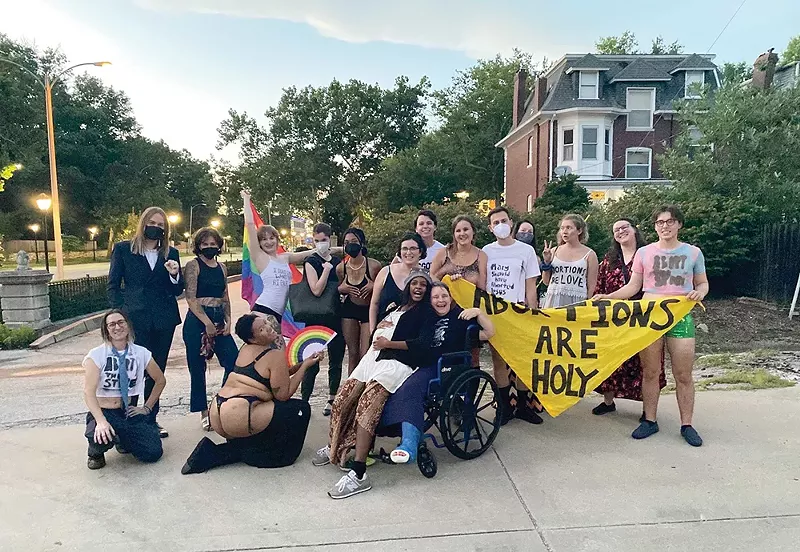
    After protesting an anti-abortion group, Resist STL gathered for a group photo.

    Last week, attendees of Coalition Life’s annual benefit dinner got more than they bargained for when the evening’s programming was interrupted by a group of protesters, who took the stage and the mic in a booty-shorted, twerktacular display of pro-choice resistance to the group’s anti-abortion agenda.

    The benefit dinner and decisively disruptive spectacle each took place in an event space in Terminal 1 at Lambert Airport last Wednesday night and were the result of a considerable amount of planning on both sides.

    For the pro-life group, which organizes and helps fund the people who hang out around abortion clinics and bother the women walking inside, there were tables to set up and centerpieces to be made, logistics to consider, and all the usual work that goes into hosting a fundraising event drawing between 600 and 800 people. For the protesters, who operate under the banner of Resist STL, there was a lot of that exact same work — because members of this group had fully infiltrated the other, working as event volunteers before making their actual intentions known loudly and proudly via an onstage dance party during a speech by a former abortion doctor.

    The subterfuge had two primary effects. For one, it helped the protesters make their plans, as they were able to see the event space and learn about the evening’s programming in the lead-up to the big night. They also found themselves helping to assign seating, which meant, most notably, they were able to position protesters at tables near the stage in order to ensure their plans would go off without a hitch.

    Secondly, and perhaps most importantly to members of Resist STL, the fact that some of the evening’s volunteers were actually protesters was meant to have a destabilizing effect on the anti-abortion group members, who would then not know whom they could trust within their own ranks.

    “And that worked really well,” says Emily Ehley, one of the protest organizers and a member of Resist STL. “At some point, they just kicked out all of their volunteers because they weren’t really sure how to know who was real and who wasn’t. So that also helped to destabilize their efforts, because then they just didn’t have any of those volunteers to help them [for] the rest of the event or breaking it down or anything like that. So it was really nice.”


    Two days before the fundraiser, a group of 18 protesters gathered in the backyard of a south-city home to put the finishing touches on their plans. It was a cool summer night, with the rain just barely holding at bay, and one of the attendees brought vegan tacos for the group to enjoy.

    After sorting through some of the logistics, the group turned to the role-play portion of the night’s proceedings, in which the protesters practiced the disruptions they’d be taking part in at the event. The plan was for there to be multiple protests at staggered intervals, with the onstage dance party being the capstone for the night. In keeping, participants were encouraged to practice the disapproving patter they’d say after others were booted from the building, in order to maintain their cover.

    “How are they ever going to get a 401k?” laughed one in a mocking tone. “How uncivilized.”

    A long-handled dustpan served as a makeshift microphone stand, where one protester stood and played the part of one of the event’s speakers. “Blah blah blah, sacred babies,” he said to the assembled crowd. “Blah blah blah, something about crosses. Blah blah blah blah, give us money.”

    Suddenly, the rousing speech was interrupted. There were sirens, whistles, a banner that read “God bless abortion,” and balloons to be used as pregnant bellies, which would then be popped to the shock and horror of the attendees. Some protesters disrobed. There were a few different chants at play, and some discussion as to which would be easiest for a crowd to make out. “Pro-life is a lie, you don’t care if people die,” was one. “Fuck the church, fuck the state, you can’t make us procreate,” was another. Eventually, the commotion was brought to an end by people role-playing as security. The still-incognito protesters who remained in their seats dutifully cheered for the authorities and booed the troublemakers.

    “Can I get another round of applause for the police?” the protester at the dustpan said into his makeshift mic. “As we all know, Jesus was once a cop.”


    Coalition Life’s theme for its benefit dinner this year was airports, in keeping with its location. The programs were made to look like passports, the centerpieces had airplanes on them, and the food was essentially inedible.

    “Destination Life,” as it was dubbed, featured a few speakers, and tickets ranged from free to $10,000 for two tables — assuredly the most anyone has ever paid for the privilege of eating warmed-over chicken out of a steam tray. For just 10 bucks, you could buy a cape with the words “Pro-life superhero” screenprinted on it.

    Seated at a table near the stage were three protesters and five pro-lifers, as well as two reporters. Kay, an older lady wearing a black and white dress with a sweater draped over her shoulders, was there with her husband, Cliff, who had a head full of gray hair and a blue suit jacket pulled on over a striped shirt with a pen in the pocket. Staying with the airport theme, the two discussed how the Lufthansa airline had canceled nearly all of its flights that week due to a strike among its workers.

    “It’s a different society now,” Kay lamented. “I worked two jobs to put my kid through school. It’s amazing they don’t just go to work.”

    Following a prayer, Coalition Life Executive Director and Founder Brian Westbrook kicked off the proceedings with a quote from the Good Book.

    “‘Any idiot can cut costs, but you can’t always build sales, and that’s what I’m doing.’ – Tom Monaghan, Domino’s Pizza,” Westbrook said to the assembled crowd. “Tom Monaghan, he wrote in his book, Pizza Tiger, he explains how he repeatedly pushed the limits of his company, his team and especially his finances. Tonight, our guarantee is that we will be stretching, much like Tom Monaghan and Domino’s Pizza, and instead of just building sales, we will be stretching to save absolutely every life possible, maximizing on every single dollar we can.”

    With the crowd fully warmed up, the night’s speakers took the stage. There was a woman named Lauren Kammerer who spoke about the years that she’s worked as a “sidewalk counselor,” the group’s term for the people who hang around outside of Planned Parenthood and bother people. There was video of a woman who had been bothered into not having an abortion by one of those folks, in which she talked about how glad she was to have had her baby. Next up was keynote speaker Dr. Anthony Levatino, a former abortion doctor, who brought some clamps as a prop and spoke in graphic detail about the abortions he performed 40 years ago, before he changed his ways.

    But meanwhile, elsewhere in the building, the protesters had begun their disruptions. Two erstwhile volunteers stepped into a bathroom and changed into crop tops — out of place at the church-formal event — and re-emerged with literature about reproductive justice, which they began passing out to people in attendance along with condoms and lube. Security soon caught on, and they were escorted out.

    Following that, Coalition Life staffers asked all of the volunteers to leave, since they couldn’t be sure who was a plant.

    “After that happened, the staff really started to crack down,” Ehley explains. “They were walking around, eyeing everyone. They were really, really nervous about potentially having been infiltrated.”

    They surely had been, but sending their volunteers packing didn’t solve the problem. Midway through Levatino’s speech, a group of protesters rushed the stage in various states of undress, some twerking in booty shorts, some holding a banner that read “Abortion is holy,” all of them shouting the chants they’d practiced. One wore a shirt with the slogan “Faggots Against Fascism” emblazoned across it, and all of them openly identified as queer. Since the police were still distracted with the first group of disrupters, it took a good while for any type of official security to get to the commotion, so when one protester grabbed the mic and started reciting the “pro-life is a lie” chant, it was regular staffers that started grabbing and pushing them off the stage. One attendee saw fit to throw a fruit cup at the group.

    Two of the protesters on the stage came from the table Kay and Cliff were sitting at, and a third stood up and filmed the action without breaking cover. Her video shows the cops escorting the group out and ultimately putting some protesters in handcuffs before a middle-aged woman in a red flower dress approached and told the officers that Coalition Life didn’t want to press charges or see anybody get arrested. With that, the officers took down some names and sent everybody on their way.

    The kicker? The woman in the red flower dress was also with the protesters, deep undercover.


    Resist STL protesters stormed the stage at a Coalition Life fundraiser. - VIA RESIST STL

    VIA RESIST STL

    Resist STL protesters stormed the stage at a Coalition Life fundraiser.

    The mood at the table was tense after the disruption, with Kay seemingly in disbelief at what she saw.

    “I think that was part of the programming,” she mused, “to show what we’re up against.” Meanwhile, police and staff hovered nearby for the rest of the night, suspicious of everyone in the area where the troublemakers had been seated.

    At the end of the event, Westbrook again took the stage to shake everyone down for money — it was the whole reason people were there, after all. He helpfully explained that if you donated $71,500 you could get a $50,000 tax credit before asking everyone to pray to God for a dollar amount they should give. That money would be used to bring Coalition Life’s mission to as many blue states, where abortion is likely to remain legal, as possible —– in addition to St. Louis, Coalition Life operates in Fairview Heights, Illinois, and a suburb outside Chicago.

    Westbrook then gravely implied that giving generously was the only sure way to avoid bloodshed in the streets.

    “We cannot do this work without you,” he intoned. “This is critically important. And we are at a crossroads in our country like never before. I do not want to solve this abortion issue, like slavery, with bitter civil war.”

    The talk of armed conflict is not idle chatter. Keith Rose, one of the protesters, says he’s heard it mentioned repeatedly from those in the anti-abortion movement in recent weeks. Moreover, it’s a possibility that some on his side of the issue are preparing for as well.

    “I was having a deep conversation with someone like two weeks ago who was passing through town,” Rose says. “And he was like, ‘Yeah, I’m just kind of going from area to area teaching people survival skills. We’re going to need these hard skills, because we’re looking at like an eight-year trajectory for, you know, collapse.’ Basically, he was like, ‘I think there’s gonna be some kind of urban-versus-suburban or urban-versus-rural civil war skirmishes within about eight years from now.’ I don’t feel that way, but that’s a whole damn thing.”


    In the meantime, though, it’s going to be up to activists and organizers to take up the fight. For this group, the efforts at Coalition Life’s event are just the continuation of a long and ongoing battle.

    “We cannot fight them in the courts anymore,” Rose says. “They’ve made that impossible. We can’t really fight them in the legislature, at least here in Missouri, anymore — they’ve made that impossible, even though we are a majority of the national population. So we’re going to be fighting them in a more guerilla style. That’s what they’ve done. They’ve forced us to have to use asymmetrical tactics like infiltration, because they’re not willing to play fair.”

    After the members of Resist STL left the airport, their mission completed, they met up for a group photo that they intend to make into a postcard to send to the people in charge of Coalition Life. As one of them put it, their mom had taught them to always send people a thank-you note after an event. After all, just because it’s a fight doesn’t mean it can’t be fun.

    In fact, for Ehley, a key element of the protest was its joyful, dance-party vibe.

    “We spent quite a bit of time planning this,” she says. “It was really important to us to create an atmosphere of joy and celebration, and to show them: You don’t control us, you don’t control our bodies. You don’t get to say how we live, how we should be. And we are going to be our full selves here in this space, and we are going to try to stop you from consolidating power, consolidating money and doing the work that you’re doing.”

    Ehley hopes that some in the crowd who might have been on the fence or in some way were coerced into attendance saw the freedom and happiness inherent in the disruption and that there’s another way to live.

    “It’s OK to be yourself,” she says. “It’s OK to be loud and queer and take up space and make your own decisions for your body. These people don’t have to speak for you.”

  • Mysterious Suicides and Missing Persons Rattle Southern Missouri Town

    Mysterious Suicides and Missing Persons Rattle Southern Missouri Town

    RYAN KRULL

    Since the beginning of March, Barbara Hall has been looking for her son Timmy Dees.

    Barbara Hall had already had the year from hell when her 26-year-old son Timmy Dees went missing in February.

    Dees had grown up in southeast Missouri, not far from Fredericktown, a city of 4,000, about 90 minutes south of St. Louis. But when he turned 18, he wanted to work and found few opportunities. He moved to the St. Louis suburb of Creve Coeur, where over the course of eight years he became a rigger, setting up stages for concerts. Music was his passion, and after becoming part of the stagehands’ union, it looked like he would be able to make a living working in live-event production. He was about to buy a house, intent on becoming a family man. He didn’t have a girlfriend, but that would work itself out.

    On June 19, 2021, Dees’ older brother Michael died of an overdose. He’d long battled mental-health issues and addiction. The whole family grieved. Dees got a tattoo of a pizza roll and ranch-dressing bottle on his calf, a tribute to his brother’s favorite food. He said that if he ever had a son, he’d name him Michael.

    “Timmy was very upset, stayed upset,” Hall says. “He told me he wished he’d stepped in and done more to help his brother, but there was nothing he could have done.”

    In February of this year, one of Dees’ friends from Fredericktown offered to pick him up and take him back to his old stomping grounds for the weekend. Dees was eager for the change in scenery. He mentioned the planned trip to Hall during one of their almost-daily phone calls.

    On Friday, February 25, Dees and his friend drove down to Fredericktown.

    When Dees didn’t call Hall over the weekend, she took note but didn’t worry. He was out with friends. She understood. She began getting nervous on Monday when she still didn’t hear from him.

    Hall called her son’s phone but couldn’t leave a message because Dees hadn’t set up his voicemail. That was nothing new. But suddenly, her text messages weren’t going through either.

    By Tuesday, Hall felt physically sick.

    “Something felt bad. Something felt wrong,” she says. On Wednesday, March 2, she reported her son missing.

    The information about her son’s weekend in the Fredericktown area is hazy, and even two months later, Hall doesn’t fully know what happened.

    A few days after she reported her son missing, she got a call from the friend who had taken Dees to Fredericktown. He had been arrested on a warrant unrelated to Dees’ disappearance. He called her over the jail’s video-conferencing system, and Hall recorded the call.

    In the video, his hair is long and unkempt, his face stubbled.

    “I’m going to do everything I can to look for him,” he said. “I’m worried, Barb. I love you. I love him. I don’t want you to think I’d do anything to hurt him.”

    The call had been made in the early days after Dees’ disappearance, Hall says, when she still held out hope he might be found alive.

    “Why would he say he’d never hurt him?” Hall asks. “What did he mean by that?”


    Surveillance video along with police and phone records paint a partial picture of the hours leading up to Dees’ disappearance.

    Around 1 a.m. on the morning of Monday, February 28, Dees was seen on security-camera footage at a gas station in Fredericktown.

    Dees withdrew $160 out of the gas station’s ATM at 1:30 a.m. and played the video slot machines.

    Fredericktown Police Chief Eric Hovis confirmed the surveillance video, saying that Dees was positively identified on it and that he looked “happy, healthy and alive.”

    About three hours later, at 4:40 a.m., someone made a 911 call from Dees’ phone. The call went to Madison County Sheriff’s Department dispatch but was not recorded. According to the dispatcher, a frantic voice on the other end said, “Someone is chasing me.” Since the call wasn’t recorded, no one knows for sure if the voice belonged to Dees or if someone else was calling from his phone.


    Fredericktown is blanketed with missing person posters for Hall's son. - RYAN KRULL

    RYAN KRULL

    Fredericktown is blanketed with missing person posters for Hall’s son.

    “Back in December, our 911 recorder went down,” dispatcher Kyle Rogers says. “And it took us about four months to get a new one replaced. I ordered it in January. It got installed in the middle of March.”

    After the call, Hall says deputies with the sheriff’s department responded to a house on Village Creek Road in Madison County, north of Fredericktown.

    There, the deputies arrested the friend Dees had traveled to Fredericktown with on an outstanding warrant. Others present at the scene said that Dees had been there earlier in the night but had already taken off.

    “And now it’s like he’s vanished,” Hall says.

    Within a few days, Hall was down in Madison County searching for her son for herself. She’s basically never left.


    The three-story red-brick Madison County Courthouse sits in the heart of Fredericktown. An impressive bell tower rises one story above the rest of the structure, making the courthouse easy to mistake for a church from a distance. It’s encircled by a roundabout where Fredericktown’s East, West, North and South Main streets all converge. These days, it’s impossible to walk more than a few feet on any of the four streets and not see a photo of Timmy Dees. His mother has blanketed the town with them.

    On a sunny April afternoon, Hall arrives and begins her usual routine: Using bungee cords, she attaches large posters of her son to the light poles dotting the roundabout. “Help Bring Me Home,” the posters read. Hall and her boyfriend, Jimmy Moyers, retrieve two camping chairs from the back of their car and set them out in the grass in front of the courthouse. They sit for the rest of the day passing out fliers advertising a $10,000 reward to anyone who can help find Dees. Hall has been at the courthouse every day for the past six weeks, except Sundays and days when it rains.

    For the most part, everyone in town already has a flier. Almost every business has one in its front window.

    A week prior, Hall went to around 20 houses in the area near where her son was last reported to be and got those homeowners to sign documents giving volunteers permission to search their properties. She organized a search, followed by another with trained dogs. Her effort to close her son’s case is nothing short of heroic.

    “I’m not going away,” she says. “I can tell you that. I don’t believe my son’s alive anymore, and he’s all I had left. At this point, what are they going to do, kill me? That would be putting me out of my misery because getting up every day living this stuff is a nightmare.”

    Her presence is simultaneously a vigil and a protest.

    A vigil because, after 10 weeks, Hall has conceded the grim reality of her situation. “I carried each of my sons for nine months,” she says. “But I lost them both in eight.”

    A protest because Hall feels law enforcement in general, and Madison County Sheriff Katy McCutcheon in particular, have dragged their feet on the investigation.

    “I couldn’t get that Madison County sheriff to do anything for me,” Hall says. She points to the sheriff’s patrol SUV, parked by the courthouse. “She just pulled up and walked inside and didn’t even look in my direction.”

    McCutcheon calls the lack of closure on the Dees case a “black eye” for her department, but she is adamant that “every lead that came through, we’ve addressed it as far as we can. We’re working with the [Missouri State] Highway Patrol on the investigation.”


    Sheriff Katy McCutcheon. - COURTESY DAILY JOURNAL

    COURTESY DAILY JOURNAL

    Sheriff Katy McCutcheon.

    In the past 10 weeks, the Dees case has received some media coverage, including a segment on KMOV.

    But Dees has become a bona fide cause célèbre among a dedicated group of vloggers and others online.

    “The police are doing nothing. There’s a whole bunch of cover-ups in that town,” one vlogger said in a video covering the Dees case.

    McCutcheon says that the interest has turned into an avalanche of “threats and harassment” directed towards her and her deputies online. In October, the department deleted its Facebook page.

    “I’m hiding absolutely nothing. We’re not covering up anything. All the Facebook warriors are getting on Facebook, saying how we’ve got all these suspicious deaths in the county. Yes, people come here, they shoot themselves, they die. I can tell you that every death we have, if it is somewhat suspicious, we call the highway patrol. They have more experience. They have more education. They deal with murders every day. We deal with a murder every three or four or five or six years.”

    The anger against the sheriff’s office isn’t just online.

    As Hall puts it: “People pull over all the time when they take a flier from me, and they say, ‘Man, I hope you find out something. This whole town is corrupt. We hope we get some answers and something changes in this town.’”

    McCutcheon isn’t the only person in Fredericktown people want answers from. There’s also James Wade.


    There’s a house along Highway Z just outside Fredericktown that is fairly isolated, partially surrounded by trees. It once belonged to James Wade, a middle-aged man with gray eyes and a salt-and-pepper goatee. While he owned it, two young men died there.

    On the morning of Halloween in 2014, Wade walked into the Madison County Sheriff’s Department. (This was before McCutcheon’s tenure as sheriff.) According to police reports, “Wade was pacing around waving his arms about. He moved in a jerky motion moving his head about his eyes wide open. He stated he wanted to report a missing person.” Wade said that 20-year-old Nick Lowrey — who was involved with one of Wade’s daughters, Brooklynn — had gone missing. A deputy gave Wade paperwork that Wade took home but didn’t fill out and never returned.

    Later in the day, Brooklynn Evans came into the sheriff’s office and said that Lowrey “said he couldn’t take it anymore. He had a gun that his grandfather had left to him, and he had only one bullet for the gun. The gun had no clip. Nick said he was going to kill himself. He took the gun and walked into the woods.”

    The next day, Lowrey’s body was found in the woods on Wade’s property with a gunshot wound to the head. The coroner ruled the death a suicide.

    The police report about Lowrey’s death states that Lowrey’s father, Matt, came to the Madison County Sheriff’s Department and spoke with deputies about the investigation. The report says Matt “stated that he has been informed by Nicholas [Lowrey’s] half-brother Brian in the past that James Wade has made threatening statements toward his son, Nicholas Lowrey.”

    However, upon further questioning of Wade, and after the coroner’s ruling, deputies found no cause to further the investigation.

    Lowrey’s death wasn’t talked about outside the area at the time, but it took on new significance in the wake of what happened on the property 6 1/2 years later.


    Derontae Martin at his high school football field. - COURTESY ERICKA LOTTS

    COURTESY ERICKA LOTTS

    Derontae Martin at his high school football field.

    Derontae Martin was a defensive lineman for Park Hills Central High School in the Fredericktown area. The school mascot is the Rebel, a mustachioed white man in a red outfit — a romanticized depiction of someone who fought for the revisionist Lost Cause. After graduating, Martin’s SAT scores weren’t high enough to go to college, so he got a job at a restaurant, but lost it during the pandemic. But things were looking up when his family moved to Ferguson, where Martin got his own room for the first time. His mom used her stimulus check to buy him some new clothes. A few weeks later, on April 23, 2021, a friend from his high school picked him up to take him to a party back in Madison County. It was an 18th birthday party for Lani Wade, James Wade’s daughter.

    Martin’s mother, Ericka Lotts, tells the RFT that on Saturday, April 24, her son arrived at the house of 47-year-old James Wade for the party.

    Martin was Black, and Wade is known for displaying a large Confederate flag and posting extremely racist content on social media. A photo of a Black man in shackles superimposed with the text “My great great great grandfather’s tractor” was a typical post of his. A 2020 Black Lives Matter protest in Madison County, which is 94 percent white, was met with a large, hostile counter-protest and, as one business owner put it, a “huge militia with an AR15 every half a block.”

    In the early hours of Sunday morning, Madison County received a 911 call from a surprisingly calm Wade saying that someone at his home was dead and that, no, he didn’t need to perform CPR. During the call, a woman in the background shouts, “I hate this.” The victim is 19-year-old Martin, who died by a gunshot wound to the head in Wade’s attic.

    Witnesses at the party told police that Martin, who had methamphetamine in his system according to a toxicology report, was acting paranoid. A 31-year-old partygoer gave Martin a gun. According to a police report, when the man was asked why he gave Martin the gun he said because “Derontae was feeling uncomfortable, so [I] gave him his gun to make him feel more comfortable.”

    Martin’s initial autopsy ruled his death a suicide, but Martin’s family requested a second examination be done by a private doctor. The second autopsy determined the gunshot to have been fired from too far away to have been self-inflicted and that Martin died “by violence.”

    The initial autopsy done on Martin was thrown into further question when it was revealed that the same medical examiner who had performed it also performed the autopsy on MiKayla Jones, an 18 year old who had just finished high school and died with meth in her system. The medical examiner ruled it a suicide despite Jones having no history of drug use or depression.

    Martin’s death made international news. His case and Dees’ are vastly different in their particulars, but their broad outlines have a haunting resonance with each other.

    In both, young men had roots in the Fredericktown area, but their families moved to the suburbs of St. Louis for better opportunities. Both young men returned to hang out and have a good time with friends and were met with horrible fates. In both cases, the stories would have likely received little to no attention if not for extraordinary efforts on the part of the bereft mothers.

    Dees. Martin. Lowrey. Jones. “Something is going on in Madison County” is a common refrain in Facebook post after Facebook post, vlog after vlog.

    Over the summer, a coroner’s inquest was held, and a six-person jury determined that Martin’s death was not a suicide. Despite this, no charges were filed against Wade or anyone at the party.

    “They’re horrible,” Lotts says about the Madison County Sheriff’s Department handling of her son’s death. “They’re not investigating. They refuse to investigate because they told me they know it was suicide because they looked at the pictures. And they’re not changing their ruling, regardless of the jury in the coroner’s inquest.”

    Many people online calling for “justice for Derontae” are, like Timmy Dees’ mother, placing the blame for the unsolved crime on the sheriff.


    Madison County Sheriff Katy McCutcheon, 42, is tall with brown curly hair. Despite the intense criticism, she is now serving her second term in office.

    McCutcheon won her first election in 2016, running as a Democrat in a county carried easily by Donald Trump. She won reelection in 2020 with only a slightly smaller margin of victory than Trump, who took 80 percent of the Madison County vote. Despite this seeming popularity, many in town say she has not done a good job.

    “We could have a better sheriff,” says Bob McMillian, co-owner of Main Street Memories, a second-hand antique shop a few blocks away from the sheriff’s office. (McMillian says he is also McCutcheon’s cousin.) “We’ve been broke-in six times. And we’re right across from the police station. Crime is horrible here. The thieving.”

    “She’s a really good person, probably just lenient with things,” he adds.

    Another longtime resident of the Fredericktown area, who asked to only be referred to as Lana, says that law enforcement in the area in general is too hands off when it comes to drugs. The sheriff, Lana says, is of the mind that the “dopers would take care of themselves.”

    “That’s the problem,” Lana adds. “They are taking care of themselves. They’re dropping like flies. And they’re not flies. They’re people.”

    McCutcheon, she says she’s truly troubled by the Dees case and she feels for his family. She’s also frustrated with how, no matter what her department says, it gets “eaten alive” by critics.

    She’s also very worried about being smeared by the media, citing specifically a KSDK segment about one of her deputies who lost a burglary victim’s masonic ring that had been entered into evidence.

    The department offered to compensate the man for the lost item, but he said that wasn’t necessary. McCutcheon’s office thought that was the end of the ordeal until a reporter came to Fredericktown and seemed to accuse McCutcheon’s department of theft.

    “See where my frustration is coming from?” she asks. “I can tell you the sun is bright today with a few clouds and reporters will smear it around to where I said it was dark green and black, and it’s raining.”

    McCutcheon says she’s talked to Hall several times; Hall insists they’ve never spoken. “She’s, called, she’s asked questions. I’ve answered her questions,” McCutcheon says. “But she still blasts me on Facebook. Why would I want to go talk to somebody if I’ve talked to her a couple times, and I’m still getting blasted?”


    However, McCutcheon’s critics found validation when, in April of this year, James Wade moved from several miles outside Fredericktown city limits into the city. Now subject to a new jurisdiction, it didn’t take him long to get arrested.

    “He only lived here for like a week, and look what we just did,” says Fredericktown Chief of Police Eric Hovis, referring to his department’s arrest of Wade.

    In the early hours of Thursday, April 14, Wade said he believed his daughters were with Jacob Graham or Graham’s brother, and in danger. Wade left his house and drove to where he believed his daughters to be. While driving, he encountered Graham and another man in a car on North Mine LaMotte Avenue.

    Wade said he pulled up behind the two men to talk. They didn’t stop, so Wade “rammed them off the road.”

    According to a probable-cause statement, Wade says Graham then opened fire on Wade’s truck. Wade tried to escape but backed up into a tree.

    He then ran to the Madison County Sheriff’s Office, an interesting choice, on foot.

    Graham and the other man in the car also gave statements to police. They said they were driving to Wade’s ex-wife’s house to borrow an extension cord for a space heater when Wade “out of nowhere” was in his truck behind them on the road. He pulled in front of them, blocking them. Graham then opened fire.

    A bullet grazed Wade’s forehead, above his right eye.

    He and Graham were arrested by the Fredericktown police and charged with assault — and are being held on $100,000 bond.

    Those advocating for justice for Derontae Martin cheered Wade’s arrest online, even though it was unrelated to the case.

    “Most of the town’s happy he’s behind bars,” one Fredericktown business owner says about Wade.

    “The whole Derontae Martin thing is still an open case; the FBI has got it,” notes dispatcher Kyle Rogers. “They’re the ones that are working it.”


    The Martin case is often mentioned in Facebook posts along with Dees, Lowrey and MiKayla Jones. Those four cases are often connected to the case of John Paul “J.P.” Parton, a 19-year-old who went missing in May of last year. J.P.’s sister Angelique says that her brother, who’d been staying in Cape Girardeau, is technically listed as missing from Jefferson County but had previously lived around Fredericktown and may have actually gone missing from Madison County.

    “I know that my brother knew Derontae, and they knew mutual people,” she says.

    A lot of people are adamant that something is going on in or around Madison County. But it’s not entirely clear what.

    Lana, the longtime Madison County resident, doesn’t claim to know exactly what’s going on, though she’s pretty sure whatever it is has to do with a new type of meth.

    Lana says that today, meth is a whole different animal than what she used for decades while still managing to function and hold down a job.

    “Now they’re using what they call ice,” she says. “It’s like a fungus grown in a cooler. One of the ingredients is glue. It’s making people crazy, like instantly crazy.”

    Martin had meth in his system and had almost certainly been around people who were using it the night he died. The friend who drove Dees down to Fredericktown has a host of drug charges. People in Fredericktown said that the frantic 911 call from Dees’ phone was made from a known drug house.

    McMillian and another store owner, Jim Fox, both say the meth problem has gotten much worse in the last few years.

    In one of the robberies in which McMillian was a victim, he says burglars stole $5,000 worth of tools from a storage shed.

    “They probably sold it all for a few hundred bucks,” he says.

    Fox, owner of Tom’s Western Wear a few blocks from the courthouse, says that his business has been robbed multiple times, too. He’s certain drugs played a role. “That’s pretty much what we’re known for,” he says, more than a little resignation in his voice.

    Another source says that meth has always caused psychosis, but previously that only came after prolonged use. Now, today’s meth can cause users to lose their mind the very first time they ingest it.

    “I look at people, and they’re not the same people,” Lana says. “I’ve seen a girl walking around on the street saying, ‘I don’t know where I’m at.’ Another girl, a beautiful girl … thought she could punch a code into her arm, like a computer.”

    When asked why so many kids are using meth even after seeing friends lose their minds on it, she says, “Their parents did it. They don’t understand that it’s different. There’s nothing to do down here so people experiment with things.”


    Through a private detective, Hall learned that there were two other men in addition to  Dees and his friend at the house on Village Creek Drive where someone called 911 from Dees’ phone. One of those men has a long criminal record, including charges for manufacturing meth.

    After getting this information, Hall organized a fourth search with volunteers on horseback, so they could cover more ground. Again, nothing turned up.

    Hall keeps up her protest/vigil outside the courthouse. She’s temporarily moved in with a friend who lives closer to the area, so she doesn’t have to commute all the way from St. Louis. One day in early May, she got sunburned and had to take the next couple days off. Afterward, a local woman she didn’t know dropped

  • The Internet Accused Her Of Murder. Now, Elizabeth Cooke Tells Her Story

    The Internet Accused Her Of Murder. Now, Elizabeth Cooke Tells Her Story

    Ryan Krull

    Elizabeth Cooke

    Around 10 p.m. on August 4, 2021, a St. Louis man named Jeff cracked open his bedroom window to smoke a joint. Looking outside onto his street in Marine Villa, he noticed his Jeep’s brake lights glowing in the dark.

    Someone was in his car.

    He hustled outside, filming on his phone. The Jeep’s driver-side door was open and the woman standing next to it wore a guilty look. A black mask covered her nose and mouth, and a ball cap sat backwards atop her head. Her eyes went wide with surprise.

    “What the fuck?” said Jeff.

    “My friend sent me over here and told me that I could use his car because my car broke down,” said the woman. “I’m so sorry, is this not my car?”

    Incredulous, Jeff looked down to see that a screwdriver, hammer and other tools he had stored in his Jeep were strewn about on the ground. “What is all this?”

    “These were all in here,” the woman replied.

    “Yeah, in my fucking car.”

    She walked around to the passenger side door, before beginning to open it. “My purse is in there,” she explained.

    “I don’t give a fuck!” Jeff erupted.

    After a brief confrontation that nearly turned physical, he let her have her purse, and she walked off into the night, muttering about how everything was a misunderstanding.

    Jeff went through the car to see if anything had been stolen. He found a bag with three orange pill bottles, including anti-anxiety medication. They were prescribed to someone named William Overturf.

    Jeff called the number beneath Overturf’s name. He told him the situation, and threatened to notify law enforcement. Overturf said he had just gotten out of prison and didn’t want anything to do with whatever was going on.

    “Anything that’s in there that’s mine you can have,” said Overturf, according to Jeff.

    Jeff asked him for the identity of the woman who tried to steal his car. Overturf said her name was Elizabeth Cooke.

    Thus began the saga of Elizabeth Cooke, which was in fact the woman’s real name. William Overturf is her real-life fiancé.

    Jeff, however, is not the real name of the man who caught Cooke in the act. He agreed to speak with the Riverfront Times only on the condition that we give him a pseudonym.

    In the coming months, the aftermath of this alleged attempted carjacking would turn Cooke’s life upside down, putting thousands of true-crime obsessives and would-be gumshoes on her tail, and propelling her from an impoverished petty criminal into a tabloid-style celebrity.

    It all happened because, when she left the scene, she forgot her smartphone.

    Jeff got the passcode from Overturf, the former said, and quickly accessed the phone’s contents. He couldn’t believe what he found. Beyond lurid messages relating to drugs and sex, it appeared to show evidence of a massive, St. Louis-based criminal ring.

    And so Jeff decided to seek vigilante justice. Over the next week and a half, he posted tons of content from 35-year-old Cooke’s phone onto the internet.


    The Internet Accused Her Of Murder. Now, Elizabeth Cooke Tells Her Story (4)

    Hacking into Cooke’s Facebook account, Jeff posted the video he took of her trying to steal his car. Then he changed her account’s name to “Elizabeth Cooke (Car Thief).”

    Her new account description? “I steal cars.”

    He discovered messages on her phone relating to other stolen automobiles and began posting them on Nextdoor. He wanted to help those whose cars had been stolen get them back, he said.

    On Facebook, Jeff also posted one of Cooke’s private conversations with a meth dealer, one with a guy who seemed to fence stolen electronics, and one about a plan to break into storage lockers. Jeff further uploaded what appeared to be her web-browsing history, which included a video titled “How to hotwire a car quickly and easily!”

    Cooke’s Facebook friends numbered about 1,500 at that point, Jeff said. They began sharing her page, and it went viral.

    “So I started posting more and more,” Jeff says. (He notes that he didn’t post everything, however, and set photos of her young son to private.)

    After going through Cooke’s now-public messages, one woman recognized her husband’s missing Cadillac. “That’s my volvo!!” another woman posted, adding: “I called the cops immediately and the car came back FULL of cheap women’s flip flops!”

    Cooke’s actual friends had no idea what was going on. “Liz…What are you doing???!!!” one posted. “I cannot believe this is you! It’s very sad and I really hope you get your life together!”

    Jeff recorded Cooke’s screen as he scrolled through her archived messages. He posted the videos to YouTube, creating about two hours of content for anyone wanting an even deeper dive.

    Tens of thousands of people across the internet began tuning in, enthralled by this ultimate doxxing. At a time when St. Louis car robberies were rising — in 2021, some areas saw catalytic converter theft rise 300% — city residents cheered him on.


    Jeff - Ryan Krull

    Ryan Krull

    Jeff

    “Keep it up,” someone wrote to Jeff on Cooke’s Facebook page. “You’re a fucking hero.”

    People began posting Cooke-themed memes. There was Cooke stealing all of the copper from a construction site, and Cooke holding hands with Kid Rock. Someone made a mock movie poster of her in Ocean’s Eleven, and another of an imaginary film called House of a Thousand Key Fobs.

    Others in Cooke’s circle began gaining fame and infamy as well, including a friend who called herself “Gypsy Jen” and another dubbed the “Meth Magician.” The latter was given this sobriquet after followers of Cooke’s story uncovered his TikTok account, in which he performed magic tricks. (The “Meth” part came from his frequent references to “zips,” “ounces,” and “re-ups” in leaked text messages.)

    Around August 9, Cooke finally got wind of what was happening. “They’re posting everything,” someone texted her, on a different phone. “All your drug deals and all that shit.”

    “That was my personal life,” Cooke later tells me, angrily. “The whole world knows who I am.”

    And so Cooke decided she needed to get out of St. Louis. On August 10, she took off in a stolen car to see her fiancé Overturf, who was staying with his mother in western Illinois.

    But she never made it. When she pulled off Interstate 55, the car broke down. Someone called the police on the “suspicious vehicle” and Cooke was arrested — and charged with possession of a stolen vehicle, possession of methamphetamine and possession of burglary tools.

    But Cooke’s problems were just beginning. While all of this was happening, a growing cadre of internet detectives had come to the conclusion that she was guilty of a much more serious crime: murder.


    Elizabeth Cooke grew up in the Patch neighborhood in south St. Louis, as well as parts of St. Francois and Franklin counties in rural Missouri.

    “I consider myself half from the city, half from the country,” she says. “My family doesn’t do drugs. They don’t get in trouble. They work. They take care of their kids.”

    She describes herself as the black sheep, a troublemaker out of step with her more straight-laced family members. (Considering her affinity for tie-dye, however, she prefers “rainbow sheep.”)

    Information about Cooke’s young adult life is hard to come by, but by 2017 she was spending significant time at regional music festivals. At the Astral Valley Art Park, an  Ozarks events space with psychedelic art displays, she met a friend named Abby, who asked the Riverfront Times not to print her last name.

    According to Abby, she and Cooke shared dark pasts, having each experienced abuse and addiction. Their troubled backgrounds helped them bond immediately.

    “Elizabeth offered me a place to stay rent free till I could find a job,” Abby said, adding that Cooke also offered to host her daughter. She added that Cooke often spoke about opening a crisis center and safe house, to help women start over.

    Without Cooke, she “would have ended up … either dead because of an OD or worse,” Abby says. “This girl can be so charming, so uplifting. She shines when people need her.”

    This description stands in stark contrast to the persona portrayed on Cooke’s hacked Facebook page. Indeed, in the years following her music festival job, Cooke’s life began coming apart. A friend named Leslie Stevenson said Cooke eked out an existence dumpster diving, doing what she could to turn other people’s trash into a living.

    Tony Callesis, the manager of the Storage of America facility in Dutchtown where Cooke stashed many of her dumpster finds, said he once looked out the back window of his south-city apartment to see Cooke putting on goggles and a helmet with a light affixed to it — like a coal miner. She proceeded to throw herself into his alley’s dumpster, and then closed the lid.


    According to Cooke, in May 2020, she began staying at the St. Louis Eco Village, a north-city hippie-style commune that also serves as a nonprofit providing unhoused people with access to showers, meals and other essentials. Eco Village also operates an Airbnb to help fund their work.


    Yvonne "Jazz" Berry - Theo Welling

    Theo Welling

    Yvonne “Jazz” Berry

    According to Yvonne “Jazz” Berry, who runs the Eco Village, Cooke rented the Airbnb for three weeks in November 2020, but afterwards refused to leave, citing squatter’s rights. (To the Riverfront Times, Cooke denied this, saying she moved in months before that, never mentioned squatter’s rights and that in lieu of rent she donated items she’d salvaged from dumpsters.)

    According to Berry, around Christmas that year a 62-year-old man named Bobby Phillips arrived at Eco Village, along with another man. They had both recently gotten out of prison, and participated in the nonprofit’s food share and used the shower.

    “It’s the middle of winter,” Berry recalls telling them. “Yeah, you guys can crash on the couch.”

    Cooke says she met Phillips when her friends brought him along dumpster diving. Another night, she came back to Eco Village and found him sitting alone in a cold, dark room. She gave him blankets and food.

    The pair began to bond; he appears to have tried to impress the younger woman by claiming money was coming his way. Cooke says that, around Christmas, Phillips told her he was going to include her in his will.

    “[H]e made me … executor of estates and power of attorney,” Cooke wrote, in a leaked message. “He left me a lawsuit worth $1.7 million it just hasn’t settled yet.”

    On January 1, 2021, Phillips died from cardiovascular disease exacerbated by methamphetamine, according to the St. Louis City Medical Examiner.

    Cooke’s involvement, if any, was not immediately clear. Later that day, Cooke filmed a video of herself discussing Phillips. In it, she wore a T-shirt with astral designs. Behind her were piles of clothes and a giant white teddy bear.

    Phillips endured childhood abuse, Cooke says in the video, before spending decades in prison. There he learned how to read and write, and studied law.

    “[Phillips] pulled my heartstrings,” she says.

    Seven months later, when Jeff began sorting through the contents of Cooke’s phone, he found the video as well as photos of other items belonging to Phillips, including his social security card, his birth certificate, his ID, documents signing over Phillips’ power of attorney to Cooke, and documents naming Cooke as the sole beneficiary in Phillips’ will.

    Jeff posted them all, and soon received a message from a man named Mike Clingman, claiming that around Christmas Cooke and others gave “an old guy” a “hot shot” of drugs. Cooke was under the impression the man had money, said Clingman.

    Jeff soon wrote on Cooke’s Facebook page: “I think I may have uncovered a murder ya’ll.”


    From this point forward, the online Cooke sleuths were no longer just trying to help victims get back their stolen property — they thought of themselves as avenging a murdered man.

    Their intensity ramped up accordingly. They ran with the narrative that, not long after Phillips wrote Cooke into his will, Cooke (or perhaps an accomplice) administered an intentionally lethal dose of illicit drugs, killing Phillips in an effort to hasten the windfall’s arrival.

    A week and a half after Jeff hacked Cooke’s phone, Facebook finally locked him out. But those interested in her case had already migrated to other forums, including Facebook groups dedicated to investigating her, numbering some 80,000 members all told.

    One group released a poll asking if Cooke killed Phillips.

    “Yes! The evidence is overwhelming” won in a landslide.


    I first became aware of Cooke in mid-August, around the same time seemingly every other St. Louisan did. I came to her story through Reddit, but it was already circulating in the national media, covered by Fox and CBS affiliates across the country, as well as digital media outlets like the Daily Dot and The Young Turks. Barstool Sports ran the lengthy headline, “The Most White Trash St. Louis Whodunit Of Our Time Is Unfolding On Facebook And It Has Everything – Murder, Drugs, Thefts, Junkies Doing Magic And More.”

    I visited Eco Village, where volunteers were overwhelmed by the sudden swell of attention, not to mention furious about online accusations that they had somehow abetted a murder.

    I later spoke by phone to Cooke, who was locked up in Macoupin County Jail in western Illinois, about halfway between St. Louis and Springfield. She remained upset about the doxxing, but acknowledged the veracity of the content Jeff had spilled online.

    “I was a drug addict,” she says. “When you’re texting someone you’re not sitting there thinking, ‘One day is someone going to get ahold of my phone and everyone’s going to see this?’ I’m doing what I had to do to survive, whether it’s finding some way to get high or finding a ride to get somewhere.”

    Though Jeff’s postings may have made her seem like a crime kingpin, she resided on the far fringes of that world, she claims. “They made me out to be a ringleader,” she says. “I’m no ringleader.”

    Lacking internet access in jail, Cooke’s only mode of communication with the outside world was prepaid phone calls and “Jail Chirp” text messages, running ten cents each. She sounded frantic and distraught during this time, overwhelmed by her sudden infamy. Someone had called the Department of Family Services on her sister, she said. It was intended as a prank, pulled for no reason other than her sister’s relation to Elizabeth Cooke.

    Cooke feared that, in jail, she couldn’t make payments on her storage units in St. Louis and Illinois, risking everything she owned, including a Beanie Baby with a misprint tag she says was worth $80,000.

    She wholeheartedly denies having anything to do with Phillips’ death. “I wasn’t even on the same floor [of Eco Village] when he collapsed,” she says

    The St. Louis Metropolitan Police Department also doesn’t seem to have taken her seriously as a suspect. Cooke says she was never contacted by them about Phillips, and Jeff says his only interactions with police were when they confiscated Cooke’s phone. St. Louis police spokesperson Evita Caldwell says an investigation is still active, but would not disclose further details.

    According to St. Louis police Officer Sean Martini’s report on Phillips’ death, medics arrived at Eco Village around 10 a.m. on January 1 last year to find Phillips on the floor, unconscious but with a slight pulse.

    Medics were ready to start procedures they hoped would save Phillips’ life when Cooke produced paperwork showing he had recently signed over power of attorney to her. The paperwork stated that Phillips did not wish to be resuscitated. The medics ceased their efforts, and Phillips died soon after.

    Phillips’ body was initially picked up from Eco Village by a funeral home, but the St. Louis City Medical Examiner considered the death suspicious and took possession of the body. The medical examiner later ruled the death to be accidental, and released Phillips’ body to another funeral home, in Illinois, where he was cremated. His ashes were given to Cooke.


    Despite no smoking-gun evidence against Cooke, the thousands of amateur sleuths investigating her continued bearing down.

    On a sunny Sunday in August, a group of them emerged from the internet into a small vape shop in Lemay to compare notes. On the sales floor were glass cases displaying bongs, vapes and Trailer Park Boys rolling trays.

    About a dozen people arrived, including Jeff. Cameras rolled as well; a production company had offered Jeff a producer credit to tell Cooke’s story, and so he was recording for a potential true-crime documentary.

    Brock Schmittler, a large and boisterous man with tattooed arms who had been invited by Jeff to spread word about the case, called the meeting to order.

    The group explored theories about what might have happened to Bobby Phillips, discussing Cooke’s messages with a woman called Gypsy Jen shortly after Phillips’ death. Phillips was the perfect mark for an elaborate honeypot scheme aiming to steal his incoming fortune, the group speculated. Cooke and Gypsy Jen may have been among those responsible for his demise.

    “Bobby falls in love easily with Elizabeth because she’s young, she’s attractive,” Schmittler theorized.

    Schmittler, Jeff and the others were particularly preoccupied with the whereabouts of Phillips’ ashes. They wanted them returned to Phillips’ daughter.

    Indeed, for many in this group, and on the internet, Phillips’ daughter was another victim in this case. The Riverfront Times reached out to her, and she agreed to speak with us, so long as we didn’t use her name.


    Phillips was only an adolescent when he first got caught up in the justice system. “He spent the rest of his life bouncing in and out of prison,” his daughter says. In his twenties, Phillips was working as a carny in Missouri when he was arrested for burglary. Because he’d previously committed many petty crimes, he drew a lengthy sentence. For years he wrote to his daughter every week, she says; the letters came with elaborate doodles.

    In prison, “Bobby read and studied criminal and civil law a lot,” says Roderick Choisser, an inmate at Western Illinois Correctional Center, who was previously incarcerated with Phillips. “He was at constant war with different prison administrations. Instead of his fists, he used civil action.”

    Phillips was litigious. In one lawsuit, he sued the Illinois prison system for forcing him to eat nonkosher food, which, he said, was an affront to his Orthodox Jewish faith. He even went on hunger strike.

    The suit was unsuccessful; Phillips’ daughter says that Phillips wasn’t actually Jewish. In another suit Phillips claimed he was in danger from various prison gangs, as well as from inmates named Snake and Shaky John.

    Phillips also sued Wexford Health Services, the prison health-care provider, over inadequate treatment for his hepatitis C. The suit began in 2008 and is still crawling its way through the courts. The supposed impending $1.7 million settlement he mentioned to Cooke referred to this case.

    “When I heard there was a big lawsuit and money was going to her, I had to giggle,” Phillips’ daughter says. “I’ve heard that my entire life. It’s always been, ‘I have a big account set aside for you.’”

    “Bobby lied to Cooke to impress her,” Jeff maintains. “It got him killed.”


    On October 14, Elizabeth Cooke was released from Macoupin County Jail. For the stolen car and possession of meth charges she was given probation and time served.

    Hoping to interview her, I offered her a ride from Macoupin County Jail back to St. Louis. She accepted.

    By the time I arrived to the small town where the jail is located, Cooke had already walked to a local Walmart, using a map hand-drawn by a fellow inmate. I met her in the checkout aisle. Wearing a purple Members Only-style jacket, she bought some new socks and a new phone to replace the one taken by Jeff. We headed back to the jail so Cooke could pick up the items she’d been arrested with.

    “Thank you,” Cooke said to the jailer after signing for her possessions. “I hope to never see you again.”

    As we drove back to St. Louis, Cooke apologized for her scattered train of thought. She has ADHD, she says, and proceeded to talk at length about tarot cards, reincarnation and spirituality. Humanity was suppressed long ago, she maintains, leaving us out of touch with our true potential.

    After a long period of sobriety, Cooke had resumed drinking in recent years, she says, and later quit drinking but started doing hard drugs. During this time period she’d encountered a whirlwind of characters, all seeming to go by nicknames: Nature, Detroit, Bigfoot, Smoke.

    She gave Phillips a tarot card reading shortly after they met. “He was blaming himself for a lot of things,” she says. “He needed to forgive himself, so that he could move on.”

    Around Christmas, Cooke says, Phillips mentioned the potential settlement money, saying he would leave it to her so she could start the women’s shelter she often talked about. Signing over his power of attorney had been his idea, Cooke says.

    On New Year’s Eve they went dumpster diving. Phillips, she says, “was like a kid in a candy store.” In the dumpster Cooke found a white teddy bear, the s

  • The Riotous Life of Stump Stephenson

    The Riotous Life of Stump Stephenson

    There is something that runs through this place where we live. It’s hard to describe, but you know it when you see it. It’s there in dive bars of south city, but also on the floor of a Missouri River casino. It’s in Wash Ave and the empty two-lane highways that roll over low, gorgeous hills. It’s Nelly and the Ozarks, pork steaks and throwed rolls. And you can feel it even beyond state lines in Sauget and East St. Louis. Capturing all that is an impossible task, but we decided to start by giving it a name, Missouriland. This week, we begin the exploration, guided by Reuben Hemmer. His frequent travels, camera in hand, helped inspire this new, recurring RFT feature, so it seemed right for him to kick it off in grand fashion with a special cover story on one of Missouriland’s fascinating characters, Stump Stephenson of Riverport Riot fame. Even (especially?) if you’ve somehow never heard of Stump, you’re going to want to read this and check out the gallery of photos Reuben has collected in recent months.

    In the future, we’ll have more photographers, more guides and more of the poignant and weird in this place. There’s plenty of Missouriland to see. Read on below. —Doyle Murphy

    It’s a sunny summer afternoon in St. Louis, and the Saddle Tramps are partying hard.

    Tucked away in the mostly industrial Patch neighborhood of south city, the local motorcycle club has pulled out all the stops to give area two-wheel enthusiasts a celebration to remember, providing an opportunity for them to showcase their custom choppers while knocking back beers and enjoying some live music. A cover band is on hand to deliver the hard-rocking hits, and anticipation has been building all day for the start of that most proper of South Broadway celebrations: a wet T-shirt contest.

    In the heart of all of the humidity and exhaust smoke, the band launches into Ted Nugent’s “Stranglehold” to the delight of the adoring audience. The group’s vocalist, a man wearing a pierced fedora and using a battle axe for a microphone stand, easily commands the attention of the crowd throughout the duration of the 1975 hit, as well as some similarly classic tracks from Alice Cooper and Black Sabbath. The more the band plays — and the more the man sings — the more pumped the crowd of bikers gets.

    I didn’t realize it at the time, but there’s a good reason for their enthusiasm: As it turns out, the man with the microphone is nothing short of south-city royalty. I’d come to the event to take photos, and yet I didn’t know that I was in the presence of one of the key figures in one of the most infamous events in St. Louis rock & roll history.

    Soon after, the band wraps up, the hoses are drawn out and the crowd gathers together for the main event. The chosen administrator of the wet T-shirt contest is none other than the lead singer, and it’s evident this is not his first rodeo.

    I was able to take numerous photos of the lively contestants and attendees, but one particular photo stuck out. The shot consisted of the singer’s eyes laser-focused on the desired target, with a joyful contestant dancing under the arc of the hose water.

    A month or so later, I used the wet T-shirt contest photo for a gallery opening at the Granite City Art and Design District. A coworker of mine brought a biker friend to the opening, and when he came across the photo his eyes lit up with recognition.

    “Do you know who that is?” he asked, to which I shook my head. “That’s Stump, man!”

    Delighted to finally learn the name of the singer who’d so enthralled me, and even more to learn his name is Stump, I asked him, “Who is Stump?”

    “Stump Stephenson,” he replied. “That’s the dude who Axl Rose tackled in ’91! You know the Riverport Riot? That’s him!”

    I could not believe my luck. I have always been fascinated by the story of the Riverport Riot, and have long thought that the person Axl Rose tackled seemed like such a character. I wanted to learn more about Stump, and, importantly, I wanted to let Stump know there was a photo of him hanging up in an art gallery.

  • STL Mugshots Built an Empire of Shame for $150 a Week

    STL Mugshots Built an Empire of Shame for $150 a Week

    On STLMugshots.com, crimes are content. The site’s visitors are treated to an endless scroll of thousand-yard stares, people reduced to their facial expressions at their lowest moments, with each mugshot, each click, leading to separate pages that package the arrest details alongside a column of automatically generated online ads.

    On the homepage, an animated wall of prison bars slams across the St. Louis skyline, all-caps text screaming “NEW MUGSHOTS EVERY DAY” — and it’s a promise the site has kept since at least 2014, with hundreds of mugshots harvested weekly and supplied directly from a central repository of the region’s law enforcement data.

    But on April 1, 2021, STL Mugshots suddenly went still. The website is still live, and the weekly newsletters keep coming, but each one displays the same mugshots, the faces never changing from those arrested and booked on March 31.

    Functionally, the site is unchanged. It still features a “Matching Game” page, which summons five random mugshots and scrambles them alongside the associated charges — offenses ranging from minor traffic infractions to violent felonies. Refreshing the page yields new faces from the bottomless supply, challenging players to correctly match the face to the alleged crime: Does a bald, middle-aged white man seem like a trespasser, or someone who would drive without a license? Did a short-haired Black woman fail to register her vehicle, or was she arrested for parental neglect, or drug possession, or speeding, or domestic assault?

    No matter the circumstances that led to their mugshots, or whether their charges were later dropped or amended or expunged, in St. Louis, they all wound up in the same place. The same website.

    That is, until the supply was cut off.

    Those running the website have not responded to requests for comment. The site’s elusive owner, Edmund Tauk, is currently being sued by former publishers of his mugshot-focused newspaper, Behind the Bars, whose issues were sold in city gas stations for $1 before quietly disappearing at some point in the past three years.

    For the people featured on the website, efforts to remove mugshots are met with either silence or demands for proof that a charge has been dropped — while others allege the website’s owner demands cash for removal. No law exists to define this process, and even an official expungement by the court is no guarantee for action online. The site’s mugshots persist in Google searches and background checks, following their subjects for years.

    But there’s no mystery here. The end of STLMugshots.com began on March 5, when the Riverfront Times contacted the St. Louis County Police Department with questions about how the website was able to not only post mugshots from every municipality in the county, but with remarkable speed — mugshots were being added in real time, with booking dates showing arrests occurring the same day the images appeared online.

    In an email, the RFT asked if the department had a position on the use of its police work: Was it aware that its mugshots were being funneled to a website that exposed arrestee booking information from even minor incidents — or that the mugshots were being monetized alongside “sponsored content” and clickbait celebrity listicles?

    “We are now aware,” Tracy Panus, a sergeant and spokeswoman for the department, replied on March 11. She went on to explain that the RFT‘s inquiry had prompted further research into the department’s protocols for distributing mugshots. The policy had been set in 2011, she wrote, “at the request of the County Counselor.”

    As a result, Panus wrote, the department would be reviewing its longstanding mugshot policy — and, as she put it, “looking into a way to change it.”


    A past issue of the Behind the Bars tabloid, Edmund Tauk's first mugshot-powered publication. (Faces blurred by RFT.) - SCREENSHOT VIA FACEBOOK

    SCREENSHOT VIA FACEBOOK

    A past issue of the Behind the Bars tabloid, Edmund Tauk’s first mugshot-powered publication. (Faces blurred by RFT.)

    For years, STL Mugshots and the Behind the Bars newspaper comprised a niche media empire that thrived on an inexhaustible supply of new material, courtesy of St. Louis law enforcement.

    But the real story of how mugshots travel from multiple police departments to a for-profit website is one that twists through a little-known government agency, the Regional Justice Information Service, better known as REJIS.

    Based in St. Louis and founded in 1974, REJIS’ website states that it was formed “under a cooperative agreement between St. Louis County and the City of St. Louis.” It is governed by an executive director and a seven-member commission appointed by the St. Louis mayor and St. Louis County executive. In Missouri police departments, its footprint is nearly everywhere, functioning as a central hub for information, connecting federal, state and local law enforcement as they run license plates, check warrants and pull up booking photos.

    And it is REJIS’ ubiquity, and essential efficiency, that helped a local entrepreneur named Edmund Tauk become the king of St. Louis’ mugshot publishing industry.

    In an August 2018 letter to an attorney representing people suing STL Mugshots, Assistant St. Louis County Counselor Priscilla Gunn, acting as counsel for REJIS, revealed that in 2011 the county had asked the agency to give two publishers “arrest reports and specific data on a continuing and on-going basis.”

    There was nothing illegal about this. REJIS concluded that records were public under the state’s Sunshine Law, which empowers anybody to request certain Missouri criminal records.

    The open records law allows news sources, including the RFT, to request police departments provide details of ongoing criminal cases, even though the defendant hasn’t been found guilty or innocent. It means stories can quote directly from probable cause documents and, yes, publish mugshots. Beyond just crime coverage, documents and information revealed through Sunshine requests are often key to quantifying the impact of government policies and identifying corruption.

    This was something different, but, as Gunn’s letter to the attorney repeatedly noted, entirely legal. She wrote that REJIS is “required to comply” with the state’s open records law, and therefore would continue to provide Tauk, owner of the Behind the Bars newspaper, with direct access to the region’s public safety data.

    In return, Gunn wrote that Tauk and a second “requestor,” Kyle Prall, the Austin-based founder of BustedMugshots.com, agreed to pay REJIS $150 every week to offset the “programming costs to provide specific information in the format requested.”

    “REJIS does not sell mugshots or data,” Gunn’s email continued. “REJIS passed the costs of producing the information to the requesters.”

    The exchange meant that Tauk and Prall received dozens of mugshots every day, direct from REJIS, with the monthly totals often exceeding 2,000 individual cases. Meanwhile, the public and journalists still had to file Sunshine requests and wait for the county to respond, a process that can take days (and sometimes, weeks) to get a single document. But Tauk and Prall now had nearly instantaneous access to the mugshots en masse.

    With the arrangement in place, REJIS opened the floodgates of St. Louis County’s crime data. According to Gunn, Prall was the first customer to make use of the data, gaining access in May 2012. The date corresponds with the start of the Busted Mugshots collection of more than 120,000 St. Louis County mugshots still available on the site.

    Busted Mugshots stopped updating in April 2019 — just a few months after Prall himself became the subject of a twenty-count federal indictment. Prosecutors accused him of diverting more than $500,000 from sham political action committees backing 2016 presidential candidates Bernie Sanders, Hillary Clinton and Donald Trump. Prall eventually pleaded guilty and, in October 2019, a judge sentenced him to three years in prison.

    Tauk ran into no such trouble with the law in St. Louis. He gained access to the REJIS mugshot supply in 2014, around four years after founding Behind the Bars. The sixteen-page tabloid offered eye-catching and often suggestive headlines — one run of issues featured stories titled “East side stripper tells all,” “Fried chicken & cocaine” and “Clowning and frowning.”

    Around the same time, Tauk founded STLMugshots.com.

  • A Terrible, Familiar Story of Abuse

    A Terrible, Familiar Story of Abuse

    Trigger warning: This story includes descriptions of sexual assault that may be upsetting to some readers.

    Amanda Cleary Spiller had no idea the reckoning she was about to foment when she fired off a Facebook post on June 18 before she went to bed.

    That night, St. Louis’ bar and tattoo communities were aflame with allegations of sexual assault against several of its prominent scenesters. Reading through the details online, Cleary Spiller felt a simmering fire within. It had been six years since she says she was drugged and raped by a well-known member of the city’s craft beer scene. The pain was something she’d buried after trying in vain to get justice at the time, and she thought that’s how it would remain. Until that night. The explosion of allegations blowing up on social media triggered something in her. Furious, she typed out a detailed account of what she says happened to her, posted it to what she thought was a comment thread on a private Facebook post, hit “reply” and went to sleep.

    “To be perfectly honest, I thought I was sharing it in a private group,” explains Cleary Spiller, who now lives out of state. “It was really late here when I did it, and when I woke up the next morning, I realized I had posted it publicly when I had 325 friend requests and so many message requests thanking me for speaking out. I had no idea, but it opened the floodgates. I said to myself, ‘Well, I guess we are doing this.’”

    Scrolling through those hundreds of friend requests, direct messages and comments on her Facebook post that following morning, Cleary Spiller was horrified by what she saw: Not only were there dozens of accounts of abuse within the St. Louis bar (in particular, those in the Grove) and tattoo scene, multiple women claimed they had been sexually assaulted by the same man. In her original post, Cleary Spiller said a (now-former) sales rep for 4 Hands Brewing Company named Steve Salas assaulted her after she encountered him at a bar in 2014. One by one, several other women contacted Cleary Spiller with similar stories — encountering Salas, becoming drunk beyond what would be expected from the amount of alcohol consumed, blacking out and, ultimately, waking up in bed with Salas and no recognition of the night’s events.

    Salas has not been charged with any crimes in connection with any of the allegations, and police have not released any information indicating he is under investigation. He and his attorney did not respond to multiple requests for comment.

    In reporting this story, the Riverfront Times interviewed five women, including Cleary Spiller, who say they were abused by Salas, reviewed sworn affidavits the women provided in a child custody case involving the ex-beer rep and interviewed four of Salas’ former coworkers at 4 Hands.

    Like Cleary Spiller, those interviewed came forward as the tsunami of allegations against figures in St. Louis’ overlapping nightlife and tattoo scenes surfaced in June.

    The accounts of abuse stretched across the city but centered on the Grove neighborhood. Once known primarily as a safe space for the LGBTQIA community with a concentration of the metro’s oldest and best-known gay bars, the south-city stretch of Manchester Avenue has transformed over the past decade into a heteronormative party neighborhood, increasingly dominated by themed bars and restaurants, trendy shops and new high-rise apartment complexes catering to the young and financially comfortable.


    Takashima Records remains closed as the estranged business partners battle. - STEVEN DUONG

    STEVEN DUONG

    Takashima Records remains closed as the estranged business partners battle.

    The Grove’s shifting identity has long been a source of controversy, but on the night of Cleary Spiller’s post, a series of allegations ripped through its adult-playground reputation to reveal something far darker than the culture clash.

    It began with a post by Twitter user @karaxlorraine alleging sexual assault by some of the owners of Grove hot spots Parlor and Takashima Records. The claim spread like wildfire, prompting others to come forward with disturbing stories about their experiences in the Grove nightlife scene and the larger St. Louis-area tattoo community. Internally, the accusations created a ragged split among the ownership of Parlor and Takashima. The bars announced temporary closures as the estranged partners denounced each other in the press and on social media.

    Sean Baltzell, a tattoo-artist-turned-entrepreneur who is an owner of both bars as well as Tower Classic Tattoo, warred openly with other owners after he was targeted by some of the barbs on social media, filing a multi-million-dollar defamation lawsuit against three of the partners. His attorney also sent letters threatening legal action against Cleary Spiller over an Instagram account, SurvivingSTL, that she started as a platform for victims to share their stories.

    In a statement issued through his attorney, Baltzell said he supported victims but was “falsely and unjustifiably named by several of his business partners” during the social media firestorm. In an interview with KMOV, he again denied any wrongdoing and promised to reopen at some point in the future.

  • Inside the Missouri Tribe That Has Made White People Millions

    Inside the Missouri Tribe That Has Made White People Millions

    Before the $300 million national scandal, the civil rights lawsuit and the accusations of fraud, the Northern Cherokee Nation meant something in St. Louis. It used to mean money.

    Instead, it is March 14, and some 200 miles west of the city, just outside the rural town of Clinton, the blue roof of the Northern Cherokee Nation’s headquarters appears on the horizon like a colorful aberration amid the green farmland. A sign proclaims the tribe’s purported founding date: March, 1755.

    Cars and trucks pull into the gravel parking lot at the tribal complex. Some of these tribal citizens have driven hundreds of miles to attend the council meeting. They arrive in regalia, dressed in ribbon shirts, feathers, beads and bone; their hair is braided, their wrists decorated with wampum.

    Kenn “Grey Elk” Descombes, the tribe’s chief, greets each arrival in a booming voice as they sign the guest book. His ribbon shirt is a rich and dense pattern of purple, and he wears multiple necklaces of bone and dangled ornaments.

    Descombes is a large man with a large presence. Surrounded by his citizens, the chief conjures a seemingly endless stream of tribal stories, tangents and legends about his people’s travails in Missouri.

    As the small crowd mingles, Descombes leads me toward a back office that’s almost as large as the main meeting hall. We come to a wall lined with file cabinets.

    Inside each drawer, he says, are “hundreds of pounds” of documents, themselves only a portion of the “thousands of pounds” of secret genealogical records scattered across vaults. He says files prove — despite denouncements from federally recognized Cherokee tribes and genealogy experts — that the citizens of Northern Cherokee Nation descend from groups which had once covered what is now the southeastern states, the same bands that were forcibly removed from their land, marched through the Trail of Tears and resettled in Oklahoma.

    Only, according to the Northern Cherokee Nation, not all the Cherokee went to Oklahoma. These “lost” Cherokee chose to stay in Missouri, where they hid from government census-takers and refused to sign the registries created by later commissions.

    As Descombes narrates, a tribal member comes into the office to tell him that the council meeting is nearly ready to start. She clips a long feather to the braid of graying hair that hangs to the center of his back.

    “Now, your civilized people, they don’t believe in this kind of thing anymore,” he says. “They assimilate. They want to be quiet.”

    Despite the circumstances, there are some aspects of civilization that Descombes and the Northern Cherokee have embraced. He acknowledges as much with a laugh.

    “We’re going to have a modern government thing going on here,” he says as we exit the office. “Now, let’s go play white.”


    Based in Clinton, the Northern Cherokee Nation claims that it is officially recognized in Missouri as a Native American tribe. It isn't. - DANNY WICENTOWSKI

    DANNY WICENTOWSKI

    Based in Clinton, the Northern Cherokee Nation claims that it is officially recognized in Missouri as a Native American tribe. It isn’t.

    What are the circumstances of the Northern Cherokee Nation?

    To hear Descombes explain it, the tribe has maintained “an unbroken line of chiefs” since the 1820s. He claims his own ancestry derives from Chickamauga Cherokee, a warrior clan which settled in Missouri and Arkansas and sided with the British during the American Revolutionary War.

    But in the world of government contracts, the Northern Cherokee’s history isn’t nearly as important as its potential dollar value — one not derived from Northern Cherokee’s assets, or tradition, or historical authenticity, but from the access it supplies to companies seeking certification for lucrative “set aside” contracts reserved for minority-owned companies.

    The potential earnings are enormous. Like a vault key, a Native American certification opens the door to local and state contracts. On the federal level, 5 percent of the government’s multibillion-dollar contractor budget is reserved for businesses owned by eligible minorities.

    For years, that category included tribes such as the Northern Cherokee. Millions of dollars flowed to companies whose owners had merely supplied their tribal ID cards and claimed they’d encountered discrimination because of their minority status.

    The web of money stretched coast to coast. In its unraveling, the first tug came from a pair of investigative reporters from the Los Angeles Times chasing a possible political scandal: In late 2018, they reported that William Wages, the brother-in-law of then-House Majority Leader Kevin McCarthy, had received more than $7 million in no-bid federal contracts for his California-based construction company — contracts he’d been awarded because the U.S. Small Business Administration certified his company as a minority-owned enterprise, or MBE, through his citizenship in the Northern Cherokee Nation.

    But Wages is white. As reporters Paul Pringle and Adam Elmahrek detailed, “[an] examination of census, birth, death, marriage and other available public records show Wages’ ancestors were identified as white. He is listed as white on his birth certificate.”

    The reporters went further, even hiring a Cherokee genealogist from the Cherokee Nation of Oklahoma, the largest of the three federally recognized Cherokee tribes. Going back to the early 1800s, Wages’ ancestors didn’t show up on any membership rolls for the recognized Cherokee bands. All evidence showed his ancestry as white.

    This first case — involving a company that had made millions on minority contracts, certification through a non-federally recognized tribe, and an owner whose ancestry lacked any documented Cherokee ancestors — led the reporters to chase the story across the country.

    It led them to Missouri, where three self-professed Cherokee tribes — including the Northern Cherokee Nation — had accounted for more than $300 million in minority contracts awarded by the federal government and seventeen states.

    The door had been opened in Missouri as well. Four companies were located in the greater St. Louis area, the fifth in Union. All had been certified as minority-owned in St. Louis through their memberships in the Northern Cherokee Nation.

    There was Premier Demolition, owned by Bill Buell. He had been awarded a $311,000 contract in 2017 for clearing space for the National Geospatial-Intelligence Agency in north city. Replaying the tactic from their first story, the L.A. Times investigative team hired a genealogist through the Cherokee Nation of Oklahoma to look at Buell: The search showed his ancestors identified as white in census records.

    There was also Global Environmental Inc., whose minority status led to more than $4 million in federal construction contracts. Census and death records showed company owner Vicky Dunn identified as white. Again, a genealogist with the Cherokee Heritage Center found no Cherokee ancestry.

    Thanks to the inquiries from the L.A. Times, St. Louis officials saw the scandal coming. On June 6, 2019, the city board that regulates certifications for minority-owned businesses voted unanimously to decertify the five companies certified through the Northern Cherokee. They were CCI Environmental Inc., Global Environmental Inc., Premier Demolition Inc., D.W. Mertzke Excavating & Trucking, Inc. and Union-based Taylor Electrical Service.

    Three weeks later, the L.A. Times dropped its bombshell report online. The story’s headline, “Claiming to be Cherokee, contractors with white ancestry got $300 million,” alleged widespread fraud and government incompetence. The story described an abandoned regulation and a system hijacked by minority contractors with white ancestry. The result was “a major failure in the nation’s efforts to help disadvantaged Americans.”

    The lead photo of the story showed a man in a ribbon shirt, his neck draped with feathers and beads, and the blue and red crescent of the Northern Cherokee Nation in the background.

    That was how Chief Kenn “Grey Elk” Descombes became the face of a fake tribe scandal.


    The Northern Cherokee Nation's headquarters are filled with artifacts (like this "Hawaiian War Ax") and other items that ostensibly support its identity as a Native American tribe. - DANNY WICENTOWSKI

    DANNY WICENTOWSKI

    The Northern Cherokee Nation’s headquarters are filled with artifacts (like this “Hawaiian War Ax”) and other items that ostensibly support its identity as a Native American tribe.

    While the L.A. Times had unraveled a nationwide failure in government oversight, what remained unexplored was a seemingly straightforward question: What did it actually mean to be part of the Northern Cherokee Nation?

    Whether its citizens are sincere believers or accomplices to an elaborate fraud, the fact that the answers are tied up in a web of money and alleged tribal identity theft demanded further inquiry.

    In a January 2020 phone call, the 68-year-old Descombes — a long-haul trucker by trade — dispenses scorn on the L.A. Times and dismisses the seriousness of the recent news coverage, which he calls “less than a little flattering.”

    Despite the chief’s recent impression of “disparaging” reporters, he invites me to attend the next tribal council meeting.

    And there I am, a couple months later, as Descombes and the six other members of the tribal council assemble before a crowd of seventeen citizens. (Less than a week has passed since Missouri confirmed its first coronavirus case, and I’m told that much of the usual crowd has stayed home amid the burgeoning pandemic.)

    Just as Descombes suggested in the back office, the council meeting is a “modern government” sort of operation. It begins with the chief explaining the procedures of swearing in a new council speaker. Motions are made and seconded. Minutes are read.

    Then, the attendees are asked to stand and remove their hats.

    Descombes is a self-professed expert in the Cherokee language. (During the earlier tour in the office, he described growing up in a Cherokee-speaking home and said he’s spent 40 years translating traditional tribal prayers and rituals. As proof he produced a thick binder, stuffed with pages, which he identified as “the world’s biggest Cherokee dictionary.”)

    Descombes addresses the citizenry. “I’ve translated a prayer here into English,” he says. Unfolding a sheet of paper, he begins to read: “My grandfather is a fire, the earth is my mother, the great spirit is my father.”

    “The world stopped at my birth and lay itself at my feet.”

    “I shall swallow the earth whole when I die.”

    The prayer continues, moving through various objects of reverence. It hails the earth and fire, earth and wind, parents and grandparents, and finally the great spirit:

    “Oh, great spirit, giver of my life,” Descombes intones, “please accept this humble offering of prayer, this offering of praise, this honest reverence of my love for you.”

    The prayer concludes, and the meeting turns back to the tasks of modern government: There’s an update about the remaining payments left on the tribal complex, details of an upcoming visit by a Boy Scout troop and plans for the annual powwow scheduled for October, the centerpiece of the tribe’s calendar. There’s a call for donations to buy a Missouri state flag and solar lights. Mostly, it feels like a small-town city council meeting.

    Weeks later, I type the words “My grandfather is a fire, the earth is my mother” into Google, and hit enter. I find the entire prayer, verbatim, in Facebook and Pinterest posts, as well as the first chapter of a 2014 romance novel titled Apache Moon available for purchase on Amazon. The same text appears on spirituality websites under the title “An Indian Prayer” as far back as 2001.

  • Inside the Afterlife of South St. Louis Bars

    Inside the Afterlife of South St. Louis Bars

    By the time I taught my last class at Webster University in the summer of 2014, my burnout level had achieved an advanced stage. I was that French fry at the bottom of the container, a once-robust potato product now reduced to a sliver of darkened, crispy mystery. Somewhere in the course of seventeen years, things had gone very wrong, and it was time to change things up. That interior renewal came in the form of an email received earlier that year, as a civically well-connected neighbor told me of a bar that would be for sale soon, located on the corner of Magnolia and Arkansas avenues.

    The place had long intrigued me, having been a longtime programmer at KDHX, which was then just a stone’s throw from the tavern. Before the place shut down in 1994, I slipped in a few times before an on-air shift and could well remember the basics of the place: a darkened tavern with a wooden hood over the backbar, a pool table on the small mezzanine level and an orange glow throughout. A basic workingman’s vibe was the memory, with the feeling of a spot that was well geared toward regulars and not young tourists.

    Since bussing tables as a teen at O’Connell’s Pub in the 1980s, I’d spotted in bar and restaurant work alongside journalism and teaching. Once the latter “career” hit the end days by 2014, the appeal of a locked-away bar seven blocks from my house was too much. A small team was assembled, a pair of buildings were bought by one of the team members, and the spot opened after what felt like a forever wait of eight months. And only then did the real education in operating a bar begin. And it never let up.

    With the last call of December 31, 2019, I planned to slide into a role at another bar being brought back from the dead in south city — this time as a manager rather than a co-owner. The idea was to open that place, then move on as operator to yet another dead bar, conveniently located next door. Dismissed from said project(s) about 75 minutes before signing HR paperwork, I began a nearly immediate, sometimes spastic search to find a new spot to hang my hat.

    As any garden variety, life-changing experience can go, I’ve spent most of 2020 in a combination of excitement, education and anxiety; my factory setting comes with a default to over analysis. So, a quarter of the time, I long for my own space, while another quarter is wondering if I should just take on a job-job with another operation. The rest of my brain is an equal split between moving to New Orleans or wishing for a crack in the earth to emerge under my feet, delivering me to the nearest corner bar in the netherworld. Honestly, after touring well over a dozen buildings, researching as many more, cold-calling places, adapting thoughts on the fly and talking to potential investors, pop-up chefs and the generally curious, I’m kinda open to any of those four outcomes.

    What follows is part travelogue, part nostalgia trip, part social experiment, part actual search for the perfect venue within the confines of the south side, from Highway 44 to the city limits, from South Broadway to Hampton Avenue.

    In this process, I’ve realized that as a south citian for the majority of life, now a full three decades into being a legal-aged drinker, I’ve hit a lot of places over the years. A lot.

    STATE STREET BLUES

    Driving around offers a weird memory mix. There’s an electric company on Arsenal Street, out near the city limits, found in a little corner space. It used to be a bar called Waves. Why I can’t find my keys on a given morning but know this bit of trivia, I cannot say. There’s an intersection near my house, at Wyoming Street and Pennsylvania Avenue, where four corner bars were said to exist. In the 1990s I visited two of them (Corcoran’s and Miss Blues), and by then a third was shuttered, with signage still in the window. How can a city resident/fan not think about what the world was like when a single corner held that many saloons? And, once upon a time, there was a bar called Dave’s Den, somewhere in what’s now the 20th Ward, which featured an entire bar full of clown art. This doesn’t feel like a figment of the imagination, though I can’t find any quick proof it existed.

    Driving the streets, the bars keep coming. There’s the old Frederick’s Music Lounge. Bernard’s Pub. The Foundry. Mom Pop’s. Big Drink #1. Space. Rock Island. Sandrina’s. AMP. Your Bar. The Office. Club Paladora. The Other Place. Frank’s First Alarm. Little Gam’s. The Blue Pearl. Somer’s. Mary’s Fine Food. The Double Bogey. And dozens more. It’s not a small list, with some empty and abandoned, some adapted into new uses, some flattened. To drive, bike or walk by them is to have a little shock of recognition, of a memorable night somewhere along the line.


    There are new plans for The Outpost, last known as the Indian food pop-up Baba Xavi. - TRENTON ALMGREN-DAVIS

    TRENTON ALMGREN-DAVIS

    There are new plans for The Outpost, last known as the Indian food pop-up Baba Xavi.

    YEBBIT, YEBBIT, YEBBIT

    When Mike Martz was the head coach of the St. Louis Rams, one of his more memorable press conferences had him dueling with the media, with Martz saying “yebbit, yebbit, yebbit” in response to repetitive questions, a play on the phrase “yeah, but.” For a lot of intents and purposes, the phrase “yeah, but” could be applied to any situation involving development in St. Louis. The phrase is almost a constant when it comes to businesses involving food, drink and nightlife.

    Top Golf is considering a facility in midtown? “Yeah, but there’ll be light pollution.” The Foundry’s going to open? “Yeah, but it’ll just pull people from other, already operating locations.” There are some interesting bars for sale on Gravois? “Yeah, but cars travel too fast down that road, and no one would ever stop for a drink there.” Too much parking, a lack of parking, poor signage, a downward trajectory of a neighborhood, the presence of a rough or racist clientele — all of these things and more can cause stress and second guessing. (Let’s call it stress-guessing.)

    Let’s loop back to Gravois Avenue. Three St. Louis taverns were featured in 2016 on Bar Rescue, one of the barrel-scraping reality shows of recent vintage, and one of the taverns would be renamed The Beechwood. It’s an impressive space, really, on the edge of Fox Park on Gravois. Going through the space, what is obvious is the cleanliness of it and the sheer size. There is a main barroom, a secondary bar behind a set of doors and a third bar in the basement. The show’s refurbishing of the rooms left a larger-than-normal kitchen, seating for dozens, large walk-ins for both food and drink … essentially, all the elements are in place. The “pro” side of the ledger felt fantastic, but a good-sized lease number had to be balanced against the hopes of a daily draw.

    Toward the end, The Beechwood (closed for a couple years, save for a short-lived relaunch under new management in 2019) was like a lot of its south side kin: a day bar for the workingman. There are plenty of those types in and around south city. But this one’s bigger than most, brighter than most, newer than most. The systems, the barstools, the parking lot. So much tipping the “pro” side of the ledger that it sounds like someone is going to bite on a good opportunity.

    My own internal “yebbit” was calling out. Gravois isn’t a walking block. Is the clientele from the nearby NexCore co-working space enough to provide a base of regulars? Can a bar so decorated in, quite literally, beechwood provide a more relaxed feel?

    Sometimes you can’t help but have “yebbit” in your brain. It’s a St. Louis thing, doncha know?

  • Weatherman Bob Richards’ Suicide 25 Years Ago Rocked St. Louis

    Weatherman Bob Richards’ Suicide 25 Years Ago Rocked St. Louis

    Karen Foss was a little surprised. She’d just finished her usual 10 p.m. newscast on KSDK when the station’s chief meteorologist, Bob Richards, asked her to stop by the weather station.

    “That was unusual,” Foss recalls. “And I was already very, very concerned about his demeanor — just the vibe he was giving off. He was obviously very upset and angry. But I’d seen him upset before; I’d seen him angry before.”

    Richards had come to Foss in the past to discuss both personal and work issues, but they weren’t exactly close. A group dinner once, perhaps, but they didn’t socialize outside of work.

    She went over to Richards’ workstation to talk. “I know there’ve been lies about you before in the community,” he said. “How did you deal with it?”

    That set Foss back; it wasn’t what she was expecting to hear from the curly-haired weatherman.

    “Bob, if what they’re saying is true — you know, you are so talented and so popular, I think you can get through this,” she told him. “If this is true, you probably need to say ‘I’m sorry’ and make amends. I think people will just forgive you because they all love you. We all make mistakes.

    “He just wasn’t hearing it. He was just totally in denial,” Foss adds.

    “It’s not true — this woman’s a liar,” Richards told her, and that was the end of the conversation. Foss got in her car and made the drive from Channel 5’s studio in downtown St. Louis to her home in Clayton. She was on Lindell Boulevard when she realized her hands were shaking so badly she couldn’t grasp the steering wheel.

    She pulled over and collected herself.

    “It had just been such a disturbing conversation,” Foss recalls. “He didn’t say anything about suicide. But he just was — I just felt like he was so out of touch with reality, that’s what I’m trying to say. I couldn’t handle it. I just stopped. Then went home, went to bed and early in the morning got this phone call. And then it all began to unravel.”

    Bob Richards — born Robert Lloyd Schwartz in Bloomfield, New Jersey, in 1956 — arrived in St. Louis in October 1983. He’d never even seen the town when he flew in to interview with KSDK. He was hired that day. “I was pleasantly surprised that it had electricity and flushing toilets,” he joked later to the St. Louis Post-Dispatch. After graduating from Penn State, Richards worked as a meteorologist in Atlanta; Knoxville, Tennessee; and Columbia, South Carolina; and joined the Weather Channel in Atlanta.

    He met his future wife, Kathy, when he moved to Stamford, Connecticut, to do weather for the Satellite News Channel; she worked in the same building. SNC was the fledgling CNN’s first competitor: At one point, Richards was recording 21 forecasts a day to sate the 24-hour news cycle. Richards must have seen the writing on the wall, though — SNC folded after just sixteen months, two days after Richards was hired at KSDK to replace Dave Murray.

    At the time, there were three news stations in St. Louis, and the majority of homes in town did not have cable or satellite television. The personalities of KSDK, KMOV (Channel 4) and KTVI (Channel 2) were written about often in who’s-who columns in the Post-Dispatch and were treated like out-and-out celebrities.

    “St. Louis was very late to adapt or embrace cable TV,” says former KSDK cameraman Cecil Corbett. “You had three or four stations back then. You invite these people into your home, and there’s a certain level of trust — so [viewers] do kind of establish a connection with them.”

    Before joining KSDK in 1979, Foss had worked at a station in Kansas City where there was not the same newscaster-as-celebrity culture.

    “It was odd. I didn’t feel it was that way in Kansas City,” she says. “I felt very much like, ‘OK, I’m going to work, do my job and go home,’ just like the teacher, the bus driver, the checkout clerk, and in St. Louis there was a certain sense of celebrity attached, which kind of threw me for a loop. I was very surprised. And I think it was partially — not exactly created, but fanned by the gossip columns.”

    Former Post-Dispatch and St. Louis Globe-Democrat columnist Jerry Berger was a big source of this, but both papers had local TV critics, which added to the high profile of on-air talent. Berger, who started his career in Hollywood, worked in public relations with the likes of Frank Sinatra, Liza Minelli and Cary Grant. He eventually came back to St. Louis and brought that movie biz sensibility with him, covering local characters’ comings and goings, often with a salacious angle. (Berger pleaded guilty in 2013 to first-degree sexual misconduct).

    It was KSDK general manager Bill Bolster’s idea to pair Richards with the station’s new sportscaster, Mike Bush.

    “Bill, for all his idiosyncrasies, really, on a gut level, understood television,” Foss says. “And he saw the potential of pairing Mike and Bob in this way, and he made it happen. And it worked.”

    Bush joined KSDK in 1985. By the late ’80s, Bush and Richards became known for a series of commercials that Bolster sent them to Hollywood to film. The ads are pure ’80s cheese — you can find them on YouTube — and feature the duo in a variety of special-effects-aided situations. (Bush stopped responding to requests to be interviewed for this story.)

    “The strategy is that both of them have strong personalities that mesh so well,” KSDK director of creative services Richard G. Brase told the Post-Dispatch ahead of the debut, noting that the silly ads wouldn’t damage their credibility the way they might Foss’ and Dick Ford’s, her on-air partner.

    “In the spots, both television personalities do a spinoff of the Blues Brothers, called the ‘Kews Brothers.’ Brase said in excess of $100,000 was spent on production for the spots,” Berger reported, next to a huge black-and-white photo of Bush and Richards in full Blues Brothers gear. The goofy spots were instantly a topic of conversation around town.

    “What is KSDK doing spending $100,000 on a promo? Second, did they have to spend the money out of town?” wrote Post-Dispatch reader Walt Lockley of Bridgeton to TV critic Eric Mink. “Third, if they had to spend the money out of town, how come they got back such a hackneyed, over-produced and self-congratulatory piece of [garbage]? … What makes me angriest is that KSDK pretends it is a serious news-gathering and news-reporting organization … but when it comes to attracting an audience, they trot out these two cartoonish clods. It makes me sick to my stomach.”

    Dorothy Boyd of Collinsville, Illinois, disagreed.

    “What’s wrong with having some fun? God knows the news is terrible and sometimes those giving the news and we, the viewers, need a break. Bob Richards and Mike Bush are believable with the weather and sports. A little clowning around certainly doesn’t hurt their reputations.”

    The dynamic duo eventually became best known for being the local hosts of the Jerry Lewis MDA Labor Day Telethon, back when Jerry Lewis was still the host. Other local personalities would answer the phones and take donations while Bush and Richards appealed to the viewers.

    Two years in a row, WKBQ disc jockeys Steve and D.C. (a.k.a. Steve Shannon and Isaiah Wilhelm) answered phones and appeared on air alongside the KSDK weatherman and sportscaster.

    “Steve and I answered phones and then Bob and Mike would come over and talk to us,” Wilhelm recalls. “Off the air, we talked to them for a little bit, but that was the extent of how well we knew them.

    “Mike was a little cold toward us because he was on a competing morning show at the time, but he was professional. Bob was the opposite. I think Bob was very outgoing and gregarious, and my impression of him was that he was the kind of guy that never met a stranger.”

    Corbett, who joined KSDK in 1984 as a cameraman, had a similar initial impression of Richards. They began working together on “Weather on the Road” TV spots on Fridays, where they’d visit an out-of-the-way small town and do the weather on location.

    “I would go out in advance in the satellite truck, and then [Richards] would come out — these were the ‘Mercedes ’80s’ — he would come out in the helicopter, and fly back and get ready for his ten o’clock show. We did that for a couple of summers, and got to be closer, because you’re out in the field, and I’d always set up something zany for him to do.”

    The two became even closer after Richards took up aviation, a hobby he also shared with St. Louis radio host and personality Guy Phillips. Corbett remembers, in particular, an afternoon where he and Richards flew down to Sikeston and had lunch at Lambert’s Café, and Corbett let Richards take the controls for a while during the flight.

    Phillips and Richards met when the latter first joined Channel 5; he was also hired as the morning weather guy on Phillips’ show on Y98.


    Bob Richards' personality and sense of humor came out in the commercials he filmed for KSDK. - VIA YOUTUBE

    VIA YOUTUBE

    Bob Richards’ personality and sense of humor came out in the commercials he filmed for KSDK.

    “He was a funny guy, and that came out on TV, especially when Mike Bush was introduced,” Phillips says. “[Richards] played accordion, nobody really knew that [at the time], so we started doing these things called ‘The Weather Raps’ — Bob would come up with these weather raps and he’d use his accordion. It was awfully funny.”

    After going up in the air with Corbett and Phillips, Richards quickly earned his private pilot’s license, and he and Corbett started working together on their instruments certification, a process which requires a lot of trust between a pilot and his safety pilot. Corbett didn’t have his own plane, but Richards, with his 1980s on-air salary, bought a cherry red Piper Cherokee 180, which sped up his certification process. Richards was even the first pilot to take off at Spirit of St. Louis Airport after it reopened in October 1993 following the big flood.

    “I think there was an element of trust [between us], but you can’t get in too much trouble at the Crawford County Fair — there’d be a tractor pull or a cow-milking contest, stuff like that,” Corbett says of their time traveling around for Channel 5. “That was Bob’s nature — he knew he had to keep ahead of the competition, and he was zany. He was fun. He loved meeting people. He’d descend out of the sky in this helicopter, and everybody would line up to say hi and take pictures. It was all quite cool, back when stations spent money on things like that.”

    Longtime friend Karlee Stratton first met Richards on the set of a public service announcement in the late ’80s, where she was an extra. They sparked up a conversation between takes.

    “He was just funny; he was always making a joke,” she says. “He was a very personable guy, but the main thing that you could really tell about him was that he had very low self-esteem. He was always kinda chucking himself. I don’t find it surprising. I think that a lot of people who are insecure overcompensate by doing something great, but it doesn’t fix what is wrong.”

    Stratton says Richards tried to ask her out at first, but she could clearly see he was wearing a wedding ring. Instead, they became close friends over the next seven or so years.

    “By all accounts he was happy,” Phillips says. “He had a young child, lived out in Grover, had a nice little house out there. His career was kicking into high gear, he was popular on the No. 1 TV station, he was popular on the No. 1 radio station — he had a lot going for him.”

    Foss, Corbett, Phillips and Stratton all agree that they didn’t see Richards as any kind of ladies’ man at the time — sure, he was famous, but women weren’t particularly taken in by him.

    In April 1989, the Post-Dispatch‘s At Home section did a feature on Richards’ new home in Grover (which has since been incorporated into Wildwood) with the headline, “Bob Richards Separates Business, Personal Life.” The story detailed the couple’s new build, filled with antiques and country-style decor and life with their two-year-old daughter, Tricia.

    “I don’t like to live a celebrity lifestyle,” Richards told reporter Carolyn Olson. “Karen Foss is into that, and I’m not. I’m more of a homebody … I like to maintain a sense of separation as far as my TV job and my personal life.”

    At the time, no one — not Richards’ friends or his colleagues — knew how truly he meant those words.