Tag: News Feature

  • How the St. Louis Six Escaped the Slaughterhouse: an Oral History

    How the St. Louis Six Escaped the Slaughterhouse: an Oral History

    Even a cow knows his own mortality. Two years ago, six steers knew enough to notice an unchained gate at a St. Louis slaughterhouse. It may have been the only chance the St. Louis Six ever had, and they seized it — dashing through the city streets for hours in a desperate bid for freedom.

    Or perhaps a cow in a slaughterhouse knows only its terror. Maybe, as a slaughterhouse employee later claimed to police, it was just the crash of a thunderstorm that startled the cows into their stampede.

    On March 30, 2017, a city of fractious humans watched in awe as animals took to the streets. In a way, it was the St. Louis version of O.J. Simpson’s trip down the freeway in that white Bronco. A city was riveted by the slow-motion spectacle — and seemingly everybody was rooting for the cows.

    Their apparent leader, nicknamed Chico, was a big reason for that. Even after others were picked off, Chico avoided capture at every turn, juking and twisting his massive-yet-nimble body through gaps in corrals, even shaking off police SUVs smashing into his flank in attempted pit-stop maneuvers.

    Eventually, all six were captured, but St. Louis wasn’t willing to let these stars end their lives in the slaughterhouse. A host of different groups and individuals rose up overnight in multiple bids to keep the escapees from becoming someone’s dinner.

    Now, almost exactly two years later, five of the six cows who wanted to live are doing just that, less than an hour away from the slaughterhouse from which they escaped. For the first time, more than a dozen people involved in the rescue are telling the complete story of what happened that day, its aftermath, as well as what happened to Spirit, the cow who didn’t make it.

    Curiously, not one of the eyewitnesses to the escape interviewed for this story can recall the thunderstorm mentioned in the police report on the incident. They insist the day was clear. What they do recall from March 30, 2017, was not a thunderclap — only the sound of hooves pounding north-city cement.


    Chico refused to be cornered, bursting through an iron fence and evading police for hours. - COURTESY OF GENTLE BARN

    COURTESY OF GENTLE BARN

    Chico refused to be cornered, bursting through an iron fence and evading police for hours.

    Act 1: Escape

    Just after noon on March 30, 2017, six steers escaped the Star Packing Company, a slaughterhouse and butcher specializing in halal meats. They were the only beef stock in the pen, and they were to be killed.

    Fate had other plans. According to a report by the St. Louis Metropolitan Police Department, an employee revealed the chain around the gate holding the steers within their pen “was not secure at the time.” The employee, the report continues, “stated he was standing outside the pen when a thunderstorm started. The storm spooked the steers and one of the steers kicked at the gate to the pen, causing the gate to open.” Police were quickly summoned.

    Buck Ford, owner of Buck’s Towing, three blocks from the slaughterhouse: I was working here on the lot and I looked outside the gate, and I saw these, might have been four or five cows. I had my truck parked over there, and they was trying to squeeze through between the truck and my car. They messed up the side of my truck.

    Jeffrey Smith, Buck’s employee: They totaled Buck’s truck on one side and kept on moving. … Man, it was crazy! I mean, it was fucking bulls running through the city of St. Louis! How often would you see that? I saw this one guy, he came running out of his yard with a clothesline, and he was trying to round them up.

    David Carson, photographer, St. Louis Post-Dispatch: We got a tip in the newsroom, it was [crime reporter] Christine Byers who got it from a contact that there were cows running around in north city. So we were trying to figure out where that was taking place, because by the time we’d heard about the cows, the cows had traveled a fair amount of distance. …. The police have encrypted their scanners, but every now and then something drops across. So I heard a little nugget come across the scanner, and it said [to] look for the cows up by a White Castle up in north city.

    Smith: Me and a friend, we followed the cows all the way down to Maffitt and Vandeventer, and then they made a right. I followed them and they hit St. Louis Avenue, and they made a left at Grand. And then we followed them and they crossed Natural Bridge. The cows were so close to me, I patted a couple of them on the head, from out the truck window. … They took a break in the park and looked around, like, “What should we do next?” I guess the leader of the pack said, “Let’s run for it again.”

    Carson: When I went over there, initially I thought I’d missed all the cows running through the streets and stuff. The police had a group of the cows pinned in, behind a chain-link fence. They had another one trapped in a backyard … people were standing around; a lot of people were smiling. It was a jovial thing, like, “Look at these cows out running around in the ‘hood!”

  • The Long, Violent Fall of Tanning Mogul Todd Beckman

    The Long, Violent Fall of Tanning Mogul Todd Beckman

    One morning, a federal prosecutor named John Davis was driving to his job at the U.S. Attorney’s Office in St. Louis when he looked in the rearview mirror of his Toyota Yaris and spotted a BMW flying up behind him on Interstate 64.

    Davis eyed the luxury car as it grew larger and larger in the mirror. When it blazed past him, the driver was a blur, but he immediately noticed the name on the vanity license plate — TANCO.

    “One of these days, I’m going to get that guy,” Davis said aloud.

    For years, the career prosecutor had heard about Todd Beckman, the founder of a chain of tanning salons called TanCo. The perpetually bronzed CEO was a local success story, turning a tanning bed in the back of his father’s beauty parlor into a small empire that extended across more than a dozen states. He opened not just tanning salons but massage parlors and gyms. In the coming years, he would debut yet another concept — a line of hormone and supplement centers, offering aging men the promise of recapturing their youthful vigor.

    It was a lifestyle Beckman not only sold but embodied. Then in his mid-40s, he was a notorious playboy with blond highlights in his hair and a smile worthy of a toothpaste ad. He had a reputation as a hard-partying daredevil with a fondness for beautiful women, gaudy automobiles and anything that could go fast. He was even for a time a professional powerboat racer on the Formula One circuit, blitzing across waterways from Creve Coeur to the Florida Keys.

    All that was fine, but it was Beckman’s rumored side business, importing crates of marijuana, that interested Davis.

    A month older than Beckman, the prosecutor had spent his federal career assigned to the Organized Crime Drug Enforcement Task Force, which focuses on large-scale narcotics conspiracies. Part of the job was talking to defendants who hoped to trade information on the bad deeds of others in exchange for shorter prison sentences. In those conversations, Beckman’s name had come up often enough to make Davis suspect the tanning mogul was up to something more than peddling a year-round glow to strip-mall customers.

    Agents from the Drug Enforcement Administration had also taken an interest in the flashy CEO, according to an agency official. So far, they did not have anything to present to prosecutors. Frankly, Beckman was a small fish compared to the major traffickers moving heroin, cocaine and mass quantities of marijuana through the metro area. And yet a supposedly legitimate businessman brazenly flouting the law had a way of annoying those responsible for enforcing it.

    Davis watched the BMW and its TANCO plates speed out of sight. That was that.

    But then, about four years later, in December 2016, the prosecutor was groggily watching the 4 a.m. news when the story of a vicious kidnapping caught his attention. A young Maplewood man had been abducted from his home, beaten and tortured for three days until his family paid a $27,000 ransom.

    The names of four suspects — a pair of twenty-something brothers named Blake and Caleb Laubinger, 24-year-old Zachary Smith and 55-year-old Kerry Roades — meant nothing to Davis. But mention of the fifth made him sit up in bed.

    “Did I just hear ‘Todd Beckman’?”


    Todd Beckman appears in a promotional video for MassageLuXe, one of the multiple brands he built into successful franchises. - YOUTUBE.COM

    YOUTUBE.COM

    Todd Beckman appears in a promotional video for MassageLuXe, one of the multiple brands he built into successful franchises.

    Todd Beckman’s marijuana arrived every month in shipments from California. An eighteen-wheeler would back up to the loading dock of his corporate headquarters at 11 Champion Drive in Fenton and offload crates of what appeared to be industrial toolboxes.

    It was a good cover. The building, which included offices and a large warehouse, was the nerve center of Beckman’s wide-ranging interests. Over the years, more than two dozen corporations have been registered there under his watch. Some fizzled, but others, including MassageLuXe and LifeXist gyms, had grown into multi-state franchises. The warehouse teemed with motorcycles, sports cars, racing go-karts or whatever else happened to grab Beckman’s attention.

    When a St. Louis Post-Dispatch reporter visited in 2010 for a profile of the successful entrepreneur, she noted walls covered with photos of him racing during his Formula One days, along with a “human-sized trophy” planted near his desk.

    “You’ve got to be motivated,” Beckman told her. “That’s why I have all those pictures here. They’re not just because I like to see myself. It’s because it reminds me of winning.”

    With everything going on, no one was going to notice a couple nondescript crates arriving every four weeks.

    It was Kerry Roades’ job to handle the incoming cargo. A capable mechanic and generally handy when it came to building or fixing things, he had helped take care of the literal nuts and bolts of Beckman’s big ideas for two decades. Once the crates were in the warehouse, Roades cracked them open and retrieved the true payload — between 50 and 80 pounds of marijuana in airtight packaging.


    Blake Laubinger was Todd Beckman's protege and the drug dealer trusted to move his marijuana. - COURTESY EUREKA POLICE

    COURTESY EUREKA POLICE

    Blake Laubinger was Todd Beckman’s protege and the drug dealer trusted to move his marijuana.

    From there, the weed went to Blake Laubinger, a dull-eyed young drug dealer who started as an investor in one of Beckman’s gyms and became an awestruck protégé. Laubinger stashed the pot at his house in the small town of Pacific, Missouri, parceling it out to a network of low-level dealers and then collecting the proceeds from their sales. He and Beckman split profits of about $800 per pound and sent the rest back to their supplier in California. On an 80-pound shipment, they could each clear $32,000, maybe more if the market was good.

    The operation hummed along month after month until October 2016, when Laubinger returned home to find his house had been burglarized. The 24-year-old searched desperately, but it was just as he feared — his safe with $15,000 and 24 pounds of marijuana was gone.

    In a panic, he called both Beckman and his older brother, 26-year-old Caleb Laubinger, and told them what happened. He even called Pacific police and reported the burglary, although he wisely omitted the bit about the missing marijuana and drug money.

    Both were problems. Not only had Blake Laubinger fronted his network of dealers — putting up the weed on the promise of being paid after they sold it — but Beckman had fronted him. Forget about profits; he was now in debt tens of thousands of dollars to the tanning mogul, and he worried about the consequences.

    “I mean, it wasn’t a good situation,” Blake later told prosecutors. “There was a lot of money lost, and I had no way of paying it.”

    In the short term, he says, his brother loaned him $75,000 to buy time. (Caleb Laubinger claims it was only $3,000.) But the only real solution was to find the burglar and get their money back.

    Luckily for Blake, he knew exactly who had ripped him off. A fellow drug dealer, Ellis Athanas III, knew where Blake kept the marijuana and had easy access to the house, because the two 24-year-olds had been literal partners in crime ever since meeting in 2010 at St. Louis Community College. Both were student drug dealers at the time and decided to team up.

    Athanas had long, light brown hair that hung past his shoulders, contributing to his surfer-bro vibe. He had met Beckman just once (when the middle-aged entrepreneur complained of an aching back, Athanas suggested they go to hot yoga together), but he knew when the shipments were incoming. After all, he was one of the people who had helped sell them.

    Athanas had been peddling marijuana since he was about sixteen years old but recently had grown more interested in daring drug ripoffs. “Seizing dealers’ assets,” is the way he described it.

    Blake Laubinger had teamed up with him on a few such escapades. Athanas would arrange to meet another seller in an out-of-the way location, snatch the drugs and speed off in his car. Blake, parked just out of sight, would wait until his partner passed and then pull his truck across the road, cutting off any pursuers.

    Now, he discovered, he was the one whose assets had been seized. And his former accomplice was on the run.

  • Do You Want to Know the Truth?

    Do You Want to Know the Truth?

    On the morning of November 3, 2016, Ken Allen was found dead in his dining room in Washington, Missouri, his hands and legs hogtied with phone cords, his stomach and chin resting on the blood-stained tiles. The medical examiner would later conclude that he’d been put into a sort of wrestling hold, with his assailant pressing against his airways as he choked to death.

    Within 24 hours, three people were charged with Ken’s death. But they were not charged with murder. Instead, the prosecutor insisted that his death was somehow an accident, the result of a robbery gone fatally wrong.

    The facts of the case were puzzling, particularly for Ken’s only daughter, Kallen, who couldn’t help but wonder about the signs of a struggle noted in the police report, the pool of blood at the crime scene and the injuries to Ken’s body. Then there was the fact that Ken had known the suspects.

    The pieces didn’t line up, and Kallen’s maelstrom of grief and discovery came to a head during a meeting in a courthouse conference room in 2017, the moments captured by a camera secretly recording from Kallen’s wristwatch.

    “Do you want to know the truth?”

    The question, posed by the county prosecutor to Ken’s surviving family, would shatter their sense of equilibrium and begin Kallen’s quest for truth and justice for their family.

    According to the prosecutor, Ken had been a pedophile.

    Born as Kathy Allen, Kallen (who now uses gender-neutral pronouns) was a freshman in college when they came out as gay to their father during Thanksgiving break in 1990. Then, three weeks later, it was Ken’s turn. In an emotional phone call to Kallen, he himself came out as gay. That bond would tie the father and daughter together over years and miles, but as Kallen sought the tolerant social climate of San Francisco and a career in startups as a systems engineer, Ken remained closeted in Franklin County. And though Ken came out to his wife, they opted to remain married.

    Ken had met his future wife, Janet, at Southwest Baptist University, and after living on a military base during a stateside deployment during the Vietnam War, the two moved to Franklin County in 1975. That’s where Ken’s career as a probation officer started to take off.

    About an hour’s drive west of St. Louis, Franklin County might generously be placed on the outer-most exurbs of St. Louis County sprawl. The county’s 100,000 residents are spread over 110 square miles in a handful of tiny towns and two modest cities, Union and Washington. Ken made his home in the latter for more than 30 years.

    In Franklin, the rules of small communities everywhere prevailed; standing out wasn’t encouraged. Growing up, Kallen quickly figured that out at the hands of school bullies. When a boy in high school showed up to class wearing makeup, Kallen recalls, he “got the shit kicked out of him.”

    Kallen believes that kind of intolerance surrounded and shaped their father from birth.

    “He was not able to live his truth,” Kallen says today. “He was a baby boomer, grew up on a farm in rural bootheel Missouri and was more or less a public figure in Franklin County. How do you know how to be gay? How do you be an out gay man in such a place? The answer is you don’t.”

    Not long after moving to Franklin County, Ken was assigned to supervise a newly hired probation officer named Roger Cook. It was the start of a friendship that stretched more than four decades.

    “He was a very dedicated professional — he seemed to have it together,” Cook says. He remembers Ken as a natural businessman. In the mid-1970s, Cook says, Ken established the area’s first programs designed for defendants with alcohol and drug abuse, and eventually he founded a private treatment company — a rarity for a rural area like Franklin County. Ken’s ambition grew, and in a matter of years he was managing multiple treatment centers and a host of other probation and social services. And in 2000, Ken’s Meramec Recovery Center began handling the treatment requirements for every drug-court participant in the county. The arrangement continued for more than a decade.

    But in 2013, the Office of State Courts Administrator terminated its contract with Meramec nine months early, and around that time Ken sold the business to a longtime employee. With his treatment center in new hands and his other businesses largely shuttered, Ken found himself in late-life crisis.

    In November 2015, Kallen returned to Franklin County for a 25th high school class reunion, only to find Ken a shell of anxious desperation. He stockpiled guns, maintained multiple phones and fretted to friends about the cars with tinted windows that apparently rolled past his home at all hours. His friends’ attempts at intervention were met with vague dismissals.

    On that trip home, Kallen remembers asking Ken, for what felt like the hundredth time, if he wouldn’t be happier in St. Louis. There, he could experiment with living openly as a gay man; he could abandon his fear of the small-town rumor mill or what his clients might say. “It didn’t go well,” Kallen says now. He had refused to move, insisting, “This is my home.”

    When Ken finally offered an explanation for his anxiety, it made Kallen more worried. He claimed that people were spreading rumors about him, and that he’d been targeted for harassment. He had apparently come home one day to find that someone had poured sugar in the gas tank of his vintage Volkswagen Beetle.

    But what the harassment and rumors added up to, exactly, Ken never fully explained. Still, Kallen could tell he was obsessing over it, and that it terrified him.

    Cook, too, remembers a change coming over his friend. Over lunch in April 2016, Cook says Ken complained about a Franklin County Sheriff’s lieutenant named Jason Grellner. Ken claimed Grellner was the source of the harassment — and that the cop and others had used subterfuge to snatch away his company’s contract.

    Later that year, Ken would file suit against Grellner, Franklin County and the competing treatment center awarded the contract over Meramec. The lawsuit accused Grellner of interfering in Meramec’s recovery program by pressuring participants to serve as confidential informants.

    Grellner, the lawsuit alleged, had threatened potential snitches with being dropped from the recovery program unless they helped him build drug cases, and, ultimately, aided his political ambitions as a candidate for county sheriff. Grellner, the suit claimed, had also been “spreading false rumors” about Ken to members of the state board that awarded the contract.

    By the time Ken filed the lawsuit in August 2016, Grellner had already lost his bid for county sheriff. (Reached by phone, Grellner “completely, 100 percent” denies any wrongdoing.)

    Still, Ken was set in his paranoia. To friends and family, he claimed the harassment and rumors were only getting worse. And always, somehow, Grellner was behind it.

    “Grellner had apparently made a statement, ‘We’re going to take care of Ken Allen,’” Cook says, recalling the April conversation with Ken. “That could mean anything, but Ken took it as violence, and a serious threat.” Ken told Cook he’d started carrying a pistol.

    Cook recalls feeling shaken after his April meeting with Ken. “I really felt sorry for him, the state he was in,” he says.

    It was the last time the two spoke. Seven months later, Ken was dead.

  • The Legend of Allen Barklage

    The Legend of Allen Barklage

    Ninety-two feet above the Mississippi, the man on the bridge wept as he talked into an early-model portable phone. It was just after 6 a.m., rush hour on June 13, 1991. The man had already swung his legs over the side. He wanted to jump.

    But the phone call provided distraction for the two officers inching closer. Sauget Police Detective Vito Parisi had offered the man the phone and a suggestion that, at the very least, he should talk to his family before ending his life. Minutes into the call, Parisi and a second Illinois cop wrapped their hands around the man’s arms and shoulders.

    The three struggled, pitting gravity and one man’s self-destruction against the efforts of two cops.

    It was a classic St. Louis summer day, humid and hot. The man was dripping sweat, and Parisi felt his grip coming loose. He remembers the next seconds seeming to stretch into minutes.

    “He just slipped right through our hands,” the detective recalls. “There was nothing that we could do, except look.” There was the man, falling with unbelievable slowness, impossibly distant, arms flapping wildly. There was the shape of a body hitting the water, and the man disappeared into the cloudy wash of the Mississippi.

    And then there was the sound of a helicopter. Parisi looked up and saw the yellow-and-black machine diving out of the sky.

    It was Allen Barklage.

    A traffic reporter and pilot, Barklage had broadcast the report on the suicidal man that originally roused Parisi into action. “There’s a jumper on the bridge,” Barklage told radio listeners. Sauget lies a few minutes’ drive from the Poplar Street Bridge; the detective arrived just in time to try to stop the man’s jump.

    A different pilot might have continued with the traffic run, leaving the tragedy for the police and the morgue to sort out. Barklage was not that kind of pilot.

    From inside the cockpit, Barklage could see the man fall. He radioed back to his passengers, who included an off-duty O’Fallon cop, to get ready for a rescue. Then Barklage tilted the helicopter toward the Mississippi.

    The impact of the fall had broken the man’s rib and punctured his eardrum, but he was alive, and he was now fighting to stay that way. While Barklage kept the helicopter in a hover, the O’Fallon cop balanced himself on the landing gear and hauled the man from the river onto the skid’s metal surface. Soaking and exhausted, the man grasped the skid as the helicopter ascended, but his arms gave out a few moments later. He dropped back into the water. Barklage swung around for a second attempt, and this time, the man hung on just long enough for Barklage to drop him on a nearby barge.

    Two TV stations had captured the heroic save — though KSDK, whose chopper Barklage had flown, wasn’t one of them. In the coming weeks, Barklage smiled for award photos and commendations. He attended fundraisers with the station’s helicopter, meet-and-greets and luncheons.


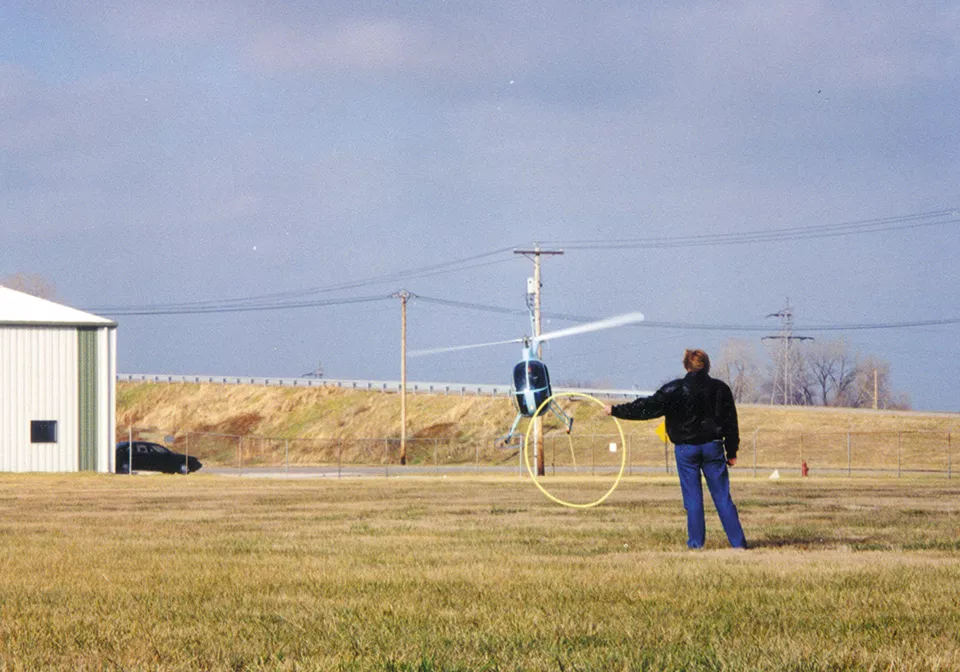
    Barklage performed aerial stunts in his Mini 500 helicopter. In this photo, he's practicing snatching a hula hoop with the craft's landing gear. - COURTESY OF GENE HOFFMEYER

    COURTESY OF GENE HOFFMEYER

    Barklage performed aerial stunts in his Mini 500 helicopter. In this photo, he’s practicing snatching a hula hoop with the craft’s landing gear.

    It wasn’t the first time he had been called a hero. For more than two decades, Allen Barklage buzzed above St. Louis as traffic reporter for KSDK as well as virtually every radio station in town. He was the voice on both AM and FM, a gearhead bantering to motorists about an overturned vehicle on the highway or a police pursuit in East St. Louis.

    Through it all, Barklage never stopped chasing thrills, and emergencies seemed to chase him as well. When he wasn’t reporting traffic, he raced go-karts and happily flew under bridges for the fun of it. There must be something wrong with him, his wife would sometimes remark. Sometimes, she was only half-joking.

    Going by newspaper accounts alone, Barklage’s helicopter skills saved several lives, including that jumper in June 1991. But it was also a helicopter that killed Barklage. He died twenty years ago, days after a fatal malfunction plummeted his helicopter into the ground.

    A second anniversary involving Barklage also takes place this year. Forty years ago, Barklage ended a hijacking by shooting Barbara Oswald in the head 500 feet above the U.S. penitentiary in Marion, Illinois. That was the day he became a hero. That was the flight that made him a legend.

    The killing haunted him for the rest of his life.


    One line of Barklage’s flight log for May 24, 1978, simply read, “Hijack.” - DANNY WICENTOWSKI

    DANNY WICENTOWSKI

    One line of Barklage’s flight log for May 24, 1978, simply read, “Hijack.”

    Gene Hoffmeyer met Barklage in the fourth grade at St. Joseph Catholic School in St. Charles.

    “He never worked at anything he didn’t enjoy,” Hoffmeyer recalls. The two spent their childhoods tinkering on cars and motorcycles, fishing and hunting rabbits in the forests and farmland around St. Charles County. They were briefly separated when Barklage’s family moved to Eureka, but the childhood friends reunited at McDonnell Aircraft Corporation, where they both landed jobs after high school. The year was 1966.

    “Of course, that was when the Vietnam War was getting hot and heavy,” Hoffmeyer recalls. “One day, Allen’s girlfriend called me up and said, ‘Come over here and talk him out of it, he’s talking about joining the Army.’” It didn’t quite work out that way. “I went over to talk Allen out of it,” Hoffmeyer says, “and instead he talked me into it.”

    The eldest of the three Barklage boys, Larry, had joined the U.S. Army intending to gain admission to flight school. He advised his younger brother to do the same, to act before the draft forced him into infantry combat. Why fight in the trenches, Larry told his younger brother, when you could soar above them?

    Allen Barklage chose the sky. Hoffmeyer enlisted a month later. Both were eighteen.

    Barklage wound up in the 192nd Assault Helicopter Company and began his flying career behind the controls of heavily armed Huey gunships. The Viet Cong shot Barklage down multiple times over the next years; photos show the young pilot in green military fatigues grinning near the wreckage of some unfortunate piece of Army property. Barklage would later tell an interviewer that he’d nearly died in Vietnam when a piece of shrapnel blew a hole into the cockpit. But he’d given up his regular seat for that flight; the man in it died.

    Barklage was lucky, but he was also very, very good at his job. After his first tour, the young combat pilot came home for additional training. He later told a reporter that he was uncomfortable with the version of America that greeted him, a place caught up in protest and anti-war fever. He wasn’t ready to come home for good.

    Hoffmeyer chose not to reenlist. Twenty-five percent of his class at flight school, some 300 pilots, had died in that first tour. For Hoffmeyer, beating the odds once was more than enough. Not so for Barklage; he remained in the Army until 1972.

    After his discharge, Barklage joined Hoffmeyer back in St. Louis, where both took jobs as commercial pilots, ferrying tourists and TV and radio reporters. Barklage was undoubtedly overqualified, but he was also lucky to find work. The war’s end had saturated the market with helicopter pilots, says Larry Barklage, who himself took a job with the Federal Aviation Administration.

    “He was a natural-born pilot, instinctual. He put on a helicopter like you’d put on your shirt every day,” he says. “I used to joke that, if they’d known how much he enjoyed flying helicopters, they would have paid him less.”

    Barklage loved flying too much to be scared by it. “I’ve been shot down three times in Vietnam,” he would tell new radio traffic reporters. The boast was meant to be reassuring — that he could handle anything.

  • Inside St. Louis’ Proud Boys, the Far-Right Frat Accused of Fascism

    Inside St. Louis’ Proud Boys, the Far-Right Frat Accused of Fascism

    By reputation, the Proud Boys are fighters.

    This past August, the far-right group gathered on the streets of Portland with its fellow travelers for a rally all but guaranteed to start a brawl. On one side were young men in MAGA hats wearing distinctive black polo shirts with yellow piping on the collars and sleeves. On the other, an assortment of avowed anti-fascist groups commonly lumped together as Antifa. The two sides circled, cat-called and then, inevitably, tried to knock the crap out of each other.

    Sticks, shields, bricks, bottles and mace were deployed, as small groups and individual brawlers clashed amid the sound of police flash bangs and homemade mortars. Both sides came prepared with helmets and homemade body armor.

    For the Proud Boys, fights like these are good for their image — a powerful advertisement to their ideal recruits. On the flip side of that empowerment is bitterness. The group thrives on painting itself as a victim of left-wing persecution.

    The Proud Boys organization is less than two years old, and has spent its entire existence fending off accusations that its members are part of a violent gang of white supremacists. In 2017, the Southern Poverty Law Center classified it as a “general hate group,” a title the Proud Boys fiercely contest.

    What is undeniable, though, is that some members of the Proud Boys have appeared uncomfortably close, figuratively and literally, to modern-day Nazis and white supremacists. Jason Kessler, a Proud Boy who was since excommunicated, organized the infamous 2017 Unite the Right rally in Charlottesville. Other Proud Boys attended.

    While the most active Proud Boy chapters operate on the coasts, smaller ones have opened in cities across the country, including two in Missouri: in Kansas City and St. Louis. One estimate places total membership across the U.S. at 6,000. Numbers are growing. But the attention has its costs.

    This has been a generally terrible summer for the St. Louis Proud Boys. They’ve been hounded by local Antifa groups. On lampposts, signs appeared blaring the members’ names and photos beneath a warning: FASCIST ALERT. A placard in a storefront window proclaimed “Proud Boys Not Welcome.” And while in Portland the Proud Boys met street fighters, in St. Louis they were confronted with something much trickier: a social media onslaught directed at both them and any venue unfortunate enough to host them. They’ve been run out of two bars — and had their private Facebook groups infiltrated.

    In July, Riverfront Times received an email from a Milwaukee, Wisconsin-based “anti-fash collective” calling itself Right Wing Leaks. Posing as a recruit via a fabricated Facebook account, the collective managed to pass the Proud Boy vetting process and gain access to a closed Facebook group for Missouri Proud Boys. Right Wing Leaks then captured screenshots of members’ Facebook profiles and about two dozen videos of the St. Louis chapter’s initiation rites.

    In one video, the president of the St. Louis chapter, a white guy with windblown black hair and aviator sunglasses, records himself taking the Proud Boy pledge.

    “My name is Mike Lasater,” he says in the video. “I’m a Western chauvinist, and I refuse to apologize for creating the modern world.”

    Lasater flashes an “OK” gesture, his index-finger and thumb joined to make an O along with three raised fingers.

    He finishes the pledge. “The West is the best,” he says.


    Proud Boys founder Gavin McInnes devised the group's distinctive look (the shirts) and jargon ("Western chauvinism"). - SHUTTERSTOCK

    SHUTTERSTOCK

    Proud Boys founder Gavin McInnes devised the group’s distinctive look (the shirts) and jargon (“Western chauvinism”).

    On the first Friday in August, Mike Lasater and two other Proud Boys settle on stools in a south-city bar. They’re drinking the group’s preferred beverage combination: Budweiser and straight shots of Maker’s Mark.

    The bar, Tuckers, is a rarity for St. Louis. Not to be confused with Tucker’s Place, the well-loved trio of local steakhouses, this Tuckers is located so far south in the Patch neighborhood, it’s practically St. Louis County. It has a dive bar’s classic grungy charm — at 8:30 on this Friday night, karaoke night, the regulars are already blasted and teetering on their feet. But not many establishments in this deep-blue city hang a sign above their front door stating, in giant red letters, “TRUMP.” Below that, the sign, a veritable jumble of messages, shouts “St. Louis needs jobs and I need customers!!!” and “Support Your Police.”

    Tuckers is the closest thing to a safe space that the Proud Boys have in St. Louis.

    On the TV above the bar, the Cardinals are playing the Pirates. The Pittsburgh players’ black-and-yellow jerseys bear an uncanny resemblance to the tightly fit, black-and-yellow Fred Perry polo shirts worn by the three Proud Boys huddled at the bar’s least crowded end.

    These three identically-clad young men, all in their late twenties, are talking about Portland.

    “It actually proved one thing, and it’s that Antifa are the aggressors,” says Luke Rohlfing, a St. Louis native who travels the U.S. while writing for the right-wing news site Big League Politics. Rohlfing spent his morning tracking livestreams and Twitter feeds of the August 3 Portland action, which he then used to opine about how the leftists were to blame for the confrontation.

    Next to Rohlfing, Lasater tips his beer in agreement. The Proud Boy chapter president wears two matching gold-leaf collar pins on his polo. His belt buckle spells out “candy,” and a gold medallion rests in a thicket of exposed chest hair. By Proud Boy standards, he’s as flamboyantly proud as they come.

    “Left to our devices, we’re not a violent organization,” he says.

    In conversation, Lasater tends to downplay the role of violence in the group’s DNA, focusing instead on similarities to traditional fraternal organizations, men’s clubs, the Freemasons and Knights of Columbus.

    “We’re a drinking club,” he says, gesturing at the bar around him. “I mean, as the St. Louis Proud Boys, what have we done since we started? We’ve gone out for beers, and we’ve made friends.”

    Perhaps. But they’ve made enemies, too. Lasater founded the local chapter in spring, not long after (as he tells it) a business partner at the bar he co-owned, the Livery Company, decided to out him on Facebook as a Trump voter. The partnership broke down from there, and he says he was forced to abandon his role.

    The bar’s co-owner, Emily Ebeling, says Lasater’s departure had nothing to do with his political views, but admits that she was the one who publicized his vote for Trump.

    “I did call him out for voting for Trump,” she says. “I considered him a friend, a close friend, and he had lots of friends who Trump wouldn’t protect. As a woman and a gay woman, I felt betrayed that he could vote for what Trump stands for.”

  • As St. Louis’ School Desegregation Program Winds Down, No One Can Say What Comes Next

    As St. Louis’ School Desegregation Program Winds Down, No One Can Say What Comes Next

    For the past five years, Cynthia Wren, 66, has applied to get her ten-year-old granddaughter, Ariel Gibson, into St. Louis’ student desegregation program.

    The Voluntary Interdistrict Choice Corporation, or VICC, oversees the student transfer program. It is a race-based transfer that allows black city children to attend county schools, even as white students in the county can attend city magnet ones.

    Ariel is black and lives in the Shaw neighborhood of St. Louis city. Part of her application includes ranking her interest in much more highly rated suburban districts. If she’s chosen, it could be a ticket to a top-tier public school district: Brentwood, Kirkwood, Clayton.

    But she hasn’t gotten in. So the ten-year old attends Tower Grove Christian Academy. In lieu of sending her granddaughter to an elementary school run by the St. Louis Public Schools, or SLPS, Wren pays Ariel’s private school tuition. A former teacher’s assistant and current substitute for St. Louis County Special School District, Wren says that paying Ariel’s tuition is a hardship for her family.

    “It’s not always easy,” she says. “But we do what we have to do.”

    Wren plans to continue applying to VICC for her granddaughter in the years to come. But it’s a lottery situation, and with a 17 percent acceptance rate, the odds are against her.

    “I just don’t understand the situation,” Wren says. “[Ariel’s] being skipped over and it breaks my heart to know she hasn’t gotten in.”

    Ariel isn’t alone. In 1999, VICC reached its peak enrollment of 14,626 students. Since then, though, the program has been on steady decline. Last school year, 4,392 students were enrolled.

    It’s not a case of lessening demand. A total of 2,488 black students living in the city applied to VICC for the 2017-2018 school year. Just 413 were accepted. (Of the 148 white students from the county who applied to attend St. Louis magnet schools through VICC, 85 were accepted.)

    And the clock is ticking for Wren and her granddaughter. This month marks the official beginning of the end for the desegregation program, beginning the five-year extension that provides one final reprieve before the education leaders running VICC plan to shut it down entirely.

    VICC oversees the longest-running race-based student transfer program in the nation, and even as it’s brought a dose of color to many affluent county districts, it’s also been a real boon to thousands of lucky city kids. State Representative Bruce Franks (D-St. Louis), who graduated from Lindbergh High School in 2002, is just one prominent alumnus.

    Yet if you ask the people in charge of the program — the superintendents of the twelve schools that make up VICC’s governing board — what comes next, and what they’ll be doing to increase diversity in districts that would be largely monolithic absent the transfer students, they’ll acknowledge they don’t know just yet.

    “We want to roll into this new five-year extension,” says Eric Knost, Rockwood superintendent and VICC chairman for the 2017-2018 school year. “Once things start to settle a little bit, we will start talking about what’s beyond the five-year extension.”

    He acknowledges, “We really haven’t even scratched the surface yet on what’s to come.”

    Since 1981, more than 70,000 black students from St. Louis city have attended schools in St. Louis County through the VICC program. Under its auspices, white students from the county have also been attending magnet schools in the city since 1982, albeit in much smaller numbers (9,000).

    Those students have added much-needed diversity to some county districts. In 1999, the year of VICC’s peak enrollment, participating county districts notched an average of 20 percent black students. Had VICC not existed, the projected black enrollment would have averaged a mere 4 percent.

    Nearly two decades later, not much has changed, demographically. In 2017, black enrollment within participating districts averaged around 15 percent. Without VICC it would’ve been just under 7 percent.

    But as the years have gone by, some of VICC’s original participants have pulled out. Hazelwood, which was steadily growing more diverse even without transfer students, left in 1988. Ladue and Ritenour both exited in 1999, Pattonville in 2005 and Lindbergh in 2011. (Students in the program were allowed to graduate from the districts they’d been placed in, making the districts’ withdrawal a gradual one.)

    According to VICC, the districts left the program after finding other ways to enable diversity in their schools. Ladue, for example, consolidated its ten neighborhood elementary schools to four in the 1970s. At that same time, Ladue also redrew its school boundaries. In doing so, the district, which is made up of nine municipalities (Creve Coeur, Crystal Lake Park, Frontenac, Huntleigh Village, Ladue, Olivette, Richmond Heights, Town and Country and Westwood) plus some parts of unincorporated St. Louis County, created more racial diversity in its schools.

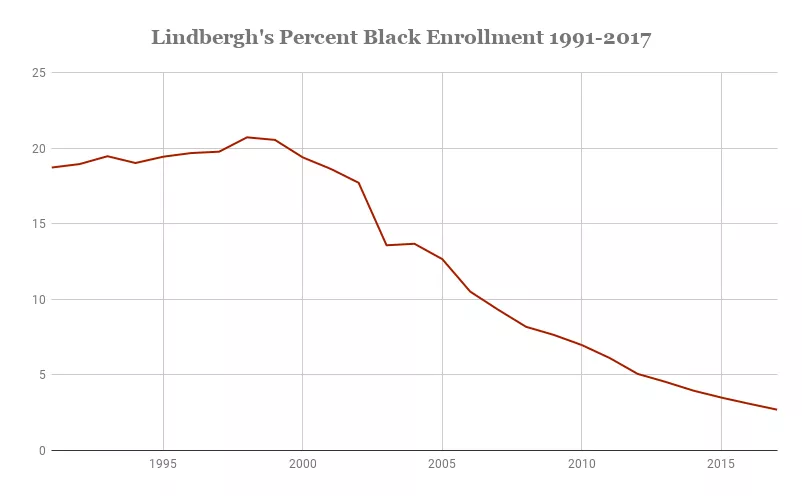
    Lindbergh, though, hasn’t quite done that. The district saw black enrollment as high as 20.56 percent in 1999 thanks to its participation in VICC. By the time it pulled out, that had dropped to 6.11 percent. Lindbergh’s last VICC student graduated in 2017, and at that point, its black enrollment had sunk to just 2.69 percent — around ten times smaller than it was in 1999.


    The percentage of black students at Lindbergh schools plummeted after it pulled out of VICC. - GRAPHIC BY CAMILLE RESPESS

    GRAPHIC BY CAMILLE RESPESS

    The percentage of black students at Lindbergh schools plummeted after it pulled out of VICC.

    In the coming years, absent some sort of replacement transfer program, what’s happening at Lindbergh could happen to districts across the county.

    VICC’s board approved that final five-year extension in November 2016. It’s set to run from the school year that just began through 2023-2024 and will accept around 1,000 students into the twelve participating school districts during these five years. Priority for acceptance into VICC during its final extension will be given to siblings of students already in the program.

    It’s a long goodbye, by any measure. If a kindergartner is chosen for the program during its last year, 2023, he or she wouldn’t be on track to graduate until 2036 — walking an increasingly lonely road as other minority students graduate and move on.

    From its inception, VICC’s model was built on continual phase-out. The program was set up in 1999 to dwindle at a rate of 5 percent over a twenty-year period. And that’s exactly the outline its remaining districts are following.

    VICC leaders say that their long-held plan to phase out the program dovetails nicely with the growing ambitions of the St. Louis Public Schools. After all, VICC takes black students to county schools who would have otherwise been zoned to attend city schools.

    “Clearly, county schools benefit [from VICC] by creating a more real and diverse student environment,” Knost says. “At the same time, we have got to keep the interest of the SLPS.”

    In 2012, the St. Louis district regained provisional accreditation after five years of operating as non accredited. In 2017, the district became fully accredited.

    “We are trying to be competitive as we can for families to look at us as a real option,” SLPS superintendent Kelvin Adams says.

    But while Adams says he believes the desegregation program has fulfilled its purpose, he agrees the ending of this iteration of VICC may not mean the end of transfer programs between the city and county school districts.

    “I’m not saying it can’t continue in some way, shape or form in the future,” Adams says.

    Maalik Shakoor, 22, graduated from Clayton High School in 2014. He was bussed from his neighborhood of Baden in north St. Louis for the twelve years he was in VICC: first to Bierbaum Elementary School in south county, then to Clayton for middle and high school.

    Shakoor graduated from Webster University in May with a degree in film production. He’s spent the summer as a teacher at the Freedom School in St. Louis.

    Though Shakoor wishes he could have gotten a strong education in his own neighborhood, he sees the value in VICC.

    “If [black children in the city] can’t get a good, quality education where they’re at, then the next best solution is to bus them out,” he says. “Until the city schools can be up to par with the county schools, I see no other option.”

  • The Samurai Killer of South St. Louis

    The Samurai Killer of South St. Louis

    Nearly two months have passed since Seth Herter thought he was the Antichrist.

    The realization that he was not — made possible through a combination of anti-psychotic and mood-stabilizing medications — came to him in the St. Louis City Justice Center, where he has been locked up since May after slaughtering another man with a samurai sword.

    For years, he had talked of himself in online posts as the “White Rider,” a reference to the Four Horsemen of the Apocalypse in the Bible’s Book of Revelation. He believed he could control all the electricity in the world and that thousands of people were clamoring to see him dance. His delusions had led to a smattering of scrapes and arrests. But in April, his thoughts turned significantly darker.

    “I started to feel like it was time to start punishing people,” he recalls.

    Herter is 29 years old, stands six feet four inches tall and wears a scruffy goatee. In the pale light of a jailhouse visiting booth, a splash of acne reddens his cheeks. He has begun to regain a bit of the weight he lost while fasting during his delusions. He lowers the waistband of his yellow uniform to reveal angry pink patches on both hips — friction burns from a rope he wore cinched around himself for a month, he says. The fasting and the rope were part of a biblically themed penance that Herter believed would increase his powers.

    “I got a hairshirt and everything,” he says, later adding, “I believed so many crazy things.” Convinced the CIA had embedded a chip in his ear, Herter even sat down one day with a mirror and a knife and tried to cut it out. He later went to an urgent care, hoping doctors would find the chip with an X-ray.

    He sounds disgusted or embarrassed as he tells these stories, like a person realizing after the fact he has been fooled by an obvious scammer. But in this case, he was tricked by his own mind.

    In some ways, it is a relief to return to reality. In others, it is crushing. He knew the man he killed. More than knew — he says they had dated for years. They had recently split up, but Herter says he called his victim on the day of the killing because he thought people were in his walls and furniture, and he needed help clearing them out. His face slowly turns red as he talks, and then he sobs. “I loved him so much,” he cries out. “Can you please say that? Please tell people that I’m not a monster.”

    St. Louis police and a medical examiner’s spokeswoman identified the man as 55-year-old Christopher McCarthy. In a probable-cause statement, a detective says McCarthy was stabbed to death. Herter will not discuss “the particulars” of the killing, but he blames his own mental illness.

    “It wasn’t like I wanted this to happen,” he says. “I was in the middle of a psychotic break, and it ended up really bad.”

    In the anguish of clarity, he says it is a nightmare to learn that so many perceptions he had were wrong and that they cost someone his life. But as the real world and its consequences barrel in, there is one big piece of the puzzle that he can’t attribute to delusion or a trick of the mind.

    He says he had known the victim for four or five years — a claim supported by others, including a former neighbor — but that the name Christopher McCarthy was new to him.

    “I thought his name was Tim,” Herter says. “He told me he was Timothy Wilson. When they told me he was Christopher, I was blown away.”

    Warning: The following page contains a graphic photo of the bloody crime scene. Sensitive readers should proceed with caution.

  • LA4SS Could Be St. Louis’ Biggest Rapper in a Generation — If He Survives

    LA4SS Could Be St. Louis’ Biggest Rapper in a Generation — If He Survives

    St. Louis rap ruled charts in the early 2000s, with Nelly and Chingy’s platinum hits revolving around hotel rooms, shiny jewels, tight jeans, slurred “rrr”s and lots of hometown pride.

    But the party ended a decade ago. Chingy’s fallen off, Nelly’s facing sexual assault charges and today’s St. Louis rappers don’t have much in the way of national hits or media coverage. No one buys records anymore, and so instead the local scene is centered mostly around YouTube. It’s much darker. Drenched in blunt smoke, these videos are filmed in front of crumbling brick buildings. The production values are high, the verité quality disturbing. Artists still in high school point actual guns at the camera, threatening rival gangs. The subject matter is often not fictionalized, instead depicting true-to-life neighborhood rivalries and personal beefs.

    These videos lead to actual killings. “In St. Louis, when you make a diss song, you have to be ready to die off of it,” says rapper Kosta Longmire, of the St. Louis group Gold Heart Family. That’s a big reason St. Louis hip-hop has been without breakout stars in recent years. The good ones keep getting murdered.

    After a long drought someone is finally set to break nationally, a young rapper from the city named Antonio Harris, also known as LA4SS. Growing up in a family waterlogged with despair, legal trouble and tragedy, he’s found an artistic voice — equal parts brutal and enchanting — that’s captivated north city, north county and beyond.

    Only twenty years old, he’s already done time in federal prison and seen the people closest to him murdered. Rumors abound that he’s got major, pressing beefs he’s not anxious to squash.

    Under the mentorship of a famed local promoter, he still might have a chance. He blew the roof off of Chaifetz Arena last month, and major labels are circling. But to some observers of the scene, the most amazing thing about LA4SS isn’t his rise.

    It’s that he’s still alive.


    At a recent concert, LA4SS performed in front of blown-up images of his younger self. - BEN WESTHOFF

    BEN WESTHOFF

    At a recent concert, LA4SS performed in front of blown-up images of his younger self.

    The nickname “LA4SS” is hard to parse; it’s pronounced “L.A. Fours” or just “L.A.” That doesn’t reference Los Angeles, but rather “Little Antonio.” “He had a friend named Lil A who killed himself, so he called himself LA to keep the name alive,” rapper Swagg Huncho, a collaborator, explained three years ago. “4” references his neighborhood set, and the SSs at the end are so it sounds cool.

    It’s a name as cryptic as Harris’ own story, one he doesn’t like to talk about. Though he’s spoken with this reporter in the past, he declined to be interviewed for this piece. His manager says he’s wary of self-incrimination, perhaps understandable considering Harris is on probation and due back in court later this month on a charge of resisting arrest. Interviews with a wide array of friends, collaborators and close observers paint him as someone who’s short on trust. It makes sense; he’s faced chaos since his first days.

    Harris raps about the drug dealing and violence that enveloped his childhood growing up on the “West Side” near Page and Union, a part of the city known to some as 51 Skan. According to statistics compiled by the St. Louis Post-Dispatch, the surrounding Academy/Sherman Park neighborhood has a higher crime rate than 62 other neighborhoods in the city, out of 77, with 59 incidents of violent crime in the past six months, including two homicides. By all accounts Harris’ upbringing was rough. “Unfortunately, he was exposed to a lot of criminality at a young age,” his lawyer Andy Sottile said at Harris’ January 2017 sentencing in federal court, revealing that his client was diagnosed with depression at a young age.

    “He really come from it,” says rapper Lil St. Louis, who over the years has shared management with Harris. “His daddy still in the street. Ever since I been knowing 4SS I been worried about him. The way he lived; the way he came up.”

    At an age when most boys are entering high school, meeting girls and studying for driver’s tests, Harris was getting gold fronts on his teeth and tattoos on his chest, and engaging in caustic disputes with adversaries. He began making music in earnest around age sixteen, finding unexpected success after performing a verse posted to a friend’s Instagram.

    “I didn’t even think it would get a hundred views,” he told the St. Louis American in 2015. “But after that they were like, ‘You might as well rap.’ They put me in the booth. We dropped the first song, and it just got a buzz from there.”

    Even among hard-edged rappers, Harris stands out for his intensity. It’s unnerving. Don’t expect comic relief or syrupy odes to girlfriends in his songs; he’s 100 percent serious, focused on life and death in the streets. And it’s been that way since the start. In his 2015 video “Intro,” he stands shirtless on an Illinois riverbank, the Arch in view across the Mississippi. Over a simple, naked beat, he squints in a series of extreme close-ups, pouring out his darkest agony in staccato bursts.

    Have you ever seen your partner get hit with a 9?

    You man’s leaking everywhere, you know he ’bout to die

    Have you ever seen your best friend mama cry

    Because her son was the one in that homicide?

    Harris’ music doesn’t glorify black violence for the entertainment of white audiences, a charge often levied against gangsta rap. Instead, it’s an unflinching expression of the deep suffering many residents north of Delmar know so well.

    Harris’ manager Slim Cunningham, a veteran St. Louis impresario known as LooseCannon, has worked with the most popular rappers in the country. He says he knew immediately that LA4SS was a major talent.

    “When I looked at his videos I was like, ‘This dude got it,’” Cunningham says. “Some people got it in their eyes, man. It’s like magnetism. The way people crowd around you. It’s that star shit.”

    Harris’ journey to the top of the St. Louis heap would not be a simple one, however. Though his charisma was never in question, a hundred other factors seemingly contrived to try to take him down. To survive he was forced to embark upon journeys both figurative and literal, descending into a pit of despair seemingly without bottom.

  • In the Shadow of the Lewis & Clark Tower

    In the Shadow of the Lewis & Clark Tower

    The Lewis & Clark Tower’s circular presence on the north-county landscape is more than a bit exaggerated in scale, its mid-century modern design a bold reminder of architectural notions from another time. Surrounded by single-story, frame-and-brick ranch homes on one side, roads and parking lots on the other three, the unusual 10-story cylinder cuts a sharp contrast to its neighbors.

    A landmark at the intersection of Lewis and Clark Boulevard and Chambers Road since 1965, the Tower showcased its human element for years, with its small terraces filled by BBQ grills, satellite dishes and clotheslines. These small touches suggested that an alien craft hadn’t, in fact, landed onto the anchor position of a suburban strip mall. Today, though, a drive-by visitor wouldn’t be blamed for not knowing what the structure was at the height of its use. The only real clue above graffitied walls and broken windows is the signage on its roof: Top of Tower Restaurant.


    See also: 15 Haunting Photos from Inside the Tower


    It was more than a restaurant, of course. In its heyday, the Tower was the ultimate suburban magnet, a destination for moviegoers, grocery shoppers and bowlers, with a residential component that spoke to the ’60s idyll of having all your needs bundled together, with ample parking for all. The Tower really mattered to north county then, a robust engine of commerce, a home to dozens of residents and a place that said, “This is how we’ll live, play and shop in the years to come.”

    We didn’t.

    The structure has been abandoned for not quite a half-decade, but the death signals came long, long before the town of Moline Acres issued the final condemnation orders in 2014. In the years before that, the condos and businesses inside had suffered internal strife within the condo association, disputes with out-of-state ownership and a general lack of upkeep, with various units losing access to essentials like working elevators and hot water. By then, the in-house pool had long since closed and the on-site movie theater and bowling alley were solely memories.

    Today a few seemingly operable cell phone towers exist on the rooftop, the only functional items within the Tower’s footprint. And while several long-running businesses remain active in the adjacent plaza, questions about its future are prevalent. Answers are much more elusive.


    "Come in here on a Friday afternoon or a Saturday morning, and our whole parking lot's full," says Tom Stelmacki, whose business is based in the Tower's adjacent plaza. - KELLY GLUECK

    KELLY GLUECK

    “Come in here on a Friday afternoon or a Saturday morning, and our whole parking lot’s full,” says Tom Stelmacki, whose business is based in the Tower’s adjacent plaza.

    Tom Stelmacki is a manager at the business closest to the Tower, Stelmacki’s Family Market, an apt name. It’s an old-school grocery in the absolute best sense; it’s tidy and trim, with design elements that haven’t changed a lot since the store opened in 1965, like the wooden, farm-like shingles hanging above the meat department, where Tom’s brother Mike works.

    Tom Stelmacki’s memories of decades spent working in the plaza mirror those of countless north county residents.

    “It was a hustling and bustling area right here,” he says. “The Top of Tower was one of the best restaurants in all of north county. I remember the limos pulling up and dropping people off on Friday and Saturday nights. I remember the kids going to proms and dinner dances there. You had the bowling alley, the movie theater. It was all right here and when that was all going, it was bustling, busy.”

    As the businesses up and down the retail plaza flourished, then receded, then hung in, Stelmacki’s thrived, becoming something of a destination of its own. These days, Stelmacki says that folks come from all over the area for specific items at his expansive grocery, especially the store’s most popular element: its meat market.

    “We’re all happy here,” he says. “We’ve been here all my life. I know the people that shop here. Those who’ve been coming for years, we know by name. Everyone that I employ is from the area. We’ve given a lot back to the area by being here, and we didn’t ever give up.”

    Stelmacki is often found in the shop’s narrow, paneled office, talking to customers on the phone, ordering products, monitoring the day’s affairs. His sister, Nancy Weber, works a few feet away at the service desk. As a businessman, he tends to both the grocery’s essential needs and probably a few tasks that shouldn’t fall on his plate, but do.

    For example: He and his staff often pick up trash on the parking lot. Much of it has blown over from the abandoned and emptied Tower, located just a few dozen feet from the market’s front door. He has a lawn service mow the grass at the Tower, too, if only to “help take care of it as best as we can.”

    “It’s not for our business to have to do,” he says. “It’s not our position, really, but if it’s not getting done, you have to do it. You have to keep it clean.”

  • For Pizza and Insults, Kevin’s Place Has Cherokee Street Covered

    For Pizza and Insults, Kevin’s Place Has Cherokee Street Covered

    When Kevin McGinn insults customers, it’s primarily through the phone. They call Kevin’s Place, his pizzeria on Cherokee Street’s Antique Row, and he greets them with a blast of anxiety: “Hellothisiskevinspeaking.” McGinn himself always answers. After all, he’s the sole employee: the order-taker, cook and the driver.

    (Yes, that means he sometimes hustles out on deliveries while pizzas are baking; yes, while his front door is propped open; yes, while guests are dining in and unsure of his whereabouts. He just leaves. Then he comes back.)

    Although McGinn is calm and witty during most transactions, he expects customers to be ready with their exact order during a rush. If they dither on the phone, he may grow impatient, curse, and hang up. Below is a sampling of things he has uttered at such moments, according to various customers and McGinn’s own memory:

    “Look, I can’t help you right now, I’m busy!” [Click.]

    “If you say ‘um’ one more time, my head is going to explode.”

    “I run this business, not the city.” [Click.]

    “Dumb bitch, go back to school and get an education.”

    “My customers are geniuses.”

    One disgruntled reviewer complained on Zomato, an online restaurant-review site, that McGinn lost his temper and labeled all city residents “tattooed drug addicts.” (The restaurateur denies this, insisting his actual words were “tattooed dog-loving freaks.”)

    It is a miracle of American commerce that Kevin’s Place is still open — and in fact, just celebrated its tenth anniversary last month. For one thing, fewer than half of all restaurants make it that far, a 2014 study suggested. For another thing, the radical honesty of Kevin McGinn defies every norm of customer service. Yet somehow, it’s working.

    McGinn, 60, is by no means the first restaurant owner to vent frustration at customers. Recall Ali Yeganeh, the authoritarian soup vendor in Manhattan who inspired “the Soup Nazi” character on Seinfeld. Consider, too, the national restaurant chain Dick’s Last Resort, which boasts of its “outrageous, surly” servers. Here in the Midwest, Chicago is home to both Ed Debevic’s, an old-school diner offering a “side order of sass,” and the Wieners Circle, a hot dog stand where the staff berates the late-night crowd.

    Yet in most of these cases, the whole thing is schtick and spectacle. It’s a gleeful trampling over the maxim that The Customer Is Always Right. And everybody’s in on the joke.

    Not so at Kevin’s Place. If McGinn sounds hot-tempered, that’s because he is. He doesn’t filter his feelings. He knows that it costs him some revenue, and occasionally he apologizes. But he’s always himself.

    “All I’m doing is saying the things you’d like to say but aren’t allowed to,” he explains. “My customers either love me or hate me, and I don’t care which it is. I do the best I can.”

    His rawness sets him apart from the artists and creatives who dwell on Cherokee Street. Practically everyone in the neighborhood would qualify as eccentric by the standards of mainstream culture. The younger crowd tends to be self-consciously so; they value expression, originality and weirdness. McGinn isn’t aiming for weird. That’s just a label he earned accidentally by delivering pizzas on a giant tricycle, talking to his adopted cat and hanging out shirtless in a dining room that’s adorned with multiple portraits of Marilyn Monroe.

    Nearby merchant Cherri Elder, co-owner of Elder’s Antiques, suggests that his quirks don’t even matter.

    “It’s Cuckooville down here, honey,” she says, “and he’s the full cuckoo package. It’s never a normal experience. Good pizza, though.”

    And that’s objectively, scientifically true: His pizza is a treasure. It’s done St. Louis-style: thin crust, tangy provel mix, baked in a brick oven, then sliced square-wise. Its fragrance fills the entire block. He takes pride in it. But to get a taste, you need to be prepared for all kinds of emotional weather.

    “He’s temperamental, like a cat with rabies, but lovable,” says Jennifer Smith, a candlemaker who sells her wares across the street at the Heirloom Room. While McGinn does get embroiled in shouting matches with neighbors, she says, he can also be quite charming. She recalls his demeanor during the solar eclipse last August when many Antique Row merchants spilled onto the street to peer up at the sky.

    “He was like a different person that day,” recalls Smith. “He was joking, he was smiling. He was wearing shoes.”

    These days, McGinn has his sights set on a whole new neighborhood: He has rented a commercial space in Northampton, adjacent to a building where he lived briefly as a kid. His plan is to open a second Kevin’s Place there. But he’s reluctant to hire another employee, so he vows to work 90 hours a week and run both restaurants himself.

    Can he pull it off? Various friends, neighbors and customers believe he can.

    As one Yelp reviewer wrote: “Kevin is like Superman, if Superman was kind of awkward and drove a Corolla.”


    The decor in Kevin's Place includes Antique Row merch and portraits of Marilyn Monroe (who reminds him of an ex-girlfriend). - PHOTO BY SARA BANNOURA

    PHOTO BY SARA BANNOURA

    The decor in Kevin’s Place includes Antique Row merch and portraits of Marilyn Monroe (who reminds him of an ex-girlfriend).

    Over the summer, McGinn appeared in a major motion picture that played in cinemas across the country.

    His cameo comes exactly an hour into Kidnap, starring Halle Berry. Berry’s character has a young son who gets abducted into a car by a shady couple. The couple speeds away, but Berry the mother-heroine chases them, all the way out to their remote home. Berry creeps into the house and glances at some framed photographs atop the mantel. McGinn is in one of those photos.

    How? The actress who played the shady female kidnapper is Chris McGinn, Kevin’s sister. The production staff asked the St. Louis-born thespian to bring in her old family pictures to use for that scene, so she dug up a shot from years ago of her and her brother.

    (When Kevin found out, he pleaded to be introduced to Berry; Chris laughed and said, “Sure.” The meeting is still pending.)

    Chris remembers all the injuries her brother suffered while they were growing up in St. Mary Magdalen parish in south city: That time he broke his shoulder playing hockey. The time his buddy stabbed him in the neck with a knife (which may not have been an accident). Or the time the siblings got into a skirmish and Chris poked him in the eye with a pencil. (Its graphite tip is still lodged in his eyelid, and still visible, to this day.)

    Most vividly, though, she recalls his entrepreneurial fire: By age nine, he was hawking copies of the St. Louis Post-Dispatch on South Kingshighway at Chippewa. A few years later and two and a half miles north, he got a job at Pagliacci’s pizzeria by lying about his age. (When they discovered he was twelve, not fourteen, they fired him.)

    He later found work at Rugerri’s on the Hill, where the legendary Stan Kann was still playing the organ, and then at Steak ‘n’ Shake. Once he earned his driver’s license, he delivered for Imo’s. He was so focused on his cash income, he would even wash and iron the bills.

    “He was always very ambitious, very driven, just trying to be self-sufficient,” says Chris.

    In 1979, when Kevin McGinn was 22, he and a friend launched their first brick-and-mortar venture, Bugsy’s Pizza, at 2810 Chippewa. They did well enough to add a second location, but the partners had a falling out and split up the business. McGinn renamed his wing of it Circus Pizza, which grew to four locations.

    But he swore he’d be out of the pizza racket by his 30th birthday, and made good on that promise: In 1987, he sold Circus Pizza and became a cab driver. (McGinn credits his stint as a cabbie with enough knowledge of city streets to obviate any need for a map or GPS while on deliveries.) He started buying cars and leasing them out to other cab drivers. Then he moved full time into car rental.

    But his destiny smelled like pizza. One summer Sunday in 2007, he ate brunch at the Mud House cafe on Antique Row, the eastern half of Cherokee Street. He was scheduled to start a new job the next day as a sales rep for a construction firm.

    After brunch, he strolled west up the block and noticed an empty storefront. A century before it had been a cigar shop. He wondered if he could rent the space for cheap. While standing there, he called the owner to inquire and learned the rent was even lower than expected. He reserved the space, without even stepping inside, and opened Kevin’s Place in October 2007.

    “My friends said, ‘You’re doing a really good job avoiding getting a real job,’” he recalls.

    McGinn threw himself back into the pizza world. A lifelong bachelor, he says, “I don’t have kids; my business is my kids.” He furnished the dining room with various wood pieces from Antique Row. He also hung up pictures of Marilyn Monroe, who reminded him of a sweetheart he had while at Bugsy’s in his early twenties.

    “I thought it’d be a good karma thing,” he says. “And Marilyn’s not so bad-looking.”

    Online reviews soon trickled in. Customers raved about his pizza, which explains in large part why he’s still in business: He’s good at it.

    McGinn mixes his own sauce and tops his pies with your choice of either mozzarella or a blend of provel and five other cheeses that he grinds himself. (He declines to divulge his trade secrets by getting more specific.) He bakes everything in his brick oven by feel; he refuses to set timers. Then he cuts the pizzas in squares, as all self-respecting St. Louisans do.

    Of course, he wasn’t pleasing everyone at first.

    “If you like provel, check it out,” wrote one customer on Zomato in May 2009. “Otherwise, I would go somewhere else. Plus, it didn’t help my confidence in the place when I walked in on a Friday night and found the owner/cook laying down on a couch watching TV.”

  • The Final Flight of Martin McNally

    The Final Flight of Martin McNally

    Finally alone after eleven hours of feverish demands, threats and hostage exchanges, the hijacker pulled off his shaggy brown wig and began to disrobe. He shrugged out of a burgundy sport coat, white dress shirt and yellow trousers — it was, after all, 1972 — revealing a second outfit: a set of dark-colored slacks and a collared blue t-shirt. Upon surveying the rows of empty seats running the length of the Boeing 727, he checked his wristwatch. Only a few hours remained until sunrise.

    It was after 3 a.m. on June 24, and the purloined aircraft was hurtling through a cloudy night sky, heading for the Canadian border.

    The hijacker, Martin McNally, was 28 years old, but with his boyish face and near-smirk, could pass for a teenager. He scooped up the discarded clothing and walked to the very rear of the plane, arriving at the open hatch and extended stairwell. He stared into the murky darkness below.

    There was still time to call it off, McNally thought. He could turn around, walk back to the cockpit and hand his rifle to the pilot. He could return the bag stuffed with $500,000 cash and then, somehow, talk his way out of the mess he’d left back in St. Louis. He could tell the FBI agents that there was never any bomb on the plane, that it was all joke.

    McNally tossed the wig through the hatch, followed by the clothing, several smoke bombs and the rifle with its two loaded cartridges. The items whipped into the air and disappeared. This was no time for second thoughts.

    Aside from a single hostage, McNally was now the only non-crew member left on the flight. Hours before, on the tarmac at Lambert International Airport, he’d negotiated to release more than 90 passengers in exchange for a fresh crew to fly him to Toronto — a city McNally had no intention of visiting. Soon after takeoff, he’d ordered the sole remaining American Airlines stewardess (through whom he had relayed all of his demands) to join the hostage and flight crew in the cockpit.

    Now, McNally’s only companion was the thrilling weight of a cash-heavy mailbag tied to his left belt loop.

    After strapping on a pair of flight goggles, McNally donned a reserve parachute, tightening the straps around his legs and chest, just as he’d been instructed by an FBI agent during an on-the-spot lesson earlier that evening. McNally had never touched a parachute before. This would be his first jump.

    Slipping a handgun into his pocket, he descended the stairs haltingly, on his butt, scooting down step-by-step into the roar of the wind. He turned onto his stomach, catching one last look at the rear hatch leading into the passenger cabin; he imagined how easy it would be for someone on the plane to walk back here and shoot him in the head.

    McNally’s hands were the only things keeping him connected to the plane. His body, suspended from the stairwell at 300 miles per hour, felt like a daisy caught in a hurricane.

    In the cockpit, the remaining crew felt their ears pop as the cabin pressure fluctuated.

    One thousand feet above the Boeing 727, from the vantage point of a military surveillance plane, an FBI agent observed a small, dark object falling rapidly from the rear hatch.

    McNally dropped like a bullet, feet-first, and the first thing he perceived was the wind punching his flight goggles into his eye sockets. In seconds, the goggles were violently ripped from his head. McNally threw out his arms, bringing his body parallel to the ground as he began counting down from twenty in his mind. Basing his calculations on the formula for terminal velocity — which he’d learned in a library physics textbook — McNally figured that this would be enough time to slow his fall to a safe speed. If he pulled the chute too early, he knew, the air would shred the canopy like tissue paper.

    The time came to test his math. McNally fumbled for the ripcord with his right hand, but he made the mistake of leaving his left arm outstretched. Instead of producing the serene, deliberate movements of an experienced skydiver, the wind took hold of his arm and slammed the hijacker into a furious spin.

    In the midst of the chaos, the parachute exploded out of the chest harness and ejected its spring-loaded contents directly into McNally’s face. Blinded and hurting, he managed to grab hold of the shroud lines above him. He tugged hard, and was rewarded with resistance as the canopy filled with air.

    McNally was going to live after all. His hand strayed down to his left thigh, hoping to be reassured by its half-million dollars.

    He could only look down in horror. The mailbag was twenty feet below him, and getting smaller and smaller by the second. As if in a dream, McNally watched the fortune tumble in slow-motion, end-over-end, until it slipped below the clouds and vanished.

    The hijacker considered his options.

    Forty-four years later, on a sweltering afternoon in August 2016, Martin McNally enters the Thomas Eagleton U.S. Courthouse in downtown St. Louis. He rides an elevator to the second floor and checks in at the front desk of the federal probation office.

    Clean-shaven, his white hair combed and slicked back from his forehead, the 72-year-old ex-con is anticipating good things from a scheduled meeting with a federal parole supervisor. Five years out of prison, McNally is now permitted to apply for release from his permanent parole, a status that saddles him with travel restrictions and random checkups. The meeting could set the wheels of true freedom in motion.

    By the time McNally had been released from a California prison in 2010, he had already spent more than half his life behind bars. He then settled into an apartment in south St. Louis, where he subsisted on disability benefits linked to an old Navy injury.

    McNally’s first decade as inmate had been marked by violence and multiple failed escapes. He was involved in numerous scraps with prisoners, and, although never convicted, he was twice brought up on charges for assaulting guards in the U.S. Penitentiary in Leavenworth, Kansas. In one instance, he was accused of wielding two sharpened pencils as shanks.

    “My first ten years, those were turbulent, no question,” McNally says, making conversation in the parole office waiting room. “The guards at the U.S. Penitentiary in Leavenworth were brutal. They beat up and assaulted prisoners; they killed prisoners. So yes, there were assaults on guards, there were indictments.”

    By the early 1980s, the inmate had calmed down a good deal. McNally dedicated much of the next three decades to appealing his conviction for air piracy. He became a proficient jailhouse lawyer, ran for president and accrued more than $10,000 by illicitly trading Wall Street stocks.

    At the courthouse, McNally waits an hour before he and his local parole officer are beckoned into the conference room to meet the supervisor.

    The meeting lasts under 30 minutes, and it doesn’t look good. During the meeting, the local officer testifies that it would be best to keep the septuagenarian hijacker on parole indefinitely.

    On the drive back to his apartment, McNally unleashes a stream of curses, mostly directed at the parole officer.

    “I would recommend retaining him on parole,” McNally quotes, sneering his impression of the testimony, “because of the nature of this crime.”

    Fuming, he says, “Yeah, no question, I’ll be on parole until I’m dead.”


    A FBI photo of Martin McNally in 1972. - NATIONAL ARCHIVES AT KANSAS CITY

    NATIONAL ARCHIVES AT KANSAS CITY

    A FBI photo of Martin McNally in 1972.

    Beginning in the mid-1960s, the“Golden Age” of airline hijacking was an era when any passenger could walk through an airport terminal unmolested, breeze onto the tarmac and board a plane — all that with their shoes on, no less. In some cases, you could even pay for your ticket on board.

    This casual freedom — a relic of a more civilized time — persisted in the face of an unprecedented wave of hijackings. Early interventions proved laughably inadequate, flabbergasting airline companies. Ticket agents were instructed to subjectively screen passengers based on a cooked-up checklist of psychological and physical traits believed to be particular to hijackers, and although sky marshals were deployed in 1970, their limited ranks couldn’t hope to make a dent in the vast number of flights taking off each day in American airports.

    The virtually non-existent security led to a frenzy of hijackings. According to Brendan Koerner’s 2013 book chronicling the period, The Skies Belong to Us, more than 130 hijackings were committed in American skies between 1968 and 1972.

    Many of the culprits were straight nutjobs, driven by religious or political yearnings that required (for some reason or another) immediate passage to Cuba. But even as the capers escalated in audacity and potential violence, airlines companies balked at beefing up their own security. Instead, they sought to avoid the possibility of violence at all cost. Crews were instructed to comply with hijackers’ demands rather than risk an altercation. Pilots on domestic flights were provided with charts outlining passage to Havana, just in case.

    But there was a second, altogether different species of hijacker: not a nutjob, but rather a certain kind of foolhardy opportunist. In other words, a common crook.

    Driving through Detroit in January 1972, Martin McNally listened with growing interest to a radio news report of a two-month-old hijacking in the Pacific Northwest. Shortly before Thanksgiving, an unidentified man had commandeered a Boeing 727 after taking off from Portland International Airport.

    According to the report, the hijacker had ordered the plane to land and subsequently demanded a parachute and $200,000. Upon receipt, the hostages were released, but the hijacker kept the crew and ordered the plane to take off once again. Forty-five minutes into flight, the man jumped from the lowered stairwell at the rear of plane. Both hijacker and cash had seemingly disappeared without a trace.

    In the coming months, McNally would spend hours poring through library books on parachutes and skydiving. An idea took root in his mind. The hijacker on the radio — soon mythologized as “D.B. Cooper” — had demonstrated an effective strategy for air piracy, and it seemed a much easier task than knocking over an armored truck or a bank.

    McNally was a product of a large family, and had lived most of his life in his hometown of Wyandotte, a suburb in the southern shadow of Detroit. McNally’s father, a shoe store owner and respected figure about town, had put eight children through Catholic school. But young Marty McNally spurned his studies. Instead of completing eleventh grade, he enlisted in the Navy, where he labored as an airplane electrician. It was no harbinger of destiny: His flight time was restricted to servicing the cramped patrol craft sweeping for Soviet submarines off the coast of Alaska.

    Given a general discharge from the Navy in 1964, McNally had no interest in joining his father at the family shoe store. He wound up scrambling through a series of odd jobs and minor scams, including a plan to embezzle gas sales from a service station and a short-lived counterfeiting operation, which ended when he was busted feeding fake quarters to a laundromat change-machine. By 1972, he was exhausted with the paltry returns on minor scams.

    One big score, that’s what he needed. All he required was a weapon, some phony documents and a passable disguise. D.B. Cooper had shown him the rest.

    Getting the gun was easy. A local pool hall hustler, Walter Petlikowski, provided a .45 rifle, and McNally cut ten inches off the barrel. The weapon fit comfortably inside a black attaché case with a wig and smoke bombs. Petlikowski, in turn, signed on as an accomplice in exchange for $50,000.

    In the fall and winter of 1972, McNally charted a tour of Midwest cities, hitting Indianapolis, Chicago, St. Louis and Kansas City. He settled on St. Louis’ Lambert Airport — it had the worst security, McNally says — and made two more trips to the airport with Petlikowski to prepare for the one-way flight.

    On the morning of June 23, a Friday, Petlikowski dropped McNally at the main terminal. Petlikowski had changed his mind about participating in the hijacking directly, but he’d still agreed to act as chauffeur for half his original fee. McNally, briefcase in hand, bid his accomplice farewell and boarded Flight 119 destined for Tulsa, Oklahoma.

    McNally encountered no metal detectors on his way to the flight. His ticket, purchased with forged Navy discharge papers, identified him as “Robert Wilson.”

    Less than 30 minutes before landing in Tulsa, McNally excused himself from his seat three rows from the rear of the plane and walked to the lavatory. When he emerged, he was wearing a shaggy brown wig and sunglasses and wielding a rifle. He handed a note to a startled stewardess.

    A few minutes later, the captain’s voice came over the intercom:

    “Ladies and gentleman. We have a passenger who needs to return to St. Louis.”

    McNally followed D.B. Cooper’s example to the letter, though he added a key embellishment: McNally demanded more than twice Cooper’s ransom, asking for $500,000. He also requested another $2,000 in small bills, most of which he gifted to the stewardesses as a tip for their compliance.

    Around 4 p.m., Flight 119 returned to St. Louis and came to a stop on a runway on the far edge of the airfield. McNally made his demands known. He claimed to control the detonator to a bomb somewhere on the plane, and that any attempts at resistance would be met with gunfire.

    Over the next hour, a flurry of negotiations and counter-negotiations played out between the hijacker — who relayed all messages to the cockpit via stewardesses — and FBI agents on the scene. Eventually, McNally permitted 80 hostages to leave the plane by way of the plane’s inflatable emergency slide.

    But raising a half-million dollars on a Friday evening was no easy task. It could take hours. So, after refueling, McNally directed Flight 119’s crew and the fourteen remaining hostages to ready themselves for takeoff. Back in the air, the plane traced circles above St. Louis. At one point, McNally allowed the pilot to redirect the plane to Fort Worth, Texas, based on reports that the money could be collected there much faster. That report turned out to be premature, and the plane instead turned back to St. Louis, where bank and airline officials were still scrambling to put together the ransom.

    It was after 9 p.m. when their efforts succeeded. Flight 119 made its second landing on a Lambert runway. Now, McNally relayed three additional demands: He needed a shovel, flight goggles, five parachutes and two harnesses.

    The money was delivered in two packages: a heavy airmail bag and a small wrapped parcel. However, despite his preparations, McNally struggled to figure out how to buckle the parachute harness. So he added an additional request: for someone to show him how to put the thing on.

    When the “instructor” (actually an undercover FBI agent) came aboard, McNally watched from a distance of several feet, rifle at the ready in case of ambush. The instructor/FBI agent made no move to disarm McNally, and after his quick lesson, left the aircraft unharmed.

    It was just after midnight, and the plan seemed to be chugging along perfectly. McNally released thirteen more hostages, leaving under his control one hostage, two stewardesses and the flight crew.

    TV and radio stations were already broadcasting the unfolding drama across the country. From behind the rectangular glass facade of the main Lambert terminal, throngs of passengers watched as a tanker truck refueled Flight 119, readying the plane for its fourth St. Louis takeoff in the past eight hours.

    But nothing could have prepared McNally for the interference of a young Florissant businessman, David Hanley, who was among the bystanders ogling the drama from the terminal.

    Hanley did not remain a bystander for long. As the jet taxied down the runway, its massive engines revving in preparation for takeoff, Hanley’s 1971 Cadillac Eldorado crashed through the runway’s perimeter, battering through a fence at 80 miles per hour on a collision course with Flight 119.

    The plane, heavy with fuel, was essentially a bomb with wings. Over the intercom, the captain’s voice crackled with panic. “Oh my god, there’s a vehicle on the runway!”

    Hanley steered the Cadillac into the nose of the plane. Inside, the impact knocked McNally forward in his seat, and the heavy vehicle careened through the nosewheel, coming to a smoldering halt against the landing gear beneath the portside wing. The damage was superficial — the jet fuel did not ignite — but the plane was crippled.

    (Interviewed by the Associated Press one year later, Hanley claimed that the crash had wiped all memory of that night, and that he was as mystified by his actions as everybody else: “My mind is a blank from 6 o’clock that night to two weeks later.” As for “reports” that he’d left a cocktail lounge near the airport, telling friends he “would shock the world,” Hanley denied it. “If I was there then any friends who were with me were a bunch of slucks,” he told the AP. “No one has come to me and said, ‘David, I was with you that night and this is what you said.’”)

    An ambulance arrived to take Hanley to a hospital. He’d suffered two broken jaws, broken ribs, a fractured skull and a crushed left arm and ankle — but the only damage McNally cared about had been inflicted on his getaway ride. The aircraft was useless now. McNally relayed an urgent message to the cockpit: “Get me another plane.”

    It took 90 minutes to bring a second Boeing 727 alongside the disabled airliner. Fearful of FBI snipers, McNally pressed himself between two stewardesses and covered his head with his briefcase until he safely entered the new plane’s lowered rear stairs.

    The second plane was fueled and ready for takeoff. Along with his civilian hostage, McNally presided over the jet’s three-man replacement crew as well as the one remaining stewardesses he’d kept from Flight 119. There was no need for more leverage than that. McNally ordered the plane to leave St. Louis and set a course to Toronto.

    Tracing a straight line, the flight path would take the plane over the vicinity of Detroit. In the preceding months, McNally had tried to work out the precise timing of his jump based on the plane’s airspeed, but he now worried that the delays had disrupted his calculations. He had originally planned to make his jump shortly after midnight. It was now nearly 4 a.m.

    Still, it was time to leave. He stripped off his disguise and buckled the parachute’s harness around his arms and legs.

    McNally didn’t know where he was. From 10,000 feet, the undisturbed whiteness of the clouds below had obliterated any landmark or geographic feature. He wondered if the pilot had betrayed him, and whether he was seeing not clouds but the deep waters of Lake Michigan.

    In reality, McNally chose to make his jump too early. The plane was passing above central Indiana, about 150 miles southwest of Detroit.

    Having already hijacked two planes that day, getting to the ground should have been the easy part of McNally’s plan. He intended to bury the money immediately, leave the area and lay low for a few weeks or months. Then he would return with a shovel.

    McNally dropped from the rear stairwell. Without firing a shot, he’d just made more money than he’d ever earn in a lifetime of shoe sales or petty crime.

    But riches were not in McNally’s future. Gravity saw to that.


    The Final Flight of Martin McNally

    NATIONAL ARCHIVES AT KANSAS CITY

    McNally landed hard in a barren field, narrowly missing a grove of trees. He had made a mistake, panicked on approach, thrusting his heels into the soil and causing his body to whip backwards into the ground. His head bounced on the soil, leaving him concussed. His vision danced with stars that were not really there.

    The money was gone. It had disappeared, eaten by a blanket of clouds in a moment that imprinted itself in McNally’s mind like a nightmare. There was nothing he could do. He didn’t even know where he was; the lack of discernible landmarks on the ground made triangulation useless. Of the $502,000 he’d had in his hands, all he had now was $300 that he’d pocketed before the jump.

    McNally peeled himself off the ground. Around him, the sound of dogs barking echoed through the night. He gathered the parachute and clambered over a barbed wire fence surrounding a thicket of trees. Finding a suitably covered spot, he laid out the parachute and collapsed for two hours.

    At dawn, woozy and shivering, he dragged the chute deeper into the woods, where he covered the canvas with leaves and shrubs. He climbed into the parachute’s folds as if it was a cocoon and slept until noon.

    McNally awoke to helicopter blades thumping overhead. The search parties were already on the move, hoping to sniff out the skyjacker and the loot.

    He decided to wait for dusk before moving from the forest’s tall canopy. In the meantime, he napped, buried the parachute and cleaned his clothes and shoes as best he could.

    Again crossing the barbed-wire fence, McNally walked 500 feet before coming to a gravel two-lane road. In one direction, he perceived a white glow against on the horizon, possibly a city or town. He began trudging in that direction, the monotony broken only by a few cars with Indiana license plates passing by.

    An hour and a half later, one car stopped short about a quarter-mile down the road. In the driver’s seat was Richard Blair, the police chief of Peru, Indiana. Chief Blair had been driving back to Peru with his wife, and the sight of a lone pedestrian on the road so late at night tugged his interest.

    McNally introduced himself as Patrick McNally (his older brother’s name) and displayed a Michigan driver’s license (a forgery) that corroborated the ID. Though McNally’s two credit cards were issued to a “J. McNally,” he explained to the chief that he had borrowed the cards — with permission — from his brother.

    The chief asked McNally what he was doing out on a country road after 9 p.m.

    McNally claimed he had recently traveled to Peru from Detroit on a mission to retrieve his brother from a nearby farm. Alas, McNally continued, his brother had gotten drunk earlier that night and beaten the snot out of him, leaving McNally in this sorry state.

    McNally’s eyes and cheeks were heavily bruised, his chin was gashed open and he sported several cuts on his forehead. He really did look like he’d taken a beating. Chief Blair offered a lift to Peru, and McNally gladly took him up on it.

    Before climbing into the car, McNally quickly slid the handgun from his pocket and tossed it to the side of the road.

    (“He did not frisk me,” McNally would later recall. “If the chief had said anything about patting me down, I would have pulled out this pistol from my right pocket, cocked it and said, ‘You’ll search nothing.’ He and his wife would probably have been killed at that point.”)

    On the drive to town, Blair warned McNally that it was a bad time to be alone on the road, what with so much traffic speeding back and forth. Hadn’t he seen the news? Search parties were scouring the area for a hijacker and a bag of money. McNally answered vaguely in the affirmative, and thanked the chief for saving him the long walk and potential hassle. Blair dropped McNally off at the Peru Motor Lodge, across the street from police headquarters.

    It was late, and McNally hadn’t tasted food in more than 24 hours. He also hadn’t had a chance to look in a mirror. Sitting down for a burger in a nearby bar, he felt the eyes of the other patrons evaluating him from all angles. He wasn’t losing his mind to paranoia. In the bar’s bathroom, McNally stared in shock at his bruised and puffy reflection. No wonder he was getting weird looks.

    McNally returned to the motor lodge and bought a room for the night. The elderly desk clerk accepted his explanation about the mismatched driver’s license and credit cards, but she couldn’t help but notice the condition of his face.

    “You aren’t that skyjacker, are you?” she asked.


  • In Missouri, Pit Bulls Are Banned in 86 Municipalities. Dog Lovers Are Fighting Back

    In Missouri, Pit Bulls Are Banned in 86 Municipalities. Dog Lovers Are Fighting Back

    In 2011, Nicole Bray thought she had found a treatment that might help her five-year-old son with his ADHD — a therapy dog. Her family adopted a boxer/mastiff mix named Gotti, and the two bonded immediately. He quickly became, Bray says, her son’s best friend.

    But despite Bray’s hopes, Gotti would only stay with the family for about two weeks. That’s because Bray lives in Florissant, which is one of many cities in Missouri with a total ban on pit bulls.

    Bray’s dog wasn’t even a pit bull. But someone had reported to Animal Control that he looked like one, and three Animal Control officers showed up at Bray’s home to to inform her that if she couldn’t find a new home for him in seven days, he would be seized by the city and euthanized. Bray says they were “complete bullies,” uninterested in her argument about Gotti’s lineage.

    “They said that I had the choice if I wanted to get a DNA test, but it would cost $500,” Bray says.

    She found a new home for the dog instead. Her son, she says, was heartbroken.

    “It traumatized him,” Bray says. “He ended up going back into therapy because of it.”

    While Bray’s dog drew the city’s attention after just two weeks, Mandi Kay Sullivan lived in Florissant for a year before authorities noticed her dog. Dexter is an American bulldog mix, also often considered a “pit bull type.” Sullivan, a former dog trainer whose husband is a veterinary technician, thought Florissant’s laws, like many other cities, merely required that her dog be licensed and microchipped.

    “I didn’t think anything of it, until one day we got the letter,” Sullivan says.

    Animal Control informed her that Dexter fell under the pit bull ban. He, too, was threatened with euthanasia.

    Rather than have him killed, Sullivan found a home for him with her 75-year-old grandmother. The city’s heavy-handed tactics still rankle her.

    “He doesn’t roam, he’s never bit anyone, no one knows he’s even there unless they see me walking him,” Sullivan says. “I feel that it’s incredibly unfair to punish him and to punish our family.”

    Florissant’s ordinance has been in effect since 2010. It formally applies to three breeds of dogs generally considered “pit bulls” — the American Staffordshire terrier, the Staffordshire bull terrier or the American pit bull terrier — as well as any mixed breed dog with any of the three as “an element of its breeding.” It also applies to any dog with “the appearance and characteristics” of a pit bull — and unless the owner pays for a DNA test, Florissant Animal Control generally relies on the opinion of whoever reports a dog as problematic.

    Not all of those owners who’ve found themselves on the city’s radar can find a new home for their dogs in a week. While Florissant recently started allowing shelters to pick up the dogs they confiscate, the city has euthanized 201 dogs since its ban went into law.

    Bray and Sullivan’s experiences led both of them to get involved with the Florissant Bully Alliance, the local group that hopes to end Florissant’s pit bull ban and the dozens of others like it in Missouri. The local ordinances are collectively known as “breed specific legislation.”

    While there have been a handful of successes — Buckner, Missouri, repealed its ordinance last year — activists have been met with defeat both at the local and state level. Even as a phalanx of heavy hitters has come out in opposition to pit bull bans, including the American Society for the Prevention of Cruelty to Animals (ASPCA) and the American Veterinary Medical Association, the laws have stayed on the books. Last year, a bill that would have repealed all breed-specific laws in Missouri was shot down in the Senate. And in Florissant, a deadlocked city council has refused for years to put a repeal of its ordinance to a vote.

    Residents like Sullivan say they still have hope.

    “They’re supposed to listen to the constituents,” Sullivan says, “and we hope they’ll listen to the people.”