Search results for: “/"”

  • Now You Can Pee on Stan Kroenke’s Stupid Face at a Hotshots Bar Near You

    Now You Can Pee on Stan Kroenke’s Stupid Face at a Hotshots Bar Near You

    VIA HOT SHOTS

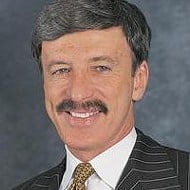
    St. Louis’ disdain for Rams owner and exotic toupee collector Stan Kroenke is deep and abiding, and the team’s recent ascent to the Super Bowl has ripped open the wounds of former fans still sore about his mistreatment of our fair town.

    So incensed are those former fans, in fact, that many have taken to social media in recent days to declare that they’ll not be tuning in to the big game this year. Even former Senator Claire McCaskill joined in , announcing her plans to watch deceased painter Bob Ross paint “happy trees” for three hours on the big day instead. It would seem that the city at large has a lot of pent-up rage that needs to come out, no matter what juvenile form that may take.

    In other words: Want to piss on Stan Kroenke’s face? Hotshots has you covered.

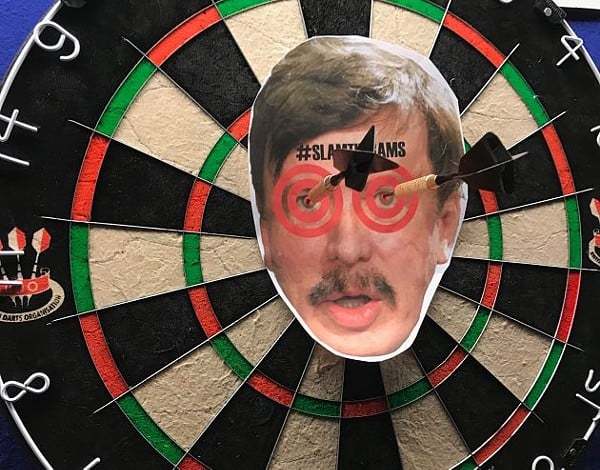
    The sports bar chain is launching a Super Bowl promotion at all nine of its Missouri locations dubbed “Slam the Rams.” It offers patrons a dollar off Bud and Bud Light pitchers for each touchdown scored by the Patriots on February 3 — as well as, yes, urinal screens and dart board targets featuring Kroenke’s mustachioed mug.

    “We were super disappointed to see Stan’s crew make the big game, but happy to help ease the minds of football fans here with cheap beer and such,” Hotshots Director of Marketing Justin Boyd tells RFT. “We still have a bad taste in our mouth from Stan’s dealings with our awesome city and want to let people take a little steam off. “

    Thanks to those urinal screens, now you can put that bad taste in Stan’s mouth instead!

    In addition to the drink discounts on Super Bowl Sunday, the sports bar is also offering a Slam the Rams Happy Hour on February 4 to celebrate when (not “if” — Hot Shots’ distinction) the Rams lose. That will feature $1 Bud and Bud Light bottles from 3 to 6 p.m.

    The promotion is a repeat performance of one the chain did back when Kroenke first moved the Rams to Los Angeles. The dart board targets and urinal screens were featured then as well — though Boyd notes that the bar had to have more of them commissioned.

    “We actually had these urinal screens back right when the Rams moved and all of them were stolen while in use,” Boyd says. “Well over 30 of them. Gross. But truly shows the hate for Stan, that people would go to these lengths to get them to….take home?”

    Deep and abiding, like we said. And soaked in pee.

  • Post-Dispatch Seeks Up to 15 More Staff Buyouts

    Post-Dispatch Seeks Up to 15 More Staff Buyouts

    FLICKR/ PAUL SABLEMAN — The state’s biggest daily is again offering buyouts to its senior employees.

    The St. Louis Post-Dispatch hopes to again interest some older employees in quitting their jobs — with a new round of buyouts being offered to up to fifteen staffers. That’s three times the size of the last buyout round last summer, which included just five people .

    Doug Moore, a reporter with the paper and secretary of the executive board for the United Media Guild, says the buyouts are being offered this time around to all Post-Dispatch employees. The only requirement is that takers have at least ten years of experience and be 50 years or older. At that point, union members could get up to six months of severance, depending on how long they’ve been on staff. (The deal for others is unclear.)

    There are 38 guild members who’d be eligible for the deal, Moore says. Packets were distributed to eligible employees Friday.

    Tracy Rouch, a spokeswoman for the daily, confirmed the details, saying only that the offer was on the table until March 4.

    Union members see the offer as a glass half-full, Moore says. Previously, the paper’s owners often mandated cuts first and then left employees who’d been targeted for layoffs waiting to see if they’d be saved by someone taking a buyout instead. Starting with a buyout first, Moore says, is a better feeling.

    “All in all,” he says, “We look at it saying, ‘At least it’s an opportunity.’”

    Still, the union is hopeful the paper will take any cost savings and use it to staff up, Moore says. “We’re looking at some vacancies that they say they’re going to fill, but haven’t been filled for months,” he notes. “We’re hoping the company will do the right thing and invest in the product so our subscribers, and our readers, can continue getting a quality product.”

    Among the open positions are the education beat, which has sat open since reporter Kristen Taketa took a buyout last July and headed to a new job in San Diego. That round of buyouts, which claimed five staffers , resulted in layoffs being averted.

    The newspaper also recently announced it would be leaving its longtime home on Tucker for a smaller space downtown.

  • The Long, Violent Fall of Tanning Mogul Todd Beckman

    The Long, Violent Fall of Tanning Mogul Todd Beckman

    One morning, a federal prosecutor named John Davis was driving to his job at the U.S. Attorney’s Office in St. Louis when he looked in the rearview mirror of his Toyota Yaris and spotted a BMW flying up behind him on Interstate 64.

    Davis eyed the luxury car as it grew larger and larger in the mirror. When it blazed past him, the driver was a blur, but he immediately noticed the name on the vanity license plate — TANCO.

    “One of these days, I’m going to get that guy,” Davis said aloud.

    For years, the career prosecutor had heard about Todd Beckman, the founder of a chain of tanning salons called TanCo. The perpetually bronzed CEO was a local success story, turning a tanning bed in the back of his father’s beauty parlor into a small empire that extended across more than a dozen states. He opened not just tanning salons but massage parlors and gyms. In the coming years, he would debut yet another concept — a line of hormone and supplement centers, offering aging men the promise of recapturing their youthful vigor.

    It was a lifestyle Beckman not only sold but embodied. Then in his mid-40s, he was a notorious playboy with blond highlights in his hair and a smile worthy of a toothpaste ad. He had a reputation as a hard-partying daredevil with a fondness for beautiful women, gaudy automobiles and anything that could go fast. He was even for a time a professional powerboat racer on the Formula One circuit, blitzing across waterways from Creve Coeur to the Florida Keys.

    All that was fine, but it was Beckman’s rumored side business, importing crates of marijuana, that interested Davis.

    A month older than Beckman, the prosecutor had spent his federal career assigned to the Organized Crime Drug Enforcement Task Force, which focuses on large-scale narcotics conspiracies. Part of the job was talking to defendants who hoped to trade information on the bad deeds of others in exchange for shorter prison sentences. In those conversations, Beckman’s name had come up often enough to make Davis suspect the tanning mogul was up to something more than peddling a year-round glow to strip-mall customers.

    Agents from the Drug Enforcement Administration had also taken an interest in the flashy CEO, according to an agency official. So far, they did not have anything to present to prosecutors. Frankly, Beckman was a small fish compared to the major traffickers moving heroin, cocaine and mass quantities of marijuana through the metro area. And yet a supposedly legitimate businessman brazenly flouting the law had a way of annoying those responsible for enforcing it.

    Davis watched the BMW and its TANCO plates speed out of sight. That was that.

    But then, about four years later, in December 2016, the prosecutor was groggily watching the 4 a.m. news when the story of a vicious kidnapping caught his attention. A young Maplewood man had been abducted from his home, beaten and tortured for three days until his family paid a $27,000 ransom.

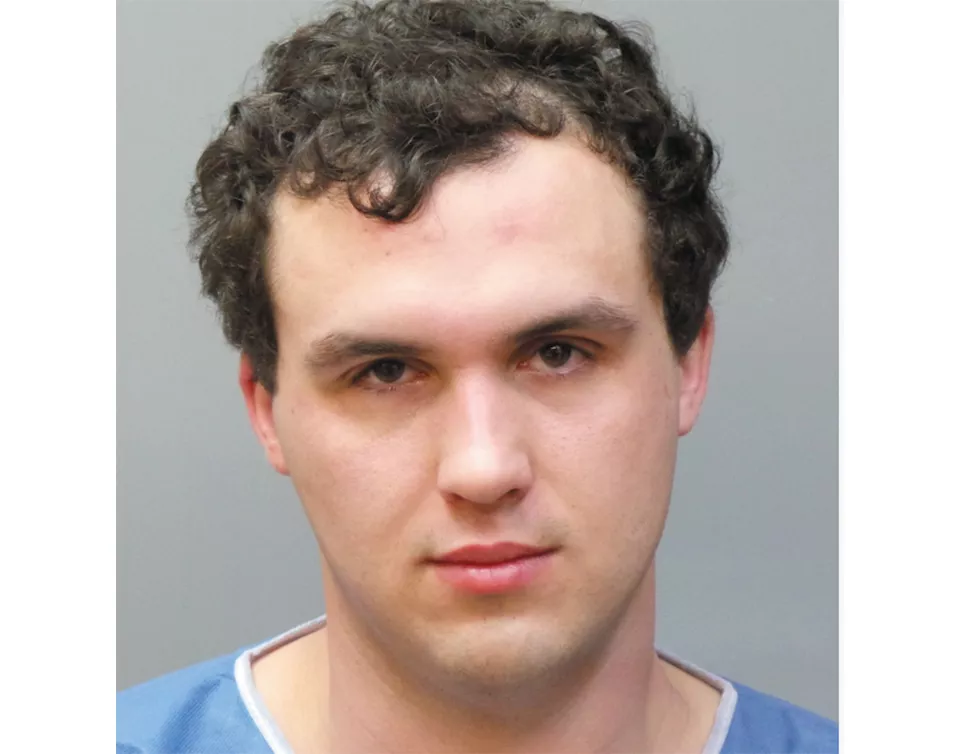
    The names of four suspects — a pair of twenty-something brothers named Blake and Caleb Laubinger, 24-year-old Zachary Smith and 55-year-old Kerry Roades — meant nothing to Davis. But mention of the fifth made him sit up in bed.

    “Did I just hear ‘Todd Beckman’?”


    Todd Beckman appears in a promotional video for MassageLuXe, one of the multiple brands he built into successful franchises. - YOUTUBE.COM

    YOUTUBE.COM

    Todd Beckman appears in a promotional video for MassageLuXe, one of the multiple brands he built into successful franchises.

    Todd Beckman’s marijuana arrived every month in shipments from California. An eighteen-wheeler would back up to the loading dock of his corporate headquarters at 11 Champion Drive in Fenton and offload crates of what appeared to be industrial toolboxes.

    It was a good cover. The building, which included offices and a large warehouse, was the nerve center of Beckman’s wide-ranging interests. Over the years, more than two dozen corporations have been registered there under his watch. Some fizzled, but others, including MassageLuXe and LifeXist gyms, had grown into multi-state franchises. The warehouse teemed with motorcycles, sports cars, racing go-karts or whatever else happened to grab Beckman’s attention.

    When a St. Louis Post-Dispatch reporter visited in 2010 for a profile of the successful entrepreneur, she noted walls covered with photos of him racing during his Formula One days, along with a “human-sized trophy” planted near his desk.

    “You’ve got to be motivated,” Beckman told her. “That’s why I have all those pictures here. They’re not just because I like to see myself. It’s because it reminds me of winning.”

    With everything going on, no one was going to notice a couple nondescript crates arriving every four weeks.

    It was Kerry Roades’ job to handle the incoming cargo. A capable mechanic and generally handy when it came to building or fixing things, he had helped take care of the literal nuts and bolts of Beckman’s big ideas for two decades. Once the crates were in the warehouse, Roades cracked them open and retrieved the true payload — between 50 and 80 pounds of marijuana in airtight packaging.


    Blake Laubinger was Todd Beckman's protege and the drug dealer trusted to move his marijuana. - COURTESY EUREKA POLICE

    COURTESY EUREKA POLICE

    Blake Laubinger was Todd Beckman’s protege and the drug dealer trusted to move his marijuana.

    From there, the weed went to Blake Laubinger, a dull-eyed young drug dealer who started as an investor in one of Beckman’s gyms and became an awestruck protégé. Laubinger stashed the pot at his house in the small town of Pacific, Missouri, parceling it out to a network of low-level dealers and then collecting the proceeds from their sales. He and Beckman split profits of about $800 per pound and sent the rest back to their supplier in California. On an 80-pound shipment, they could each clear $32,000, maybe more if the market was good.

    The operation hummed along month after month until October 2016, when Laubinger returned home to find his house had been burglarized. The 24-year-old searched desperately, but it was just as he feared — his safe with $15,000 and 24 pounds of marijuana was gone.

    In a panic, he called both Beckman and his older brother, 26-year-old Caleb Laubinger, and told them what happened. He even called Pacific police and reported the burglary, although he wisely omitted the bit about the missing marijuana and drug money.

    Both were problems. Not only had Blake Laubinger fronted his network of dealers — putting up the weed on the promise of being paid after they sold it — but Beckman had fronted him. Forget about profits; he was now in debt tens of thousands of dollars to the tanning mogul, and he worried about the consequences.

    “I mean, it wasn’t a good situation,” Blake later told prosecutors. “There was a lot of money lost, and I had no way of paying it.”

    In the short term, he says, his brother loaned him $75,000 to buy time. (Caleb Laubinger claims it was only $3,000.) But the only real solution was to find the burglar and get their money back.

    Luckily for Blake, he knew exactly who had ripped him off. A fellow drug dealer, Ellis Athanas III, knew where Blake kept the marijuana and had easy access to the house, because the two 24-year-olds had been literal partners in crime ever since meeting in 2010 at St. Louis Community College. Both were student drug dealers at the time and decided to team up.

    Athanas had long, light brown hair that hung past his shoulders, contributing to his surfer-bro vibe. He had met Beckman just once (when the middle-aged entrepreneur complained of an aching back, Athanas suggested they go to hot yoga together), but he knew when the shipments were incoming. After all, he was one of the people who had helped sell them.

    Athanas had been peddling marijuana since he was about sixteen years old but recently had grown more interested in daring drug ripoffs. “Seizing dealers’ assets,” is the way he described it.

    Blake Laubinger had teamed up with him on a few such escapades. Athanas would arrange to meet another seller in an out-of-the way location, snatch the drugs and speed off in his car. Blake, parked just out of sight, would wait until his partner passed and then pull his truck across the road, cutting off any pursuers.

    Now, he discovered, he was the one whose assets had been seized. And his former accomplice was on the run.

  • Wild St. Louis Ladies Twerk on SUV’s Roof as It Rolls Down the Highway

    Wild St. Louis Ladies Twerk on SUV’s Roof as It Rolls Down the Highway

    SCREENSHOT FROM THE VIDEO BELOW

    This past week has seen many St. Louis drivers exercising rare caution on the roadways after a massive weekend snowstorm resulted in nearly 900 car accidents across Missouri . But two women spotted twerking on the roof of an SUV as it traveled down the highway Monday apparently missed the memo.

    A Washington University employee named Jackie Friedhoff is the source of a pair of now-viral videos that show two women bent over and shaking what their mommas gave them atop what looks to be a GMC Yukon. They’re twerking even as the vehicle rolls down I-64, passing beneath the St. Louis Science Center’s pedestrian bridge at Kingshighway.

    A third person can be seen leaning out the passenger-side window, filming the spectacle. (If this is for a music video or something, please do send that our way ASAP .)

    The women in the videos are not wearing what we would call proper twerking-on-a-moving-vehicle-in-January attire, with shirts baring their exposed midriffs. (Please note, the high temperatures yesterday were in the 30s.) At least neither of them fell onto the highway during the stunt like one of our other favorite local maniacs ?

    It all just goes to prove what we’ve long known: St. Louis is wild as fuck, through and through.

    Watch the videos below:

  • St. Louis County Will Stop Prosecuting Marijuana Possession Under 100 Grams

    St. Louis County Will Stop Prosecuting Marijuana Possession Under 100 Grams

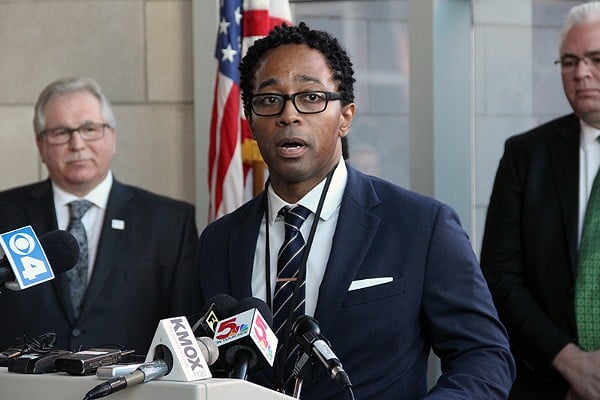
    DANNY WICENTOWSKI — St. Louis County prosecutor Wesley Bell.

    VIA POST-DISPATCH — The leaked Bell memo’s section on marijuana policy.

    When an internal policy memo from St. Louis County Prosecutor Wesley Bell leaked to local media last week, its sections on marijuana were overshadowed by the controversy over the office’s new child support policy , as well as Bell’s decision to to fire several veteran prosecutors.

    But though Bell complained in a January 5 Facebook post that the memo’s policies should not have been interpreted as “finalized,” his office confirmed to the RFT Friday that, as outlined in the memo, it is indeed halting the prosecution of all marijuana possession cases under 100 grams.

    The policy, says Bell’s chief of staff Sam Alton, is already in action.

    “For possession cases alone — not a possession with a weapon or an intent to sell — possession alone, that policy is in effect and will stay in effect,” Alton wrote in an email last week.

    That means the isolated crime of marijuana possession is no longer a crime in St. Louis County. According to the memo , “Prosecution of more than 100 grams of marijuana will only be pursued if evidence suggests the sale/distribution of marijuana.”

    It’s important to note that while Bell’s office handles felony and misdemeanor cases across St. Louis County, the 87 municipalities within its borders can still deploy police and write citations to enforce their own local ordinances. Although those come with no chance of prison, they can still count as convictions on your record.

    Still, it’s a major shift that the county’s chief prosecutor will be declining such possession cases — one that brings St. Louis County in line with a new policy rolled out last year in St. Louis city .

    “If a municipality sends our office a case of possession of less than 100 grams, and that is the only charge that does not meet an exception and/or there is no extenuating circumstance, our office will not entertain and/or issue on that case,” Alton wrote. “We look forward to working with the municipalities on this and every other issue.”

    Here’s the relevant portion from Bell’s policy memo:

    Language in the memo seems designed to disrupt multiple corners of justice system. Associate prosecutors are instructed to issue “Nolle Prosequis” on current marijuana possession cases under 100 grams, formally abandoning even those cases involving a plea deal. Also cancelled: Warrants filed for failure to appear “on possession of marijuana matters.”

    The policy also reaches into the probation system, where until now a positive test for weed could result in a violation and a possible return to prison. According to the new policy, associate prosecutors “will not file or pursue Motions to Revoke Probation arising solely from the use or possession of marijuana.”

    In the email, Alton explains that the office is looking into past cases as well, ones in which individuals had their probation revoked solely for marijuana possession.

    “If those cases meet the standard, they will also be subject to review and possible dismissal,” he wrote.

    Bell’s policy now makes St. Louis County the third major Missouri municipality to end prosecution of most marijuana possession cases. In June, St. Louis Circuit Attorney Kim Gardner set a similar policy in an email to staffers .

    Then, in November, after Missouri voters approved a ballot measure legalizing medical marijuana, Jackson County Prosecutor Jean Peters Bakers announced that her office would respond to the “mandate from voters” and end the prosecution of most marijuana possession cases. The policy, which affects Kansas City and its suburbs, was met with support by Jackson County Sheriff Darryl Forté, who called it “bold and progressive.”

    That hasn’t been the reaction in St. Louis County.

    Although the region voted for Bell, some members of the county police department aren’t that eager for the changes he seeks to implement. In an interview with KMOX , St. Louis County Police union president Joe Patterson claimed last week that officers are still obligated to enforce the federal prohibition on marijuana, no matter what Bell wants.

    “I can’t pull a guy over with 96 grams of weed in his pocket and just let him keep it. That’s not something we can do,” he said. “We’re still going to have to either write a county-level arrest summons, or there’s other recourses we have.”

    Follow Danny Wicentowski on Twitter at @D_Towski. E-mail the author at [email protected]

  • Do You Want to Know the Truth?

    Do You Want to Know the Truth?

    On the morning of November 3, 2016, Ken Allen was found dead in his dining room in Washington, Missouri, his hands and legs hogtied with phone cords, his stomach and chin resting on the blood-stained tiles. The medical examiner would later conclude that he’d been put into a sort of wrestling hold, with his assailant pressing against his airways as he choked to death.

    Within 24 hours, three people were charged with Ken’s death. But they were not charged with murder. Instead, the prosecutor insisted that his death was somehow an accident, the result of a robbery gone fatally wrong.

    The facts of the case were puzzling, particularly for Ken’s only daughter, Kallen, who couldn’t help but wonder about the signs of a struggle noted in the police report, the pool of blood at the crime scene and the injuries to Ken’s body. Then there was the fact that Ken had known the suspects.

    The pieces didn’t line up, and Kallen’s maelstrom of grief and discovery came to a head during a meeting in a courthouse conference room in 2017, the moments captured by a camera secretly recording from Kallen’s wristwatch.

    “Do you want to know the truth?”

    The question, posed by the county prosecutor to Ken’s surviving family, would shatter their sense of equilibrium and begin Kallen’s quest for truth and justice for their family.

    According to the prosecutor, Ken had been a pedophile.

    Born as Kathy Allen, Kallen (who now uses gender-neutral pronouns) was a freshman in college when they came out as gay to their father during Thanksgiving break in 1990. Then, three weeks later, it was Ken’s turn. In an emotional phone call to Kallen, he himself came out as gay. That bond would tie the father and daughter together over years and miles, but as Kallen sought the tolerant social climate of San Francisco and a career in startups as a systems engineer, Ken remained closeted in Franklin County. And though Ken came out to his wife, they opted to remain married.

    Ken had met his future wife, Janet, at Southwest Baptist University, and after living on a military base during a stateside deployment during the Vietnam War, the two moved to Franklin County in 1975. That’s where Ken’s career as a probation officer started to take off.

    About an hour’s drive west of St. Louis, Franklin County might generously be placed on the outer-most exurbs of St. Louis County sprawl. The county’s 100,000 residents are spread over 110 square miles in a handful of tiny towns and two modest cities, Union and Washington. Ken made his home in the latter for more than 30 years.

    In Franklin, the rules of small communities everywhere prevailed; standing out wasn’t encouraged. Growing up, Kallen quickly figured that out at the hands of school bullies. When a boy in high school showed up to class wearing makeup, Kallen recalls, he “got the shit kicked out of him.”

    Kallen believes that kind of intolerance surrounded and shaped their father from birth.

    “He was not able to live his truth,” Kallen says today. “He was a baby boomer, grew up on a farm in rural bootheel Missouri and was more or less a public figure in Franklin County. How do you know how to be gay? How do you be an out gay man in such a place? The answer is you don’t.”

    Not long after moving to Franklin County, Ken was assigned to supervise a newly hired probation officer named Roger Cook. It was the start of a friendship that stretched more than four decades.

    “He was a very dedicated professional — he seemed to have it together,” Cook says. He remembers Ken as a natural businessman. In the mid-1970s, Cook says, Ken established the area’s first programs designed for defendants with alcohol and drug abuse, and eventually he founded a private treatment company — a rarity for a rural area like Franklin County. Ken’s ambition grew, and in a matter of years he was managing multiple treatment centers and a host of other probation and social services. And in 2000, Ken’s Meramec Recovery Center began handling the treatment requirements for every drug-court participant in the county. The arrangement continued for more than a decade.

    But in 2013, the Office of State Courts Administrator terminated its contract with Meramec nine months early, and around that time Ken sold the business to a longtime employee. With his treatment center in new hands and his other businesses largely shuttered, Ken found himself in late-life crisis.


    click to enlarge

    Growing up, Kallen (pictured here as an infant) decided early to flee Franklin County's intolerance. Ken, though, refused to leave his home.

    Growing up, Kallen (pictured here as an infant) decided early to flee Franklin County’s intolerance. Ken, though, refused to leave his home.

    In November 2015, Kallen returned to Franklin County for a 25th high school class reunion, only to find Ken a shell of anxious desperation. He stockpiled guns, maintained multiple phones and fretted to friends about the cars with tinted windows that apparently rolled past his home at all hours. His friends’ attempts at intervention were met with vague dismissals.

    On that trip home, Kallen remembers asking Ken, for what felt like the hundredth time, if he wouldn’t be happier in St. Louis. There, he could experiment with living openly as a gay man; he could abandon his fear of the small-town rumor mill or what his clients might say. “It didn’t go well,” Kallen says now. He had refused to move, insisting, “This is my home.”

    When Ken finally offered an explanation for his anxiety, it made Kallen more worried. He claimed that people were spreading rumors about him, and that he’d been targeted for harassment. He had apparently come home one day to find that someone had poured sugar in the gas tank of his vintage Volkswagen Beetle.

    But what the harassment and rumors added up to, exactly, Ken never fully explained. Still, Kallen could tell he was obsessing over it, and that it terrified him.

    Cook, too, remembers a change coming over his friend. Over lunch in April 2016, Cook says Ken complained about a Franklin County Sheriff’s lieutenant named Jason Grellner. Ken claimed Grellner was the source of the harassment — and that the cop and others had used subterfuge to snatch away his company’s contract.

    Later that year, Ken would file suit against Grellner, Franklin County and the competing treatment center awarded the contract over Meramec. The lawsuit accused Grellner of interfering in Meramec’s recovery program by pressuring participants to serve as confidential informants.

    Grellner, the lawsuit alleged, had threatened potential snitches with being dropped from the recovery program unless they helped him build drug cases, and, ultimately, aided his political ambitions as a candidate for county sheriff. Grellner, the suit claimed, had also been “spreading false rumors” about Ken to members of the state board that awarded the contract.

    By the time Ken filed the lawsuit in August 2016, Grellner had already lost his bid for county sheriff. (Reached by phone, Grellner “completely, 100 percent” denies any wrongdoing.)

    Still, Ken was set in his paranoia. To friends and family, he claimed the harassment and rumors were only getting worse. And always, somehow, Grellner was behind it.

    “Grellner had apparently made a statement, ‘We’re going to take care of Ken Allen,’” Cook says, recalling the April conversation with Ken. “That could mean anything, but Ken took it as violence, and a serious threat.” Ken told Cook he’d started carrying a pistol.

    Cook recalls feeling shaken after his April meeting with Ken. “I really felt sorry for him, the state he was in,” he says.

    It was the last time the two spoke. Seven months later, Ken was dead.

  • The Legend of Allen Barklage

    The Legend of Allen Barklage

    Ninety-two feet above the Mississippi, the man on the bridge wept as he talked into an early-model portable phone. It was just after 6 a.m., rush hour on June 13, 1991. The man had already swung his legs over the side. He wanted to jump.

    But the phone call provided distraction for the two officers inching closer. Sauget Police Detective Vito Parisi had offered the man the phone and a suggestion that, at the very least, he should talk to his family before ending his life. Minutes into the call, Parisi and a second Illinois cop wrapped their hands around the man’s arms and shoulders.

    The three struggled, pitting gravity and one man’s self-destruction against the efforts of two cops.

    It was a classic St. Louis summer day, humid and hot. The man was dripping sweat, and Parisi felt his grip coming loose. He remembers the next seconds seeming to stretch into minutes.

    “He just slipped right through our hands,” the detective recalls. “There was nothing that we could do, except look.” There was the man, falling with unbelievable slowness, impossibly distant, arms flapping wildly. There was the shape of a body hitting the water, and the man disappeared into the cloudy wash of the Mississippi.

    And then there was the sound of a helicopter. Parisi looked up and saw the yellow-and-black machine diving out of the sky.

    It was Allen Barklage.

    A traffic reporter and pilot, Barklage had broadcast the report on the suicidal man that originally roused Parisi into action. “There’s a jumper on the bridge,” Barklage told radio listeners. Sauget lies a few minutes’ drive from the Poplar Street Bridge; the detective arrived just in time to try to stop the man’s jump.

    A different pilot might have continued with the traffic run, leaving the tragedy for the police and the morgue to sort out. Barklage was not that kind of pilot.

    From inside the cockpit, Barklage could see the man fall. He radioed back to his passengers, who included an off-duty O’Fallon cop, to get ready for a rescue. Then Barklage tilted the helicopter toward the Mississippi.

    The impact of the fall had broken the man’s rib and punctured his eardrum, but he was alive, and he was now fighting to stay that way. While Barklage kept the helicopter in a hover, the O’Fallon cop balanced himself on the landing gear and hauled the man from the river onto the skid’s metal surface. Soaking and exhausted, the man grasped the skid as the helicopter ascended, but his arms gave out a few moments later. He dropped back into the water. Barklage swung around for a second attempt, and this time, the man hung on just long enough for Barklage to drop him on a nearby barge.

    Two TV stations had captured the heroic save — though KSDK, whose chopper Barklage had flown, wasn’t one of them. In the coming weeks, Barklage smiled for award photos and commendations. He attended fundraisers with the station’s helicopter, meet-and-greets and luncheons.


    Barklage performed aerial stunts in his Mini 500 helicopter. In this photo, he's practicing snatching a hula hoop with the craft's landing gear. - COURTESY OF GENE HOFFMEYER

    COURTESY OF GENE HOFFMEYER

    Barklage performed aerial stunts in his Mini 500 helicopter. In this photo, he’s practicing snatching a hula hoop with the craft’s landing gear.

    It wasn’t the first time he had been called a hero. For more than two decades, Allen Barklage buzzed above St. Louis as traffic reporter for KSDK as well as virtually every radio station in town. He was the voice on both AM and FM, a gearhead bantering to motorists about an overturned vehicle on the highway or a police pursuit in East St. Louis.

    Through it all, Barklage never stopped chasing thrills, and emergencies seemed to chase him as well. When he wasn’t reporting traffic, he raced go-karts and happily flew under bridges for the fun of it. There must be something wrong with him, his wife would sometimes remark. Sometimes, she was only half-joking.

    Going by newspaper accounts alone, Barklage’s helicopter skills saved several lives, including that jumper in June 1991. But it was also a helicopter that killed Barklage. He died twenty years ago, days after a fatal malfunction plummeted his helicopter into the ground.

    A second anniversary involving Barklage also takes place this year. Forty years ago, Barklage ended a hijacking by shooting Barbara Oswald in the head 500 feet above the U.S. penitentiary in Marion, Illinois. That was the day he became a hero. That was the flight that made him a legend.

    The killing haunted him for the rest of his life.


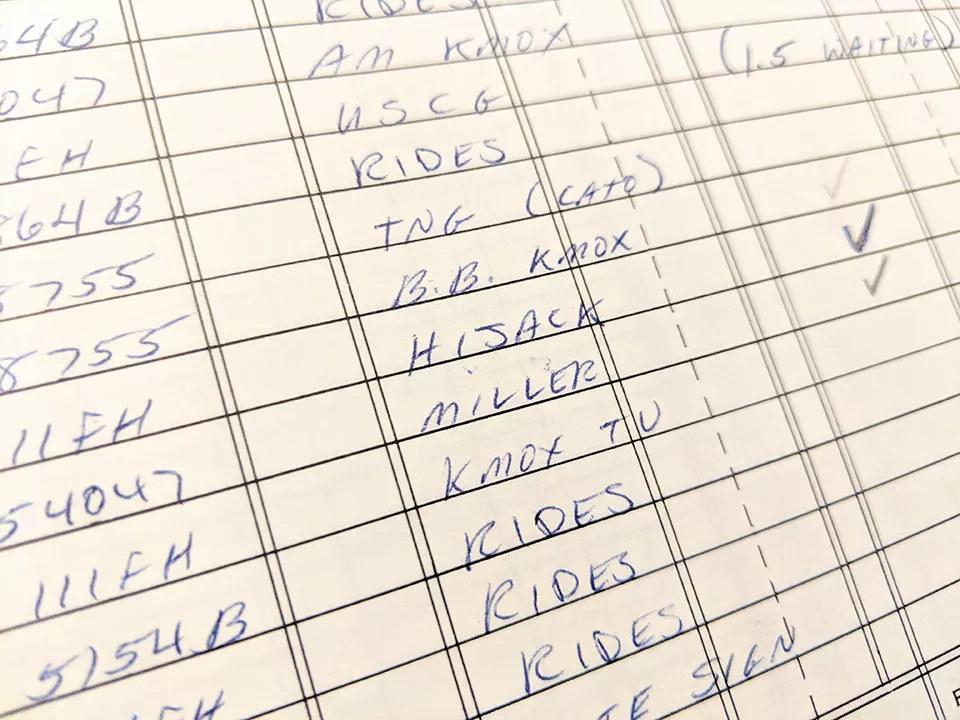
    One line of Barklage’s flight log for May 24, 1978, simply read, “Hijack.” - DANNY WICENTOWSKI

    DANNY WICENTOWSKI

    One line of Barklage’s flight log for May 24, 1978, simply read, “Hijack.”

    Gene Hoffmeyer met Barklage in the fourth grade at St. Joseph Catholic School in St. Charles.

    “He never worked at anything he didn’t enjoy,” Hoffmeyer recalls. The two spent their childhoods tinkering on cars and motorcycles, fishing and hunting rabbits in the forests and farmland around St. Charles County. They were briefly separated when Barklage’s family moved to Eureka, but the childhood friends reunited at McDonnell Aircraft Corporation, where they both landed jobs after high school. The year was 1966.

    “Of course, that was when the Vietnam War was getting hot and heavy,” Hoffmeyer recalls. “One day, Allen’s girlfriend called me up and said, ‘Come over here and talk him out of it, he’s talking about joining the Army.’” It didn’t quite work out that way. “I went over to talk Allen out of it,” Hoffmeyer says, “and instead he talked me into it.”

    The eldest of the three Barklage boys, Larry, had joined the U.S. Army intending to gain admission to flight school. He advised his younger brother to do the same, to act before the draft forced him into infantry combat. Why fight in the trenches, Larry told his younger brother, when you could soar above them?

    Allen Barklage chose the sky. Hoffmeyer enlisted a month later. Both were eighteen.

    Barklage wound up in the 192nd Assault Helicopter Company and began his flying career behind the controls of heavily armed Huey gunships. The Viet Cong shot Barklage down multiple times over the next years; photos show the young pilot in green military fatigues grinning near the wreckage of some unfortunate piece of Army property. Barklage would later tell an interviewer that he’d nearly died in Vietnam when a piece of shrapnel blew a hole into the cockpit. But he’d given up his regular seat for that flight; the man in it died.

    Barklage was lucky, but he was also very, very good at his job. After his first tour, the young combat pilot came home for additional training. He later told a reporter that he was uncomfortable with the version of America that greeted him, a place caught up in protest and anti-war fever. He wasn’t ready to come home for good.

    Hoffmeyer chose not to reenlist. Twenty-five percent of his class at flight school, some 300 pilots, had died in that first tour. For Hoffmeyer, beating the odds once was more than enough. Not so for Barklage; he remained in the Army until 1972.

    After his discharge, Barklage joined Hoffmeyer back in St. Louis, where both took jobs as commercial pilots, ferrying tourists and TV and radio reporters. Barklage was undoubtedly overqualified, but he was also lucky to find work. The war’s end had saturated the market with helicopter pilots, says Larry Barklage, who himself took a job with the Federal Aviation Administration.

    “He was a natural-born pilot, instinctual. He put on a helicopter like you’d put on your shirt every day,” he says. “I used to joke that, if they’d known how much he enjoyed flying helicopters, they would have paid him less.”

    Barklage loved flying too much to be scared by it. “I’ve been shot down three times in Vietnam,” he would tell new radio traffic reporters. The boast was meant to be reassuring — that he could handle anything.

  • The Pink Slip Has Closed, Ending an Era in Brooklyn

    The Pink Slip Has Closed, Ending an Era in Brooklyn

    NICK SCHNELLE

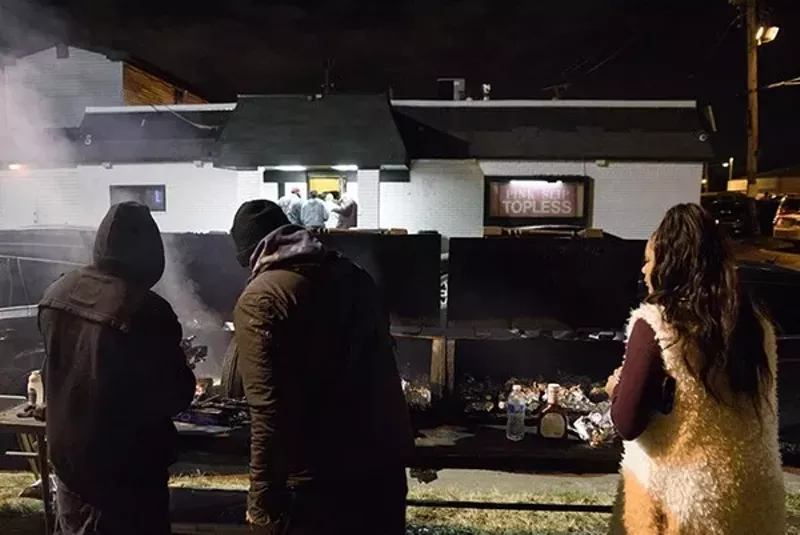
    Chef Nell served patrons outside the Pink Slip in November 2017.

    One of the East Side’s long-running strip clubs, the Pink Slip (114 South 4th Street, Brooklyn, Illinois; 618-271-3151) has closed its doors after 25 years.

    A sign on a window states simply “CLOSED out of business.” It includes a phone number for people to call for more information, but no one answers (or has responded to messages left over a two-day period). And the Pink Slip’s phone number simply rings and rings. A man patrolling a nearby parking lot confirms that the place closed a few weekends ago.

    The Pink Slip was built in 1975 and became an adult club in 1993. At one point, it was quite the establishment — parking lots both across the street and a few blocks away are marked specifically for its overflow.

    But as Thomas Crone reported in a memorable December 2017 cover story, time has been hard on the Brooklyn scene. At the time of his visit, Crone reported, the Pink Slip’s customers were 95 percent black, writing,

    Brooklyn’s scene used to be not only livelier, but also more racially diverse. P.T.’s Brooklyn, also known as P.T.’s Classic, rebranded as Black Magic just one year ago, only to later close its doors. Its primarily white sister club, Roxy’s, is still hanging in there, though at reduced hours, with a multi-hued clientele and worker base.

    Meanwhile, the S&L Rub, an erstwhile massage house, is now an empty lot, the same fate that befell Brooklyn Books after a fire. The ’round-the-clock Mustang Sally’s, up the road a piece, became a clearance house for, of all things, outdated hotel furniture; it’s now empty, the same status as the nearby club last known as C-Ro’s. Many a dollar has been made — and lost — along this short, winding, weedy stretch of highway.

    During Crone’s visit, an observer noted, “The Pink Slip itself is a community stalwart. The number of people it employs, the money it puts back in the community … tonight, it has between 25 and 30 dancers alone.” No more.

    Pour one out for the Pink Slip. And maybe read Crone’s story one more time, an elegy to a club that survived a long time in Brooklyn, but didn’t live to see 2019.

    We welcome tips and feedback. Email the author at [email protected]

  • Inside St. Louis’ Proud Boys, the Far-Right Frat Accused of Fascism

    Inside St. Louis’ Proud Boys, the Far-Right Frat Accused of Fascism

    By reputation, the Proud Boys are fighters.

    This past August, the far-right group gathered on the streets of Portland with its fellow travelers for a rally all but guaranteed to start a brawl. On one side were young men in MAGA hats wearing distinctive black polo shirts with yellow piping on the collars and sleeves. On the other, an assortment of avowed anti-fascist groups commonly lumped together as Antifa. The two sides circled, cat-called and then, inevitably, tried to knock the crap out of each other.

    Sticks, shields, bricks, bottles and mace were deployed, as small groups and individual brawlers clashed amid the sound of police flash bangs and homemade mortars. Both sides came prepared with helmets and homemade body armor.

    For the Proud Boys, fights like these are good for their image — a powerful advertisement to their ideal recruits. On the flip side of that empowerment is bitterness. The group thrives on painting itself as a victim of left-wing persecution.

    The Proud Boys organization is less than two years old, and has spent its entire existence fending off accusations that its members are part of a violent gang of white supremacists. In 2017, the Southern Poverty Law Center classified it as a “general hate group,” a title the Proud Boys fiercely contest.

    What is undeniable, though, is that some members of the Proud Boys have appeared uncomfortably close, figuratively and literally, to modern-day Nazis and white supremacists. Jason Kessler, a Proud Boy who was since excommunicated, organized the infamous 2017 Unite the Right rally in Charlottesville. Other Proud Boys attended.

    While the most active Proud Boy chapters operate on the coasts, smaller ones have opened in cities across the country, including two in Missouri: in Kansas City and St. Louis. One estimate places total membership across the U.S. at 6,000. Numbers are growing. But the attention has its costs.

    This has been a generally terrible summer for the St. Louis Proud Boys. They’ve been hounded by local Antifa groups. On lampposts, signs appeared blaring the members’ names and photos beneath a warning: FASCIST ALERT. A placard in a storefront window proclaimed “Proud Boys Not Welcome.” And while in Portland the Proud Boys met street fighters, in St. Louis they were confronted with something much trickier: a social media onslaught directed at both them and any venue unfortunate enough to host them. They’ve been run out of two bars — and had their private Facebook groups infiltrated.

    In July, Riverfront Times received an email from a Milwaukee, Wisconsin-based “anti-fash collective” calling itself Right Wing Leaks. Posing as a recruit via a fabricated Facebook account, the collective managed to pass the Proud Boy vetting process and gain access to a closed Facebook group for Missouri Proud Boys. Right Wing Leaks then captured screenshots of members’ Facebook profiles and about two dozen videos of the St. Louis chapter’s initiation rites.

    In one video, the president of the St. Louis chapter, a white guy with windblown black hair and aviator sunglasses, records himself taking the Proud Boy pledge.

    “My name is Mike Lasater,” he says in the video. “I’m a Western chauvinist, and I refuse to apologize for creating the modern world.”

    Lasater flashes an “OK” gesture, his index-finger and thumb joined to make an O along with three raised fingers.

    He finishes the pledge. “The West is the best,” he says.


    Proud Boys founder Gavin McInnes devised the group's distinctive look (the shirts) and jargon ("Western chauvinism"). - SHUTTERSTOCK

    SHUTTERSTOCK

    Proud Boys founder Gavin McInnes devised the group’s distinctive look (the shirts) and jargon (“Western chauvinism”).

    On the first Friday in August, Mike Lasater and two other Proud Boys settle on stools in a south-city bar. They’re drinking the group’s preferred beverage combination: Budweiser and straight shots of Maker’s Mark.

    The bar, Tuckers, is a rarity for St. Louis. Not to be confused with Tucker’s Place, the well-loved trio of local steakhouses, this Tuckers is located so far south in the Patch neighborhood, it’s practically St. Louis County. It has a dive bar’s classic grungy charm — at 8:30 on this Friday night, karaoke night, the regulars are already blasted and teetering on their feet. But not many establishments in this deep-blue city hang a sign above their front door stating, in giant red letters, “TRUMP.” Below that, the sign, a veritable jumble of messages, shouts “St. Louis needs jobs and I need customers!!!” and “Support Your Police.”

    Tuckers is the closest thing to a safe space that the Proud Boys have in St. Louis.

    On the TV above the bar, the Cardinals are playing the Pirates. The Pittsburgh players’ black-and-yellow jerseys bear an uncanny resemblance to the tightly fit, black-and-yellow Fred Perry polo shirts worn by the three Proud Boys huddled at the bar’s least crowded end.

    These three identically-clad young men, all in their late twenties, are talking about Portland.

    “It actually proved one thing, and it’s that Antifa are the aggressors,” says Luke Rohlfing, a St. Louis native who travels the U.S. while writing for the right-wing news site Big League Politics. Rohlfing spent his morning tracking livestreams and Twitter feeds of the August 3 Portland action, which he then used to opine about how the leftists were to blame for the confrontation.

    Next to Rohlfing, Lasater tips his beer in agreement. The Proud Boy chapter president wears two matching gold-leaf collar pins on his polo. His belt buckle spells out “candy,” and a gold medallion rests in a thicket of exposed chest hair. By Proud Boy standards, he’s as flamboyantly proud as they come.

    “Left to our devices, we’re not a violent organization,” he says.

    In conversation, Lasater tends to downplay the role of violence in the group’s DNA, focusing instead on similarities to traditional fraternal organizations, men’s clubs, the Freemasons and Knights of Columbus.

    “We’re a drinking club,” he says, gesturing at the bar around him. “I mean, as the St. Louis Proud Boys, what have we done since we started? We’ve gone out for beers, and we’ve made friends.”

    Perhaps. But they’ve made enemies, too. Lasater founded the local chapter in spring, not long after (as he tells it) a business partner at the bar he co-owned, the Livery Company, decided to out him on Facebook as a Trump voter. The partnership broke down from there, and he says he was forced to abandon his role.

    The bar’s co-owner, Emily Ebeling, says Lasater’s departure had nothing to do with his political views, but admits that she was the one who publicized his vote for Trump.

    “I did call him out for voting for Trump,” she says. “I considered him a friend, a close friend, and he had lots of friends who Trump wouldn’t protect. As a woman and a gay woman, I felt betrayed that he could vote for what Trump stands for.”

  • ALL OPPOSED, SAY “NEIGH”

    Thousands of British telly viewers recently learned a great deal more about Missouri’s warm-and-fuzzy down-home culture than the state Department of Tourism probably wanted them to know.

    In their living rooms, the Brits watched as Carl Junction, Mo., resident Mark Mathews led his wife, Pixel, into his trailer, then made passionate love to her.

    “She’s gorgeous,” Mathews gushed. “She’s sweet. She’s loving. I’m very proud of her…. Deep down, way down, I’d love to have children with her.”

    But there’s a slight biological hitch:

    Pixel is a horse.

    The British documentary, Hidden Love: Animal Passions, was an exploration of Missouri’s zoophile community, which claims that copulating with critters should simply be considered an alternative sexual orientation. Missouri, it turns out, is one of 26 states that do not bar human beings from having intercourse with animals.

    “In Missouri,” wrote television commentator Victor Lewis-Smith for the London Evening Standard after the show’s airing on UK Channel 4, “you can not only take your poodle to the opera, you can buy it a negligee and indulge in some no-nonsense beef-bayoneting afterwards, without fearing a knock on the bedroom door from the disapproving authorities.”

    There’s some evidence to suggest that interspecies intercourse is going on in the Show-Me State. According to Tim Kniest, spokesman for the Missouri Department of Corrections, polygraph tests administered last year to 116 sexual offenders who were on parole or probation in the northwestern section of the state indicated that half of them admitted to having had intercourse with an animal at some point in their lives. And there’s anecdotal evidence that others outside the criminal-justice system are indulging their animal passions.

    “There’s a very big underground community here,” says Sheila Rilenge of the Missouri Alliance for Animal Legislation, a not-for-profit group in St. Louis that wants to see laws passed during the next legislative session that would, at the very least, make intercourse with animals a misdemeanor.

    Animal-welfare organizations say the explosion of Web sites promoting bestiality and zoophilia is forcing the issue out of the barn.

    “In the past, in a town of 100,000 there might be one person with this predilection,” says Stephanie Lafarge, a sex therapist and director of counseling at the American Society for the Prevention of Cruelty to Animals. “And that person would never announce it and would go to his grave with it.

    “Because of the Internet,” Lafarge says, “there is a lot of new communication going on, urging people to come forward, to be identified and to get trained. They have parties. There are personal ads. They’ve created a support system for themselves. Nobody has any numbers, but because of the Internet, I am sure there is much more of this going on now than there used to be.”

    Lafarge notes that two groups of people indulge. The first are bestialists, who like to rape animals or like to watch trained animals rape other people. Type the word “bestiality” into any search engine, and you’ll get more than 450,000 hits such as “The Fun Farm” or “Man’s Beast Friend,” which mostly show pictures of things like “Heidi Sucking on Joey the Horse.”

    The second group are zoophiles, people like Mark Mathews, who love animals in an emotional sense and want to have intercourse with them as a result. A search of “zoophilia” turns up more than 15,000 hits such as “The Ultimate Zoo Page” and “The First Church of Zoophilia,” which will perform marriage ceremonies between adherents of the church and their loved ones.

    According to the unnamed author of the Ultimate Zoo Page, sites like his are a place for “zoos” to find solace and to learn how to express their love for animals. He adds that as more and more people come out of the closet about their zoosexuality, the easier it will be for society to accept them. “Zoosexuality is an orientation, in the same category as hetero-, homo-, and bisexuality,” the author states. “We are not sick at all…. Zoosexuality is an alternative lifestyle…. We do not choose to be zoos, it is a part of us.”

    Links are provided for the visitor, directing them to other sites where they can learn how to make love to the animal of their choice, including geese, dolphins, sheep and pigs. Rilenge, of the Missouri Alliance for Animal Legislation, says that on one zoophile page she investigated, six ads had been placed by Missouri residents with trained animals available for lease.

    “But this is not just about the animals,” Rilenge says. “This is a social issue. Frequently the abuse of animals is linked to the abuse of women and children later on, whether that be cruelty to animals in a sexual nature or just neglect. It’s almost unusual when a violent offender has not first had experiences with animals.”

    In New York, where copulating with critters is illegal, Lafarge counsels offenders for the state correctional system. She says it’s important to make the distinction between bestialists and zoophiles, because zoophiles try not to hurt their animals, whereas bestialists do.

    “There is no evidence yet that zoophilia leads to sexual deviation, but that’s not to say that’s not the case,” Lafarge says. “We do make the link between other forms of physical violence against animals as being a predicator of physical violence against women and children. I would go on to say that someone who is sexually violent with an animal, like a beastialist, is a predator and might very well do that toward people.”

    The Alliance for Animal Legislation is talking with state lawmakers about sponsoring a bill that would ban interspecies intercourse, and even though it is not legislation most politicians would vote against, the alliance, as of our deadline, has not pinned down a sponsor.

    “I wouldn’t touch that with a 10-foot pole,” one legislator told The Riverfront Times.

  • Kerry Roades, Sidekick to Tan Mogul Todd Beckman, Sentenced to 10 Years

    Kerry Roades, Sidekick to Tan Mogul Todd Beckman, Sentenced to 10 Years

    COURTESY ST. LOUIS COUNTY

    Kerry Roades was sentenced to more than a decade in prison.

    A St. Louis tanning executive’s right-hand man was sentenced on Wednesday to ten and a half years in federal prison for his role in a violent kidnapping-for-ransom case.

    Kerry Roades, 57, of Fenton was a longtime friend and business associate of Todd Beckman, the founder of TanCo tanning salons and string of other lifestyle brands. The two men also ran an off-the-books marijuana distribution scheme, parceling out shipments of 50 to 80 pounds to other dealers.


    Todd Beckman and Roades were longtime friends. - Image via BAM Brands

    Image via BAM Brands

    Todd Beckman and Roades were longtime friends.

    In November 2016, Beckman sent two young brothers after a 24-year-old marijuana seller who had ripped him off. The brothers, Caleb and Blake Laubinger, snatched the man from his Maplewood home, beat him and hauled him back to Blake’s house in Pacific.

    There they bound him to a pole and tortured him with beatings and a Taser. Authorities say Beckman and his sidekick Roades arrived later and took turns torturing and threatening to kill the man.

    The man was eventually moved to a shipping container on a rural piece of property owned by Beckman; they only let him loose after the man’s parents paid a ransom. All four of the kidnappers, plus a fifth defendant, Zachary Smith, who played a minor role, were arrested in December. Beckman, Roades and the Laubingers all pleaded to conspiracy to commit kidnapping.

    Roades, who was forced to switch attorneys after his lawyer was hired by the U.S. Attorney’s Office, was the last defendant to be sentenced in the case. During the hearing, Assistant U.S. District Attorney John Davis described him as a shrewd operator, making him “the alpha male and the alpha criminal” among the other players, the St. Louis Post-Dispatch reported.

    U.S. District Judge Audrey Fleissig previously sentenced Beckman to twenty years, Blake Laubinger to six and a half years and Caleb Laubinger to five years, ten months.

    We welcome tips and feedback. Email the author at [email protected] or follow on Twitter at @DoyleMurphy.

  • As St. Louis’ School Desegregation Program Winds Down, No One Can Say What Comes Next

    As St. Louis’ School Desegregation Program Winds Down, No One Can Say What Comes Next

    For the past five years, Cynthia Wren, 66, has applied to get her ten-year-old granddaughter, Ariel Gibson, into St. Louis’ student desegregation program.

    The Voluntary Interdistrict Choice Corporation, or VICC, oversees the student transfer program. It is a race-based transfer that allows black city children to attend county schools, even as white students in the county can attend city magnet ones.

    Ariel is black and lives in the Shaw neighborhood of St. Louis city. Part of her application includes ranking her interest in much more highly rated suburban districts. If she’s chosen, it could be a ticket to a top-tier public school district: Brentwood, Kirkwood, Clayton.

    But she hasn’t gotten in. So the ten-year old attends Tower Grove Christian Academy. In lieu of sending her granddaughter to an elementary school run by the St. Louis Public Schools, or SLPS, Wren pays Ariel’s private school tuition. A former teacher’s assistant and current substitute for St. Louis County Special School District, Wren says that paying Ariel’s tuition is a hardship for her family.

    “It’s not always easy,” she says. “But we do what we have to do.”

    Wren plans to continue applying to VICC for her granddaughter in the years to come. But it’s a lottery situation, and with a 17 percent acceptance rate, the odds are against her.

    “I just don’t understand the situation,” Wren says. “[Ariel’s] being skipped over and it breaks my heart to know she hasn’t gotten in.”

    Ariel isn’t alone. In 1999, VICC reached its peak enrollment of 14,626 students. Since then, though, the program has been on steady decline. Last school year, 4,392 students were enrolled.

    It’s not a case of lessening demand. A total of 2,488 black students living in the city applied to VICC for the 2017-2018 school year. Just 413 were accepted. (Of the 148 white students from the county who applied to attend St. Louis magnet schools through VICC, 85 were accepted.)

    And the clock is ticking for Wren and her granddaughter. This month marks the official beginning of the end for the desegregation program, beginning the five-year extension that provides one final reprieve before the education leaders running VICC plan to shut it down entirely.

    VICC oversees the longest-running race-based student transfer program in the nation, and even as it’s brought a dose of color to many affluent county districts, it’s also been a real boon to thousands of lucky city kids. State Representative Bruce Franks (D-St. Louis), who graduated from Lindbergh High School in 2002, is just one prominent alumnus.

    Yet if you ask the people in charge of the program — the superintendents of the twelve schools that make up VICC’s governing board — what comes next, and what they’ll be doing to increase diversity in districts that would be largely monolithic absent the transfer students, they’ll acknowledge they don’t know just yet.

    “We want to roll into this new five-year extension,” says Eric Knost, Rockwood superintendent and VICC chairman for the 2017-2018 school year. “Once things start to settle a little bit, we will start talking about what’s beyond the five-year extension.”

    He acknowledges, “We really haven’t even scratched the surface yet on what’s to come.”

    Since 1981, more than 70,000 black students from St. Louis city have attended schools in St. Louis County through the VICC program. Under its auspices, white students from the county have also been attending magnet schools in the city since 1982, albeit in much smaller numbers (9,000).

    Those students have added much-needed diversity to some county districts. In 1999, the year of VICC’s peak enrollment, participating county districts notched an average of 20 percent black students. Had VICC not existed, the projected black enrollment would have averaged a mere 4 percent.

    Nearly two decades later, not much has changed, demographically. In 2017, black enrollment within participating districts averaged around 15 percent. Without VICC it would’ve been just under 7 percent.

    But as the years have gone by, some of VICC’s original participants have pulled out. Hazelwood, which was steadily growing more diverse even without transfer students, left in 1988. Ladue and Ritenour both exited in 1999, Pattonville in 2005 and Lindbergh in 2011. (Students in the program were allowed to graduate from the districts they’d been placed in, making the districts’ withdrawal a gradual one.)

    According to VICC, the districts left the program after finding other ways to enable diversity in their schools. Ladue, for example, consolidated its ten neighborhood elementary schools to four in the 1970s. At that same time, Ladue also redrew its school boundaries. In doing so, the district, which is made up of nine municipalities (Creve Coeur, Crystal Lake Park, Frontenac, Huntleigh Village, Ladue, Olivette, Richmond Heights, Town and Country and Westwood) plus some parts of unincorporated St. Louis County, created more racial diversity in its schools.

    Lindbergh, though, hasn’t quite done that. The district saw black enrollment as high as 20.56 percent in 1999 thanks to its participation in VICC. By the time it pulled out, that had dropped to 6.11 percent. Lindbergh’s last VICC student graduated in 2017, and at that point, its black enrollment had sunk to just 2.69 percent — around ten times smaller than it was in 1999.
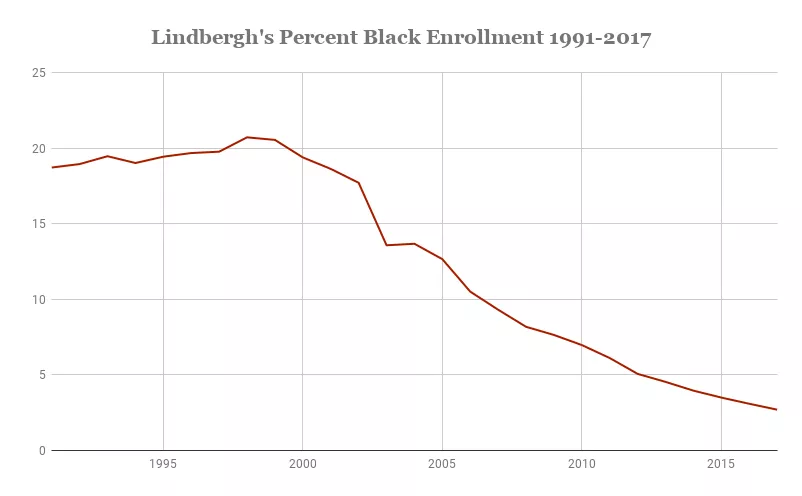
     

    The percentage of black students at Lindbergh schools plummeted after it pulled out of VICC. - GRAPHIC BY CAMILLE RESPESS

    GRAPHIC BY CAMILLE RESPESS

    The percentage of black students at Lindbergh schools plummeted after it pulled out of VICC.

    In the coming years, absent some sort of replacement transfer program, what’s happening at Lindbergh could happen to districts across the county.

    VICC’s board approved that final five-year extension in November 2016. It’s set to run from the school year that just began through 2023-2024 and will accept around 1,000 students into the twelve participating school districts during these five years. Priority for acceptance into VICC during its final extension will be given to siblings of students already in the program.

    It’s a long goodbye, by any measure. If a kindergartner is chosen for the program during its last year, 2023, he or she wouldn’t be on track to graduate until 2036 — walking an increasingly lonely road as other minority students graduate and move on.

    From its inception, VICC’s model was built on continual phase-out. The program was set up in 1999 to dwindle at a rate of 5 percent over a twenty-year period. And that’s exactly the outline its remaining districts are following.

    VICC leaders say that their long-held plan to phase out the program dovetails nicely with the growing ambitions of the St. Louis Public Schools. After all, VICC takes black students to county schools who would have otherwise been zoned to attend city schools.

    “Clearly, county schools benefit [from VICC] by creating a more real and diverse student environment,” Knost says. “At the same time, we have got to keep the interest of the SLPS.”

    In 2012, the St. Louis district regained provisional accreditation after five years of operating as non accredited. In 2017, the district became fully accredited.

    “We are trying to be competitive as we can for families to look at us as a real option,” SLPS superintendent Kelvin Adams says.
    But while Adams says he believes the desegregation program has fulfilled its purpose, he agrees the ending of this iteration of VICC may not mean the end of transfer programs between the city and county school districts.

    “I’m not saying it can’t continue in some way, shape or form in the future,” Adams says.

    Maalik Shakoor, 22, graduated from Clayton High School in 2014. He was bussed from his neighborhood of Baden in north St. Louis for the twelve years he was in VICC: first to Bierbaum Elementary School in south county, then to Clayton for middle and high school.

    Shakoor graduated from Webster University in May with a degree in film production. He’s spent the summer as a teacher at the Freedom School in St. Louis.

    Though Shakoor wishes he could have gotten a strong education in his own neighborhood, he sees the value in VICC.

    “If [black children in the city] can’t get a good, quality education where they’re at, then the next best solution is to bus them out,” he says. “Until the city schools can be up to par with the county schools, I see no other option.”