Tag: Music News & Interviews

  • Review: Celebration Day Delivered a Whole Lotta Top-Notch Led Zeppelin

    Review: Celebration Day Delivered a Whole Lotta Top-Notch Led Zeppelin

    Jen Gray

    Celebration Day effectively captures the verve of Led Zeppelin.

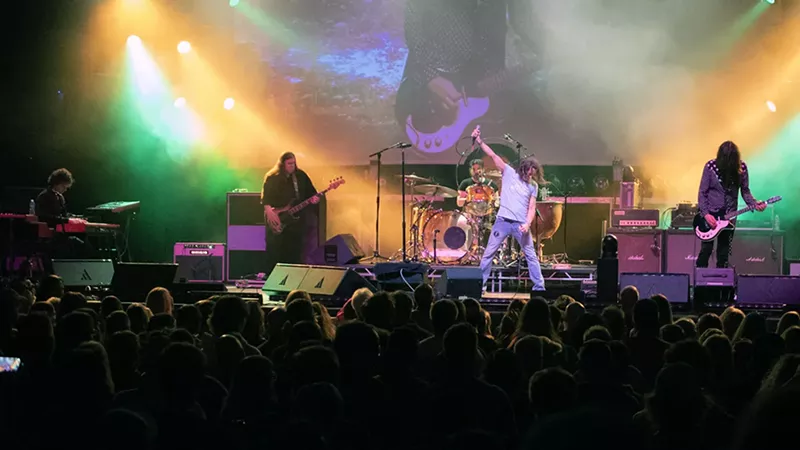
    Celebration Day played two sold-out nights at the Pageant over the weekend, a late-February tradition for St. Louis’ all-star Led Zeppelin tribute band.

    The show has become heaven for a crowd that has worshiped Zeppelin since Mondale was vice president, but the men in Celebration Day have earned rock-star status themselves by bringing the music to badass life with remarkable accuracy and muscle since 2006.

    This year’s installment came with a massive, video-screen backdrop that provided close-ups of the band in action, embellished with psychedelic swirls and other trip-tastic effects. It was the kind of thing normally found only in arena-sized venues — but a welcome element here.

    On Saturday night, the opening minute of the band’s namesake song made clear that singer Mark Quinn’s voice was resplendent despite having just performed three hours of prime Robert Plant the night before. Hitting the stage with his shirt tied in front, halter-top-style, Quinn is a painfully fit frontman, and while the band makes no attempt to physically resemble the members of Led Zeppelin, Quinn clearly knows his way around his wrist-cocked Plant-ian hand gestures.

    Vocally, Quinn was a cyclonic force, belting every song in their original keys, never cheating a millimeter of a note — not on the Viking orgasms on “Immigrant Song,” the Mordor-cliffs-high notes on “Ramble On” or the chest-voice F5 on “Since I’ve Been Loving You.”

    Quinn introduced guitarist Jimmy Griffin as “the Magician,” who proved Quinn right all night. Dressed in a riot of polka dots, Griffin got to all of his famous stage moves (the reverse bunny-hop, the knock-kneed squat, the backbend, the grinning leaner) and scratched the itch of Zepheads waiting for their favorite Jimmy Page moments — the Les Paul-mauling breakdown on “Heartbreaker,” the cello bow on “Dazed and Confused,” the slide solo on “What Is and What Should Never Be,” and even the space-out theremin sorcery on “Whole Lotta Love.”

    Drummer John Pessoni had the herculean task of replicating John Bonham’s time shifts and Bonzo-bonkers fills all night, and there is no trick he didn’t turn — the inverted reggae of “D’yer Mak’er,” the herky kick-drum timing of “Kashmir,” the hi-hat-crazy cadence of “Rock and Roll,” the brawny backbeat of “When the Levee Breaks.”

    Cubby Smith has the busiest right hand in the bass biz, ideal as he manhandled the runs on “Black Dog,” locked into the pocket of “Living Loving Maid” and zipped through the bumblebee lines on “The Lemon Song.” (Kudos also to the videographer for the salacious camera work when “The Lemon Song” got to the juice-down-the-leg bit.)

    Keyboards ace Dave Grelle was nursing a broken finger, but you’d never know it. His big moment was a sense-altering extended solo in the middle of “No Quarter” — his left hand on organ, his right on electric piano — filled with improvisational winds-of-Thor avant-garde-jazz.

    A midshow acoustic set saw Smith switching to electric mandolin and guest Jim Peters on lap steel as the band ran through “That’s the Way,” “The Battle of Evermore” (arranged as a lovely duet with Trixie Delight’s Kelly Wild), “Going to California” and “Babe, I’m Going to Leave You.”

    Quinn dedicated a gorgeous version of “The Rain Song” to the “heavenly birthday of George Harrison,” who’d inspired Page to write the song and who would have turned 80 on Saturday.

    Then the band took the night’s deepest dive with the Physical Graffiti track “In the Light,” with Quinn and Pessoni singing spooky harmonies and Grelle bending organ notes, at which point a fan in front of the stage got a bustle in her hedgerow and passed out. The band cut the song short as a medical team revived her, at which point Quinn returned to the stage wearing a timely “Nurses Do It Better” T-shirt.

    After Homeric takes on “Whole Lotta Love” — with “Bring It On Home” and “How Many More Times” interludes — Quinn told the crowd, “We hope you got your money’s worth!” After three hours of serious Zeppelin, a still-energized Pageant let him know that the band had more than earned it.

    Coming soon: Riverfront Times Daily newsletter. We’ll send you a handful of interesting St. Louis stories every morning. Subscribe now to not miss a thing.

    Follow us: Google News | NewsBreak | Reddit | Instagram | Facebook | Twitter

  • A St. Louis Rapper Lost His Brother — Then Wrote a Hit Single

    A St. Louis Rapper Lost His Brother — Then Wrote a Hit Single

    Braden McMakin

    Donald Walker poured his pain into “Not Alone” after his brother died. The song blew up, getting more than a million views.

    Donald Walker can feel Nunu in the Starbucks. He pauses. He stares off into the walls of the quiet coffee house in north county, his eyes full of water and a soft smile on his face, as if he’s sharing a moment that no one else can see. It’s been three years and three months since Nunu was murdered at the age of 13. But Walker still sees him a lot. His smile. His warmth. His desire to be a musician. Whenever he gets in the studio for sure. And now in this Starbucks.

    “I feel like he right beside me,” Walker says. “He here right now.”

    Nunu, a.k.a. Clifford Swan III, was the reason that Walker started making music. Becoming a famous musician was Nunu’s dream, not Walker’s. Nunu would bounce around the house, blasting YoungBoy Never Broke Again, holding a toy microphone, freestyling for days, pretending to be a Louisiana rapper. Nunu brought life to a room, always joking and playing. “Nunu was funny as hell,” says his cousin Rico, who also goes by Ap5ive. “Like, I promise you, Nunu can make you laugh when you got a badass day.” He was sweet — the kind of person to call randomly just to say hi — and incredibly smart, a straight-A student who had recently signed a contract with Nickelodeon for acting.

    Then, Nunu was killed on September 12, 2019. The 13-year-old, an innocent bystander, was shot while walking to the store by an 18-year-old who mistook him for someone else.

    The killing suffocated Walker in pain. They were extremely close. Nunu looked up to Walker, wanted to be like him, and Walker saw himself as his little brother’s protector. “He was like more of a father figure than a big brother to him,” Rico says.

    Nothing touched Nunu — until it did. And Walker didn’t know how to respond. People told him that he wasn’t alone. “You’re not alone, you’re not alone,” they repeated. But, as Walker says, “I felt alone.” His little brother was dead.

    So a week after Nunu was killed, Walker walked into his little brother’s room. He did what Nunu would have done: He made a song. He found a YouTube beat that “touched” him and bought it for $800. In one day, he emptied all of his grief, trauma and sadness onto the pages of his notebook with a red pen. Everything he felt. “They told me, ‘Hold my head up,’ but I just keep it down,” he wrote. “Ain’t no more smiles, all frowns when people come around.”

    The emotions were easy to describe, he says. But finding a hook to draw people in and capture his pain — that wasn’t so easy. Sitting in his brother’s room, he asked Nunu for help. Then it appeared in his mind, the iconic chorus that would define his first song.

    “Tell me how I’m not alone / They say you are not alone / And I just want my brother home / I can’t believe my brother gone / So tell me how I’m not alone.”

    He released the song on October 29, 2019.

    It blew up.

    “Not Alone” would become Walker’s hit song, under his childhood nickname, Head. Within 45 days, it had 1 million views on YouTube. Agents from Capitol, Atlantic and Def Jam Records flooded his phone. Fans from Germany FaceTimed him. A 13-year-old from Australia told him that the song stopped him from committing suicide.

    Nunu’s story and “Not Alone” were highlighted in a 2021 Riverfront Times cover story. But Walker’s story is still ongoing. The song sent him down an unexpected path: At 23, he is a musical artist known around the world. Since “Not Alone,” he has released multiple songs that drew more than 100,000 views, and he moved to Atlanta to pursue music.


    A man holds out an image on a phone screen.

    Braden McMakin

    Donald Walker’s brother Nunu, left, was central to his life.

    To this day, “Not Alone” is still Walker’s most famous song, with more than 9 million views on YouTube. It touched people in a way few songs can. Really, it was how candidly he spoke about death. In the song, Walker doesn’t try to hide from grief. He doesn’t try to sugarcoat it. He doesn’t try to pretend that it’s all OK or that he should feel better or move on or forget about it or use it as fuel.

    He raps what he feels: pain. Pure, aching, neverending pain.

    “Pain,” he says, “lasts forever.”

    You can read it in his lyrics. “People telling me that you feel me / Fuck nah you just hear me.” You can hear it when he sings, his soft voice crying out for help, or the parts where he raps, his voice sinking deeper, booming louder and cracking with anger.

    Even after he released “Not Alone,” death has been a constant in Head’s music. His next song, “Die Today,” gave advice to his family if he died. “If I die today, God please take my soul / No funerals, party it up, I’mma forever gonna live long.” “By Myself” portrays a character contemplating suicide. “Moma I’m Sorry” is a letter to his mom, apologizing for going back into the streets and risking his life.

    To an outsider, Walker’s musical catalog resembles a diary. He only has 15 songs, and he seems to make music when he needs it. “It’s like therapy,” his cousin, Deontra, says. Some songs are one minute long, others three minutes. One is a love letter to his daughter. In another, he’s fighting the “demons” inside of him.

    “We all got feelings,” he says. “I’m gonna let it out. … I’m gonna open up for them, and I’m gonna let it be known that it’s OK to open up.”

    But he’s still trying to make sense of a career he never saw coming.

    “I still got to tell myself I’m a rapper,” he says. “I be telling people, ‘Yeah man, I ain’t no rapper.’ And they be like, ‘No, boy, you is a rapper. You know how many views you got?’”

    Music surrounded Walker throughout his life. Multiple people in his family were artists. Walker, though, was more of a “sideman,” Rico says, a manager. He helped his cousin, 5ive, for example, write his hit song “Me and My Brother,” which received nearly 90 million views. And of course, he listened to Nunu talk about music all the time.

    But Walker never planned to make his own songs. In many ways, it was because he never had the opportunity.

    “Head wasn’t nowhere near rap,” Rico says. “That shocked everybody.”

    Walker grew up all across St. Louis in a large, close-knit family made up of his mom and five siblings. He went by the nickname Head — a nod to his big head. Walker was the life of the party, just like his little brother. “[Walker] can make a joke out of everything,” Rico says.

    But his childhood wasn’t easy. They had little money. They bounced from house to house.

    “I feel like [Walker makes] music for people that grew up like him and came from places like him,” Deontra says. “Shit, we grew up in the hood. We didn’t really have much.”

    Then, at 12, Walker had his firstexperience with death — when he lost his four-month-old little brother, who died in his sleep. With his mother absorbed in grief, Walker stepped up.

    As a teenager, he began stealing from stores, disguising “BB guns as if they were real guns” and selling weed — doing anything to feed and clothe his family.

    “It was a purpose behind everything I was doing,” he says. “I wasn’t just doing it because I’m hanging around these boys and they stealing, so I want to steal [because] I ain’t got no friends. Hell nah. I was really doing this shit for my mama’s kids to eat. So everything I was doing, I’m bringing it home — for us.”

    As a high schooler, Walker stopped stealing, focused on his schoolwork and graduated from Hazelwood East in 2017, where he starred as a linebacker and received two college scholarship offers. But he didn’t take the offers. He couldn’t go to college. His family needed money, he says. When asked what he wanted to be when he grew up, he says: “To tell you the truth, a provider.”

    He had no grand plans — until Nunu died, and he found a new path.

    “I’m like, fuck it, I’m just gonna chase his dream,” Walker says. “He’s gonna live through me.”

    Another turning point happened nine months after Nunu died: Walker’s daughter was born. The second he saw her feet, he says, he knew his life had changed. Still grieving over Nunu, his daughter gave him a new sense of motivation and purpose. “He wasn’t thinking for himself, no more,” Rico says. “He got somebody to live for. He got a daughter.”

    In the summer of 2021, he moved out to Atlanta to focus more on music, spending long days in the studios and meeting producers. “I can’t jeopardize my life no more / My little girl need a father,” he wrote in “Benji,” the love letter to his daughter. “… For you, baby, I shake the ground.”

    But the music industry hasn’t been a simple rise to the top.

    When “Not Alone” was released, Walker dropped into the music world with no blueprint. Labels offered him million-dollar contracts, but he turned them down because they wouldn’t give him creative control. “I’m worth more,” he says. He has sporadically put out music since 2019, totaling around 15 songs. None have struck the same chord as “Not Alone.” Sometimes he wonders if he missed his chance. His money trickled away as time passed, and for a period, he returned to the old life that he had set behind. “Shit hit the fan again,” he says. “I had to hustle. I had to hustle again.”

    But Walker says he doesn’t feel bitter that his career hasn’t skyrocketed yet. Actually, he feels encouraged. He has no manager or label or agent. He hasn’t put out an album, hasn’t posted consistently, hasn’t even wrapped his head around being a rapper — and yet, he’s made it this far.

    Still splitting time between Atlanta and St. Louis, he wants to post more consistently. “Consistency completely will change everything,” he says. This year, he plans to release a mixtape, six singles and an album. Already, he has put out two new songs. He says he is expanding his repertoire, combining his signature pain music with fast-moving, turn-up music.

    “My numbers, in my eyes, can only go up,” he says. “I came a long way. … I don’t care if … this song-flower don’t bloom overnight. I started from nothing. So to them, I’m not doing something. To me, I’m doing something.”

    But Walker says he’s not doing this for the fame or money.

    He’s making music for the reason he made it in the first place: to carry on the legacy of his little brother, Nunu.

    “He’s the reason I do it,” Walker says. “He’s the only reason I do it.”

    This story has been updated to correct the date Clifford “Nunu” Swan III was killed. We regret this error.

    Coming soon: Riverfront Times Daily newsletter. We’ll send you a handful of interesting St. Louis stories every morning. Subscribe now to not miss a thing.

    Follow us: Google News | NewsBreak | Reddit | Instagram | Facebook | Twitter

  • Inside St. Louis Glam-Metal Legend Frankie Muriel’s Rise and Fall

    Inside St. Louis Glam-Metal Legend Frankie Muriel’s Rise and Fall

    Courtesy Photo

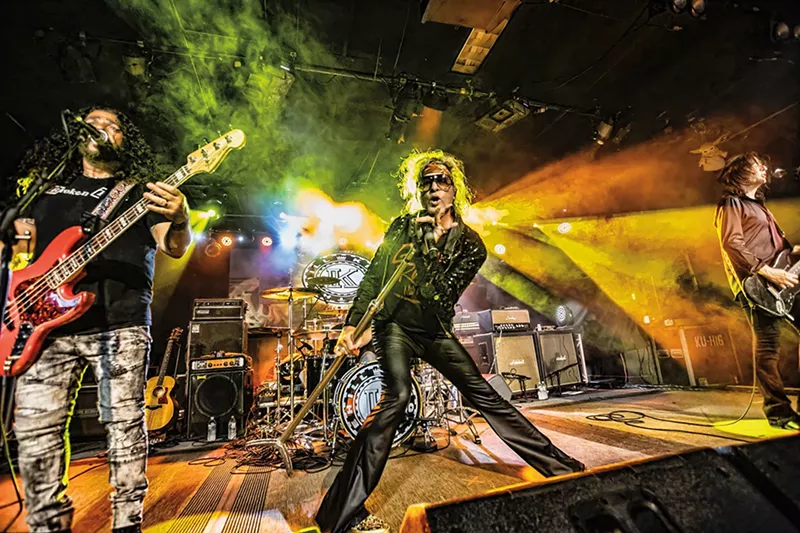
    Frankie Muriel performs with King of the Hill.

    If you tuned into MTV around 1990, chances are good that you were watching a glam-metal video. In those days, the lipstick-and-leather hair-metal bands — shimmering with spandex, Aqua Net, triple-innuendos, finger-tapping guitar solos, castrato vocals, cherry pies, girls writhing on the hoods of Jaguars, etc. — dominated the Dial MTV most-requested video countdown every day.

    Amid a steady stream of Bon Jovi, Def Leppard and Guns N’ Roses videos, you might have caught a clip from a young band out of St. Louis called King of the Hill — often stylized as an attention-demanding KINGOFTHEHILL — with an equally over-the-top video for their debut single “I Do U.”

    The hard-rocking quartet checked all the boxes to be the next belles of the Headbangers Ball: big sexy anthem, rake-thin bangs-flipping guitar ace, hard-hitting shag-haired drummer, bassist with great pecs and a strutting, outfit-changing, hyperactive lead singer.

    King of the Hill followed the arena-filling archetype of hard-rock bands with blond singers (Van Halen, Mötley Crüe, Warrant, Skid Row, Poison), but Frankie Muriel took rock-star tresses to the next level with a platinum avalanche of hair that seemed to grow more voluminous as the video went along.

    Muriel flashes lascivious dance moves, leather chaps and eyes the color of a resort pool while prancing around an airplane hangar like a horny pony and executing a Lou Brock-style slide between a girl’s legs atop a two-story platform.

    He epitomized the go-big sensualism of a glam-rock lothario, and with MTV airplay, chart-climbing singles, oodles of talent and a major-label deal, King of the Hill appeared to be a lock for the big time. But then, just as it really got going, it came to an end.

    Thirty-two years later, Muriel tells me the whole story from his chic home on the Hill — it is an extraordinary twist of fate that his old band was prophetically named King of the Hill.

    Muriel holds forth from a blue, plush, U-shaped couch between a wall of glass-framed posters of himself in various attitudes of rock-hero dazzle and an illuminated display of high-end tequila bottles. With its theater room, full recording studio and sleek, outdoor courtyard equipped with a heated pool and a massive LED video wall, Frankie’s house is a rock-star dream pad.

    St. Louisans know Muriel best as the frontman for Dr. Zhivegas, the legendary disco-rock cover band that has been playing 200-plus dates a year for nearly three decades. Dr. Zhivegas’ enormous success and longevity — thousands of sold-out shows, Vegas residencies, Mexico engagements, its own nightclub — have afforded Muriel the lavish lead-singer lifestyle he thought he had missed out on when King of the Hill came to an end.

    That dream of a musical life started as far back as Muriel can remember. The son of a Latin music percussionist, Muriel grew up around the scene, and he recalls his father’s jazz jam sessions fondly.

    “There were a lot of cats at the house all the time, and I’d sneak down the steps and listen to them play,” he says. “The next morning, I’d go around on all the instruments after they left.”

    Despite that, Muriel’s biggest musical influences were two singers he has often been compared to over the years: David Lee Roth and Prince.

    “I can remember riding my bike down the street and hearing [Van Halen’s] ‘You Really Got Me’ for the first time,” he says. “Whenever magazines would write about me, they would always say I’m like a cross between David Lee Roth and Prince. Those two guys went into my blender, and I came out.”

    Despite his flamboyant, extroverted stage persona, Muriel insists that back in the ’80s at Hazelwood West High School, he kept to himself.

    “I was always in the music room,” he says. “I had the greatest music teacher, Mr. Dole. He gave me a pack of signed passes, and I could get out of class any time I wanted.”

    His focus on music paid off fast: Muriel was playing professionally with his old grade-school pal Cubby Smith (bassist for Dr. Zhivegas to this day) by age 16. While gigging at ’80s-era teen club Animal House, Muriel and Smith connected with drummer Vito Bono to form a new band: Broken Toyz. Then came Jimmy Griffin.

    “He was just a kid, but he was already a wizard,” Muriel says of Griffin, whose classic-rock-reviving guitar heroism has been a vital force in St. Louis for decades. “We rehearsed and instantly had that thing. Jimmy and I just connected.”

    That chemistry would put Broken Toyz on a fast track: Soon they were playing almost every night for weeks at a time.

    Then, to get the attention of the major labels, Muriel executed an ingenious sleight of hand.

    “I had the idea to play on a rooftop at the VP Fair, do like a U2 thing,” he says. “There would be millions of people there, and the record company wouldn’t know that the crowds weren’t there for us.” Muriel rented a video truck and placed five camera operators on the roof and street to film the guerilla-style concert. “That’s what got us our deal,” he adds.

    As bassist George Postos came on board to replace Smith, who departed to study jazz, the group flew into a whirlwind of Sunset Strip showcases and New-York-record-company courting, eventually inking a deal with EMI subsidiary SBK. With a name change to King of the Hill, a pile of advance money and management by the legendary Shep Gordon, the boys were swimming in the excesses of the LA high life. “We were like, ‘We made it!’” Muriel says. “It was everything you can imagine and more.”

    King of the Hill cut its self-titled debut album with producer Howard Benson at the iconic Village Studios in LA. (“I have the shaker from [Steely Dan’s] ‘Rikki Don’t Lose That Number’!” Muriel says.)

    When the other boys hit the bars after recording sessions, Muriel stayed behind, learning how to make records. “I didn’t party,” he says. “I sat there from the time they opened the studio in the morning to the time they locked up at night, and I learned what everything did. That was my college.”

    Then, just as the debut album was set for a big splash, the culture shifted as Nirvana burst onto the scene in September 1991 and released its landmark album Nevermind. Its first single, “Smells Like Teen Spirit,” became a sensation, sweeping the hair-metal bands away in favor of grunge.

    Suddenly, all the Ratts and Wingers and, yes, Kings of the Hill were out of style.

    “The very thing you do all of a sudden is not cool,” Muriel says.

    Still, the band forged ahead behind a big marketing push. The video for “I Do U,” complete with the UCLA marching band and a 40-foot Ferris wheel, cost more to make than the album itself. The band hit the road, opening for bands such as White Lion, Lynch Mob and Extreme, who took King of the Hill on a sold-out arena tour across Europe.

    The second single, “If I Say,” did even better, climbing to No. 63 on the Hot 100. Muriel saw the video for the first time on MTV in a UK hotel.

    “I remember waking up and seeing my face staring back at me, and I thought I was dreaming,” Muriel says. “I was, like, holy shit! That’s us! We’re on TV!”

    The label rushed the band back into the studio to record a follow-up with engineer Keith Olsen, producer of some of the biggest rock albums of the ’70s and ’80s. Muriel remembers thinking it was a better, more mature record.

    Then the roof caved in.

    “I was working on the liner notes for the second album when my manager called and said, ‘I wouldn’t do that’,” Muriel recalls. The label had decided to reject the album and dropped the band. King of the Hill was suddenly left with nothing.

    “It was a tidal wave of financial ruin and crushed dreams,” Muriel says, calling it his lowest point. Finding himself rudderless and isolated back in St. Louis, Muriel let King of the Hill go fallow and put his life as a rock performer on ice.

    Then Smith, his old childhood friend and bassist, came to the rescue, dragging Muriel along to do “this disco thing.”

    “I thought I was going to do it for a week or two,” Muriel says. “It’s been 28 years.”

    Dr. Zhivegas was an instant success, and over the years, Muriel’s rock & roll dreams came true after all.

    Still, Muriel has long felt that King of the Hill had unfinished business.

    To that end, 2023 is shaping up to be a full-scale redemption. This week sees the official release of that long-dormant (but oft-bootlegged) second album, now titled King of the Hill II, along with a separate collection of bonus cuts, acoustic b-sides and live tracks called Sessions. The four original members will be celebrating the new releases with a February 4 concert at Diamond Music Hall.

    Muriel has been amazed by fans at recent King of the Hill reunion shows who know all the words to the band’s songs, even those that have never been officially released. At one point, he reads me a recent message on his phone from a fan in Austria who credits the unreleased song “Better U” with saving his life.

    “You feel like it’s a failure, and you wait 30 years, and then you get something like this, and you realize that song was a success after all,” he says.

    With Dr. Zhivegas still going strong and King of the Hill fielding offers from summer festivals, Muriel is prepping for one of his busiest years ever. But that doesn’t mean he’s maxed out.

    “I’m working on a solo album,” Muriel says with visible excitement. “I started thinking about what I want to be singing when I’m an old dude, you know?”

    Frankie takes me into his home studio and blasts the solo-project tracks — soaring soul-rock bangers and rich heartbreak ballads — at muscle-failure volume. While he listens to his own songs, Frankie the showman suddenly materializes, dancing in his chair, making orgiastic faces and playing an orchestra of air instruments.

    Watching him come alive to the solo recordings, I realize that Frankie, despite spending a lifetime in bands, has always been something of a lone soul. The high school kid hanging in the practice rooms by himself. The solitary singer studying in the studio when everyone else was out partying. The isolated rocker in his apartment after LA. The social media posts with the cigars, the pools, the tequilas, the beaches — most often alone. I ask him if he hangs out after the shows: “No. I hang out here,” he says, referring to his current bachelor pad detailed to only his specifications.

    Like his hero Prince, Muriel is a paradox. He makes his living in the middle of the party but mostly prefers his own company. He has mastered the art of pleasing crowds but is himself most pleased when toiling away alone in the studio.

    Nonetheless, he has great affection for the fans who have made this life possible, expressing his deep gratitude for the people who have followed his shows for more than 30 years, keeping him on stage doing the thing he loves.

    I love it,” Muriel says. “You’re always playing someone’s favorite song.”

    Coming soon: Riverfront Times Daily newsletter. We’ll send you a handful of interesting St. Louis stories every morning. Subscribe now to not miss a thing.

    Follow us: Google News | NewsBreak | Reddit | Instagram | Facebook | Twitter

  • 30 Deep Grimeyy Sentenced to 7.5 Years in Prison Day After New Album Drops

    30 Deep Grimeyy Sentenced to 7.5 Years in Prison Day After New Album Drops

    Screen shot from 30 Deep Grimeyy’s “The Biggest Dookie” video in which he raps outside the federal courthouse in St. Louis where he was sentenced today.

    Popular St. Louis rapper Arthur Pressley, better known as 30 Deep Grimeyy was sentenced in federal court today to more than 7 1/2 years in prison for being a felon in possession of a firearm.

    The felon-in-possession charge, which Pressley pleaded guilty to last October, stemmed from a January 5, 2021, police stop during which Pressley and three other men in a 2008 Pontiac G8 were pulled over in north city.

    On the backseat, between Pressley and another man, sat a Beretta M9.

    Pressley, 25, subsequently admitted to trying to forge a bill of sale from three months prior to make it look like the gun wasn’t his but instead belonged to the man seated next to him.

    However, numerous social media posts showed Pressley with the gun, including in October 2020 when it was purchased.

    Most sentencing hearings for felons-in-possession last around an hour, but Pressley’s took all morning, starting at 9:30 a.m. and not wrapping up until around 2 p.m. The hearing was also more well-attended than the average sentencing hearing, with about 30 people — almost all Pressley supporters — in the courtroom’s public seating area.

    The recommended sentencing guidelines for Pressley’s crime and his criminal history was between 41 and 51 months. But Assistant U.S. Attorney Cassandra Wiemken asked for Judge Stephen Clark to impose the maximum possible sentence of 10 years. Wiemken said that the longer sentence was warranted because Pressley was a “prolific possessor of firearms” and “a gang leader” who had “no respect for the law.”

    During the hearing, the prosecution displayed photos posted to social media that showed Pressley holding firearms. They also played excerpts from Pressley’s music videos, including one in which the rapper gets a simulated blowjob outside the very courthouse where the hearing was taking place.

    “My rap name is an image I have to portray. I have a certain type of fan base,” Pressley told the judge.

    He added: “I feel like I’m being targeted because of my rap name. I’m Arthur Pressley. I’m a human being.”

    Wiemken said that Pressley’s being a rapper was largely irrelevant, aside from the music videos that seemed to prove Pressley did possess weapons despite a prior felony conviction making his doing so illegal. She said that what should impact Pressley’s sentencing is that he was the leader of the so-called “30 Deep Gang,” whose members she alleged had committed assaults and other crimes involving drugs and violence.


    Photos of Pressley with the Beretta included in the prosecution's court filings.

    U.S. Attorney’s Office

    Photos of Pressley with the Beretta included in the prosecution’s court filings.

    Pressley’s attorney, Lenny Kagan, called the prosecutor’s argument an “unbelievable leap.”

    He pointed out that when Pressley was arrested, authorities searched him and two residences of his, finding no drugs or guns of any kind.

    “This is your alleged gang leader?” he said.

    He pushed back on the idea that 30 Deep Gang was a gang at all, saying that it is a brand associated with Pressley’s rap persona, not unlike Kanye West’s Yeezy brand.

    When prosecutors played clips of Pressley’s music, they said that he was rapping about real crimes that his peers had committed.

    Kagan retorted that rapping about something doesn’t prove a person is involved in those activities. He also questioned why all this was even being brought up when Pressley was being sentenced for the crime of being a felon in possession of a firearm.

    “I feel like I’m on trial for murder,” Pressley said at one point.

    Much of the morning’s proceedings involved testimony from ATF Special Agent Kirsten Ellerbusch, who began investigating the 30 Deep Gang in 2019.

    At one point, Kagan asked Ellerbusch if it was illegal to receive a fake blowjob from a woman dressed like a corrections officer outside the Thomas F. Eagleton Courthouse.

    Ellerbusch said that she didn’t know if it was illegal, though it was in poor taste.

    After deliberating in his chambers for more than an hour, Judge Clark returned to the bench to deliver his sentence of 92 months. He said that he’d determined that the 30 Deep Gang had been a “street gang” and that Pressley was its leader.

    Out in the courthouse lobby, prior to Judge Clark reading the sentence, Pressley’s manager, Jeremy Fips, who goes by JFips, highlighted the album Pressley just dropped last night, called Let Me In.

    “He wants to be let into the industry. That’s why it’s called Let Me In, Fips says. “The songs on the album are based on everything he’s feeling right now.”

    For the album, Pressley worked with producer Alley Knock, who was also there in court to support Pressley.

    “Me and him had a nice run together, and we will continue to have a nice run together,” Alley Knock said.

    Pressley announced the new album last night on his Instagram page, and included a photo of himself in the St. Louis City Justice Center in the post. “Had to leave my supporters wit Summ!” he wrote.

    Fips says about Pressley’s future: “He’s good. He’s got two more albums on the way. He’s going to count these days down. Do his time and get out.”

    We welcome tips and feedback. Email the author at [email protected]
    or follow on Twitter at @RyanWKrull.

    Coming soon: Riverfront Times Daily newsletter. We’ll send you a handful of interesting St. Louis stories every morning. Subscribe now to not miss a thing.

    Follow us: Google News | NewsBreak | Reddit | Instagram | Facebook | Twitter

  • Former MTV VJ Spills Tea About the Early Days at the Iconic Music Channel

    Former MTV VJ Spills Tea About the Early Days at the Iconic Music Channel

    Courtesy Photo

    Alan Hunter in his MTV VJ days with his signature feathered hair.

    Alan Hunter, one of the original VJs during the first years of MTV, is a very close personal friend of mine.

    Or at least, that’s how it always seemed. I mean, we go way back. He was in my house practically every day when I was a teenager. I looked up to him. He was a key source of company, he helped me forget the drudgery of the school day and he turned me on to a lot of music.

    The fact that I was a teenager in small-town Missouri and that Alan Hunter was a television personality in New York who had never heard of me did little to lessen our bond.

    When MTV debuted in 1981, the moment video killed the radio star, Hunter was the first VJ to appear on the network. Of the original five VJs — Hunter, Martha Quinn, Mark Goodman, Nina Blackwood and J.J. Jackson — Hunter was my favorite. So I hung out with him the most.

    Each of the five VJs was also an archetype, as though picked from central casting, like a video-jukebox Breakfast Club: Martha, the girl next door; Nina, the rock vamp; Mark, the jock; J.J., the elder statesmen. And Alan?

    Alan was the lovable goofball, a jovial, blond-mulleted everyguy who talked with a warm amiability, a comic physicality and a unique blend of telegenic polish and parodic irony. Of the five VJs, it was Hunter who most established the standard VJ aesthetic — informal accessibility, sharp speechcraft, cool whippersnappery — that was as new to television hosts as was the music-video format itself.

    Hunter was not a rock expert like Jackson, a radio legend who helped break Led Zeppelin in America, or Goodman, a seasoned disc jockey from the biggest rock stations in Philly and NY. But what Hunter lacked in musical expertise, he made up for in Cronkitean trustability and easy charm.

    I wanted my MTV. All the time. The way kids come home from school today and transform into video game zombies, I got lost for hours in the music videos ushered in by Hunter. I felt like I was hanging out with a cool older neighbor kid who brought his Tom Petty and ZZ Top records over. I came for the U2, the Madonna, the Whitesnake; I stayed for the Alan Hunter.

    So imagine my surprise when I heard that Hunter is now living in St. Louis. My old buddy lives here! I was floored to discover that Hunter’s SiriusXM radio shows broadcast from his home in Webster Groves.

    I wasted no time in tracking him down, and Hunter agreed to meet me at a pub in Webster.

    As I arrive for our big reunion, I realize that I had not laid eyes on my old pal in decades. When I watched him on MTV, he was in his 20s. Now he’s 65. Would I recognize him?

    Then, through the door walks Alan Hunter. Wearing a blue puffer jacket and jeans, Hunter approaches me with much the same youthful countenance as I remember, his blond hair a little darker, his downturned eyes now behind glasses.

    “How ya doin’?” he asks — as though this is in fact a reunion of old friends. I immediately feel as if he is about to pull out a microphone and point it at me à la his old MTV spring break segments. But amid the clatter and laughter of afternoon drinkers, we snag two pints and a table, and I ask him about the things I always wanted to know.

    We discuss his early bio: Hunter grew up in Alabama, attended college in Mississippi where he met his first wife and, in 1980, struck out for New York to become an actor. He landed minuscule roles in Annie (the Carol Burnett one) and David Bowie’s video for “Fashion,” but the kind of Broadway roles he wanted eluded him.

    As he recounts these events, Hunter is quick with details when I ask where he lived (“55th and Broadway in a little one-bedroom apartment for $550 a month”), where he tended bar (“The Magic Pan at 57th and 6th”) and what he thought of the city then (“In 1980, New York was in the toilet”).

    In June 1981, Hunter had a chance encounter in Central Park with a TV producer named Bob Pittman who was starting a new cable channel that would show music videos around the clock. “I said, ‘That’s funny — I was just in a David Bowie video. Good luck with your channel,’” Hunter says, adding that he thought nothing more about it. Two days later the phone rang.

    “They brought me in to audition at the studio at 33rd and 10th in Hell’s Kitchen,” Hunter says. “Being an actor, I needed a role. They said, ‘Be yourself.’ And I said, ‘Who’s that?’ So I thought I sucked. But they had me back three more times in three successive days.”

    Hunter was the last of the five VJs to be hired, and a month later he was on the air. If he was unsure how to do the job, he was not alone. “MTV was put together by duct tape and tons of people who didn’t know what the hell they were doing,” he says. “It was a 50-ring circus. Total chaos. Things would change every day. I would come in, and the set would be moved around. They were constantly experimenting.”

    What of Hunter’s signature look with the feathered hair, the suspenders, the vests? “When I got hired, they gave me an envelope on the first day with 500 dollars cash in it and told me to go buy some clothes,” he says, noting that MTV had no makeup or wardrobe staff. “So my wife and I went to Macy’s and bought some clothes on sale.”

    As I ask more questions about the behind-the-scenes production of live television, Hunter drops a bomb: “Well, MTV was never live.”

    Wait. What? Alan, Mark and Martha were not talking to me in real time? I admit that I always thought his video intros were live, as if this new information was some sort of betrayal. “Sorry to take some of the luster off for you,” Hunter laughs. “All of our breaks were pre-recorded a day in advance. I would do my five-hour shift in an hour and a half.”

    I also get my old amigo to reveal his VJ salary that first year: a cool $28,000. “That wage was a little bit better than a chorus guy on Broadway, which was my yardstick at the time,” Hunter says. He even kept his bartending job for a while after he started VJing, unsure as he was about MTV’s future.

    Hunter says he had no idea that MTV was going to be a success, noting the channel was losing money. Moreover, Hunter had no sense of the network’s cultural impact early on, as MTV was not broadcast in Manhattan for its first year of existence.

    Then, after a few months, MTV sent its VJs to make promotional appearances across the country, and Hunter realized something big was happening. “They would send me to a record store in Little Rock or Grand Rapids or somewhere and a thousand people would show up,” Hunter remembers. “I would say, ‘What are all these people doing here?’ And they would say, ‘They’re here to see you.’”

    Hunter hit it off right away with Quinn and Blackwood but not Goodman. “He thought I was a nerd, and I thought he was an asshole,” Hunter says.

    Later, they became close, but the early friction came as Goodman’s music snobbery clashed with Hunter’s casual fandom. “My schtick was less about being some music journalist and more about being a fun guy messing with regular folks,” Hunter says. “They eventually started having me do man-on-the-street stuff and going on trips to cover spring breaks and other things.”

    The Hunter-hosted trip I most remember is MTV’s Hedonism Weekend in Jamaica with Bon Jovi in 1987, a wild hair-metal beach party with the world’s hottest rock band and a smorgasbord of booze and bikini-clad girls. I had to ask Hunter — with such immediate access to Bon Jovi-level sex, drugs and rock & roll — how much did he himself partake?

    “Did I party? Oh god, yes,” Hunter says. “But I was happily married at the time, and I have a pretty strong willpower. That doesn’t mean that when it’s three in the morning and I’m partying with everyone that I’m not struggling to try to not do another line of coke. But you have to show some professionalism. I wasn’t going to screw up my job.”

    While Hunter says he was never about serious music journalism, he was nonetheless at the center of some history-making musical events, including Live Aid and Billy Joel’s groundbreaking concert in the Soviet Union. At Live Aid, Hunter was given the tough task of interviewing the members of Led Zeppelin just after their infamously maligned reunion performance. “The whole scene was so chaotic, that about all I could get out was, ‘What was that like?’” Hunter recalls. “But overall it was 17 hours of standing in awe of everything that was going on.”

    Hunter’s talent for conversational spontaneity led to road shows such as Amuck in America, which saw Hunter traveling across the country interacting with locals, a ratings boom that precipitated MTV’s eventual pivot from music videos to reality shows. Ironically, the changes that Hunter helped initiate roughly coincided with his 1987 decision to leave the network.

    “Burnout was high, and I felt like I should leave while I was on top,” Hunter says. “So I chose not to exercise the last two years of my contract. In hindsight, I should have stayed longer.”

    Hunter moved to Los Angeles, looking to fulfill his old dream of being an actor, only to find that path blocked by his success as a VJ. “I would go to auditions, and they would be, ‘Hey, it’s Alan Hunter from MTV,’” he says. “What I didn’t understand is that I had played ‘me’ for six years. It’s very difficult to change that.”

    Still, Hunter forged a successful path in entertainment on the other side of the camera. In his hometown of Birmingham, he started Hunter Films, was nominated for an Oscar in 2004 for producing the short film Johnny Flynton, built a multi-use entertainment facility and co-founded the acclaimed Sidewalk Film Festival.

    Several years ago, while planning Sidewalk, Hunter, then divorced from his first wife, received an email from a female film executive in New York. “She said, ‘Your high school girlfriend’s older sister’s daughter is my first cousin’s roommate,’” Hunter says with a laugh. She was interested in teaching a film workshop in the festival.

    That email eventually led to a second-time-around family for Hunter. His wife, Elizabeth, became a pioneer in the world of digitally augmented reality and experiential theater, and Hunter started hosting shows on two of SiriusXM’s most popular channels (80s on 8, Classic Rewind) six days a week from his home office. (Brace yourself: Those aren’t live either.)

    Then, in late 2021, Elizabeth accepted a position at Washington University, and the Hunters relocated to St. Louis. And we’re caught up.

    After a thorough 90-minute walk down memory lane, Hunter is due to pick up one of his kids from a class. “Let’s talk again,” he tells me.

    Strolling alone out of the pub, unbeknown to the patrons around him, goes a pioneer who was at the tip of the spear of a music and cultural revolution, and is a seminal figure to a generation raised on MTV. And, also, is a very close personal friend of mine.

    This story has been updated.

    Coming soon: Riverfront Times Daily newsletter. We’ll send you a handful of interesting St. Louis stories every morning. Subscribe now to not miss a thing.

    Follow us: Google News | NewsBreak | Reddit | Instagram | Facebook | Twitter

  • BB’s Jazz, Blues & Soups Is Closing Indefinitely

    BB’s Jazz, Blues & Soups Is Closing Indefinitely

    Holly Ravazzolo

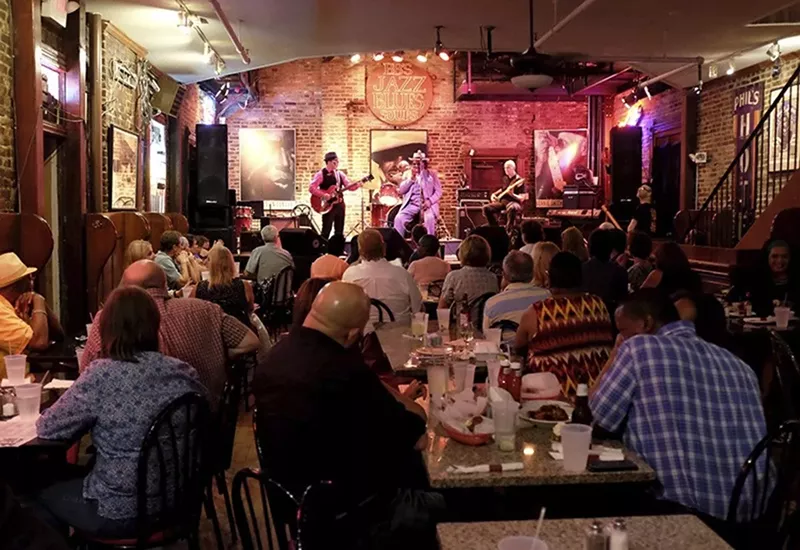
    If you wanted jazz, blues and soup, you knew exactly where to go. (The salads were pretty good, too.)

    Another historic St. Louis venue is closing its doors while the owners “re-think the future” of the space, according to KSDK.com.

    BB’s Jazz, Blues & Soups (700 South Broadway, bbsjazzbluessoups.com) is currently closed for business and a re-opening date is unknown.

    The club first opened in 1976 and was part of the famed “Blues Triangle” on South Broadway which included a trio of hot entertainment spots: BB’s, Beale on Broadway and Broadway Oyster Bar. Beale on Broadway closed in January 2019, and now local blues fans are worried that BB’s will soon follow.

    The owner of BB’s Jazz, Blues & Soups, John May, declined an interview with KSDK but acknowledged that he was pressing pause on the business. The hope is that BB’s will be able to re-open later this year.

    The Facebook page for BB’s reports that the venue is “closed for renovations” and KSDK reports the venue is undergoing some renovating inside, and those involved are trying to figure out how to bring in a new generation of blues fans.

    The website for BB’s includes the same “closed for renovations” message. There are no upcoming gigs listed on the live music calendar or on the upcoming events pages of the website, either.

    More information on this developing story as we have it.

    Coming soon: Riverfront Times Daily newsletter. We’ll send you a handful of interesting St. Louis stories every morning. Subscribe now to not miss a thing.

    Follow us: Google News | NewsBreak | Reddit | Instagram | Facebook | Twitter

  • Remembering Mississippi Nights, St. Louis’ Most Iconic Nightclub

    Remembering Mississippi Nights, St. Louis’ Most Iconic Nightclub

    SEAN DERRICK

    Alanis Morissette at Mississippi Nights on September 1, 1995.

    Editor’s Note: Garrett and Stacy Enloe love music and actually met at a concert at the now-shuttered American Theater (they were seeing Jackyl). Marriage followed in 2000, and then in 2016, they won a piece of St. Louis music history: a portion of the Mississippi Nights awning. That spurred Garrett to make a Mississippi Nights fan page on Facebook for the venue that opened in 1976 and shuttered in 2007.

    The page soon had 2,000 members recalling working at, playing or attending concerts at the venue. That energetic fan base inspired the book Mississippi Nights: A History of the Music Club in St. Louis, which came out in October. Part scrapbook, part oral history, the book also features a comprehensive list of every band that ever played the venue. It shares photos, ticket stubs, concert fliers, setlists and band photos, as well as stories like the one about the time Hole performed and Courtney Love said she was sick and fell over, or that time Nirvana nearly started a riot. It also highlights the characters of Mississippi Nights, including the Cookie Lady and Beatle Bob.

    Below are excerpts from the book that capture what made the all-ages venue an iconic part of St. Louis for 30 years.

    Welcome to Mississippi Nights


    Mississippi Nights on Laclede's Landing was an all-ages concert venue.

    PAUL HILCOFF

    Mississippi Nights on Laclede’s Landing was an all-ages concert venue.

    Los Angeles had the Whiskey a Go Go, Troubadour and the Roxy Theater.

    New York City had CBGB, Studio 54 and the Palladium.

    St. Louis had Mississippi Nights.

    Mississippi Nights, appropriately promoted as “The Music Club of St. Louis,” operated from 1976 until 2007 and was located in the historic Laclede’s Landing section of downtown St. Louis at 914 North First Street.

    To get to Mississippi Nights, you drove past the Gateway Arch grounds, under the ornate arches of the Eads Bridge, over several blocks of cobblestone streets and past century-old buildings that once housed fur traders, slaughterhouses and dry-goods warehouses. The old, weathered brick building had character with its arched doorways and windows. The color variation in the bricks suggested that once there were more windows and doors, removed for unknown reasons. The Eads Bridge, spanning the mighty Mississippi River, could be seen from the parking lot on the south side of the building.

    Upon entering the wooden door on the right, you were in a vestibule surrounded by signed 8×10 band photographs in black frames. To the left, past the second door, were a couple of video games; a pinball machine; a cigarette machine; some round, white-topped tables with black, wooden chairs; a small bar in the corner; and another set of doors that sometimes opened to accommodate large crowds. It was a short walk forward to have your ID checked, hand stamped and ticket torn.

    To the right was the bar with wood paneling up the back wall, neon beer signs and open shelves of liquor and glasses. Following a sloped walk down past two tiers of additional tables and chairs on the left (the first tier also housed the sound mixer), the walkway opened, revealing restrooms and the underage section (the raised area often referred to as the “kiddie corral”) on the right, and to the left was the dance floor and stage.

    The stage was covered with parquet flooring and elevated about three and a half feet off the floor. A small walkway to the right of the stage led to the back door and, behind the building, steep metal steps where the bands loaded out their equipment at the end of the night. (Fortunately for the crew, they were able to load in through the front door into the empty venue in the morning.) Sometimes, metal barricades blocked the front of the stage, but often you could press yourself right up against this platform in front of your favorite band.

    Chuck McPherson* Remembers…
    “What was special about Mississippi Nights? The people. The atmosphere. The smell. The experience. You could not only see a good show but meet the artist. It was seeing up-and-coming bands before everyone else, as well as bands on the way down. It was all-ages shows in a bar atmosphere. I was underage and limited to the floor and the side of the stage for much of my time there, but it didn’t matter. To borrow the phrase, it was the most magical place on Earth. Mississippi Nights was one of the places where I spent much of my mid-teens to early adult years. I made friends at the club that I still have to this day. It’s a place I will never, ever forget. No other club can compare. 914 North First Street will be in my heart until the day I die.”

    *Mississippi Nights patron

    Several factors contributed to the longevity and popularity of Mississippi Nights. [The venue] did an excellent job of booking shows and showcased a variety of music genres, unlike many clubs that catered to one genre. The sound system was incredible, appealing to the audiences and the musicians. The staff was welcoming and made the club feel like a second home to many. Finally, you were able to get up close and personal with the bands — in front of the stage as they played, at the bar while they drank, or outside as they came and went.

    Being the best place to experience music in St. Louis for so many years, countless people forged new relationships and memories at Mississippi Nights. Many concertgoers developed friendships that would last a lifetime with the staff or fellow patrons. Some went to the club on first dates or even met their spouse there. The memories run the gamut from meeting bands, the friendly staff, amazing performances and crazy incidents (some involving liquor).

    Mississippi Nights was a treasure in St. Louis. Unfortunately, as time passes, memories fade. … So, we preserve those memories and the music that Mississippi Nights produced for 30 years with this book.

    Angela Prada* Remembers…

    “Mississippi Nights was lightning in a bottle. Having worked there, I have to say everyone felt they were part of the show, not just watching it. There was a true sense of community and a love of music between patrons, staff and the bands. No one complained about it being hot, crowded, smoky or that they were eating popcorn out of a trash can. They were there to see the show.”

    *Mississippi Nights server

    1867: Pork Packers

    Although the building may date as early as the 1830s, the first confirmed business in the Mississippi Nights building does not appear in records until 1868. James Reilley & Co. Pork Packers may have lasted for less than a decade, but the business is responsible for one of the signature features of the club, the floor that began to slope as you passed the ticket window.

    Documents from 1868 declare the building was owned by James Reilley, David A. Spellen and Michael McEnnis. The 1874 book St. Louis: The Commercial Metropolis of the Mississippi Valley contains an advertisement for James Reilley & Co. Pork Packers, located at 914, 916 and 918 North Main Street. “Pork Packers” is a euphemism for a slaughterhouse or meat processing facility. The building’s signature slanted floor, eventually bordered by the bar and the over-21 seating section, was designed to drain blood from animal carcasses.

    Becoming Mississippi Nights*


    Joe Haynes, Michael Stipe, Jim Warchol, and Buddy Weber of Stipe’s pre-REM band Bad Habits, November 13, 1978.

    JOHN KORST

    Joe Haynes, Michael Stipe, Jim Warchol, and Buddy Weber of Stipe’s pre-REM band Bad Habits, November 13, 1978.

    Steve Duebelbeis started Mississippi Nights after attending live concerts at clubs in Springfield, Missouri. He appreciated how the clubs featured more than just cover bands. Duebelbeis looked at the space, which was previously a nightclub called On the Rox, and bought the building on August 30, 1976.

    Duebelbeis sold the venue to real estate investor Rich Frame in 1979. He owned it until it closed in 2007.

    *Editor’s note

    1983: The Grandmother of Rock & Roll

    Pat Lacey’s name is connected with Mississippi Nights more than anyone who worked there in the club’s 30-year history. She began her association with the club by taking her daughter Sarah and her friends to concerts at Mississippi Nights.

    On the night of the X show, October 24, 1983, [owner] Rich Frame asked Lacey if she knew of anyone who would want an office job at the club. Frame knew she worked as a nurse, so he was surprised when she responded, “Yes, me!”

    With her husband laid off and their daughter Susan in college, Lacey needed another job to make ends meet.

    Lacey admits she did a terrible job in her interview with Frame. She kept reinforcing that she didn’t have any experience and was uncertain she could do the job. However, with his knack for reading people, Frame had the confidence in Lacey that she lacked, and he hired her on the spot.

    Frame speaks of Lacey with reverence. “She did everything,” he asserts. She juggled nursing and rock & roll for four years before leaving her nursing job to dedicate her time to the club.

    Lacey broke down her duties. “I wrote the checks, sold tickets, did the inventory and the ordering. I did the pouring costs, which was how much we spent on alcohol and whether we made a profit or not, and I did the same thing with shows. When [manager] Patrick [Hagin] left [in 1990], I stepped in and took on a lot more. I was doing everything that he did: doing the contracts, going to the bank, making sure the shows were advanced, so that we knew what time bands were coming in and what time they wanted to be fed, etcetera,” Lacey says. “I was the den mother there. I took care of the bands. A lot of them became my friends.”


    Danny, Mike (holding their RFT Slammie Award) and Steve of New World Spirits, and Brandi Welti, December 3, 1996.

    ANDY MAYBERRY

    Danny, Mike (holding their RFT Slammie Award) and Steve of New World Spirits, and Brandi Welti, December 3, 1996.

    “Lacey had many jobs,” says manager Tim Weber (1998- 2007), “but arguably her most important job was to advance the shows.”

    She organized hospitality events for bands and their crews, including solving problems before they arrived.

    Jason Voigt* Remembers…

    The only event I attended at Mississippi Nights was Joan Jett & the Blackhearts on October 27, 2006. Eagles of Death Metal opened. They rocked the house, but there were other things on people’s minds that night; that was the same night the St. Louis Cardinals won their first World Series since ’82. There were no TVs on, and this was before smartphones. Suddenly, people were yelling right in the middle of a song. Everyone knew it happened. I left the concert early and joined in on the fun outside as people were happily shouting and cheering on the Landing.

    *Mississippi Nights patron

    “She’d call up and say, ‘Do you really need four gallons of hummus?’ She was able to do it in the nicest possible way so that every band that showed up was in a good mood when they got there,” Weber says. “If you screw that up, every band shows up in a shitty mood, and the days are wrecked. So that tiny little thing of making the bands understand ahead of time that they were going to be cared for at least gave you a running shot to start every day pretty good.” Lacey made the bands happy, everyone’s job more manageable, and Mississippi Nights more successful.

    “Absolutely nobody tops the legend that is Pat Lacey,” proclaims Mississippi Nights patron Chuck McPherson. “She was the heart and soul of the club. … She always treated me and my friends like her children. She got to know us on a first-name basis and was supportive of us in our love for music.”

    Patron Michelle Weber Rigden says, “Pat Lacey was my concert mom. She was so kind and nurturing, but I also knew she would take my ass out if I misbehaved as a minor.”

    Patron Wade Monnig says, “Pat Lacey was always amazing, always so nice and sweet. I’d always go see the Alarm at Mississippi Nights, not just because they were a great band [but] because Pat was so passionate about them. I wanted to support her!”

    Lacey decided to retire the year she turned 65, thinking that’s just what you do at age 65, and at the end of 2002, she did.

    In May 2003, Lacey entered Mississippi Nights with a gift of strawberry shortcake for the staff. She quickly learned that her replacement was having problems managing the office. For example, he wrote checks out for every invoice without checking if they were already paid.


    A signed promo shot of one of St. Louis' breakout glam bands King of the Hill.

    COURTESY RICH FRAME

    A signed promo shot of one of St. Louis’ breakout glam bands King of the Hill.

    Before long, Mississippi Nights had substantial credits with the vendors. Tim Weber asked Lacey to return, and she agreed to come back two days a week. After that, she didn’t think of retiring from Mississippi Nights again and worked there through February 2007. “The Nights officially closed at the end of January, but I needed to clean out the office,” she remembers.

    At 84 years old in 2022, Lacey wishes she could still be working at her beloved Mississippi Nights.

    “[Pat Lacey] was the grandmother of rock & roll,” says Tim Weber. “She cared more about more people and more bands than anybody I’ve ever met in my life.” He adds, “I still get tour managers at the Old Rock House that remember Pat Lacey.”

    Tony P. Pona* Remembers…

    “I worked at Mississippi Nights for 10 years, so I have many memories of the place. One that stands out is the night of [the] Alvin Lee [concert] when Bon Jovi’s Richie Sambora was sitting stage right in a packed house [on October 31, 1984]. I believe [Bon Jovi was] playing in town the same week of Alvin Lee, got in early, and [was] bummin’ in the city. Absolutely every lady in the place knew who Sambora was. He was just there to see Alvin Lee. I worked secondary security. We kept the public away from Sambora (for the most part). He did sign and take a few pics, though.”

    *Mississippi Nights stagehand and security

    1990: The Eyes/Pale Divine

    Opening an exciting new decade for St. Louis music, Richard Fortus was the guitar player of arguably the most popular local band in St. Louis, the Eyes. Fortus founded the band six years earlier when he was merely 15 with vocalist Michael Schaerer, bassist Steve Hanock and drummer Greg Miller (later in Radio Iodine and Suave Octopus). Hanock left the band before 1990 and was replaced with Dan Angenend.

    The Eyes rose through the ranks of local bands in St. Louis, constantly playing at the under-21 club Animal House, Kennedy’s 2nd Street Company (that would come to be known simply as Kennedy’s) on Laclede’s Landing, and Mississippi Nights.


    Stewart Copeland of The Police on March 16, 1979.

    DEBBY MIKLES

    Stewart Copeland of The Police on March 16, 1979.

    One night in 1990, record executive Jason Flom saw a line of people waiting in the rain to get into 1227, a club on Washington Avenue in downtown St. Louis, to see the Eyes. Flom was famous for signing hard-rock bands like Skid Row and Twisted Sister. So he decided to send his assistant to Mis

  • A St. Louis Family Randomly Had Bruce Springsteen Over for Late-Night Eggs

    A St. Louis Family Randomly Had Bruce Springsteen Over for Late-Night Eggs

    TODD OWYOUNG

    Bruce Springsteen has a friend in St. Louis.

    Here’s a story that sounds apocryphal, but isn’t: Bruce Springsteen made friends with a teenager after they met randomly in the lobby of a St. Louis movie theater in 1980 — and the friendship continued for years.

    Talk about the coolest celebrity encounter ever! And get this: The details actually check out.

    The story, which the Boss recently relayed on the BBC’s Graham Norton Show, dates back to 1981. Springsteen had released The River the previous fall and, after initially playing two nights at Kiel Opera House (now Stifel Theatre) in October, he came back to St. Louis in January for a show at the Checkerdome, the now-demolished arena across I-64 from Forest Park.

    At some point during the trip, the nation’s biggest rock-and-roll star wandered into a movie theatre.

    On the bill: Woody Allen’sStardust Memories, which had debuted in September of 1980.

    People didn’t like the movie. Here was the director of Annie Hall and Manhattan, and he seemed to be painting his fans as pretentious (and potentially murderous) grotesques.

    Springsteen nevertheless wanted to see it. But then, in the lobby, he was approached by one of his fans, whom he describes to Norton as a “kid.”

    “He was there with his girlfriend and said, ‘Do you want to sit with us?’” Springsteen says.

    Springsteen tells Norton he said yes, to Norton’s consternation. “That’s a hard no!” the BBC host interjects.

    “So I went, and I sat,  and we watched the movie,” Springsteen continues. “And he said, ‘Is that how you feel about your fans?’ I said, ‘Not so much.’ He said, ‘I’m going to go home now. Will you come home and meet my parents?’”

    “You didn’t!” another guest on the show cuts in.

    “I said, ‘OK,’” Springsteen says, smiling modestly. “So, I went somewhere in St. Louis, with this kid, and we walked in the door, and it’s about 11 o’clock at night. And he says, ‘Mom! Mom! I have Bruce Springsteen with me!’ And she goes, ‘Who?’

    “And he runs in his bedroom and comes out with the album cover and goes ‘BRUCE SPRINGSTEEN.’”

    And then the mom gets it.

    “Oh my God,” she said, per Springsteen. “Let me make him some eggs!”

    “And so around  midnight,” Springsteen continues, “I was sitting in a little house in St. Louis, having some eggs with this kid and his mom, and I saw them for decades after that every time we came to town.”

    So, if Springsteen wanted to prove he isn’t Stardust-era Woody Allen, not-so-secretly loathing all of us as we clutch at his coat and beg for selfies, he couldn’t have picked a better story. Rock stars, they’re just like us — they hang out in little houses in St. Louis!

    And the best part is that it’s (almost) entirely all true. Decades ago, matriarch Sophie of the Satanovsky family relayed her version of the story to Channel 5’s John Pertzborn.

    She told the station that it all began when Springsteen was standing in line for popcorn at a movie theater in Brentwood. Only in this story, the “kid,” Steve Satanovsky, was there with his sister, Lisa.

    Mom Sophie (helpfully described on screen as “Bruce’s friend”) told Eye Witness News that the Boss actually sat between the two siblings during the movie.

    “On the way out,” Sophie Satanovsky recalled, “he asked Steve for a quarter so he could call a cab.” Instead, the siblings offered to drive the rock star home — but said they’d have to stop by their mother’s house first.

    As Sophie related it, when they all came inside, she initially didn’t believe it was actually Springsteen, and it took not only holding up the album cover to his face, but Springsteen showing his credit cards to establish his identity.

    According to Sophie, they then sat around and “he told us about his mom, and his dad, and his folks.” Springsteen said his dad wished he would cut his hair and be a lawyer. Then he had Sophie call his mom and relate that he’d had a good, home-cooked meal.

    Sophie told Channel 5 she hadn’t talked to Springsteen since 1982, perhaps giving lie to the rock star’s story about a long-time friendship (or maybe he only stayed in touch with the siblings?). Even so, she said, “There’s a word in Jewish — a mensch. He was such a nice person, coming into the house.”

    One interesting digression from the story Springsteen told on the BBC: Sophie Satanovsky said she actually fed him not eggs, but bagels. What are the odds they were bread-sliced?

    Coming soon: Riverfront Times Daily newsletter. We’ll send you a handful of interesting St. Louis stories every morning. Subscribe now to not miss a thing.

    Follow us: Google News | NewsBreak | Reddit | Instagram | Facebook | Twitter

  • The Fixer: Dave Anderson’s one-stop guitar shop

    The Fixer: Dave Anderson’s one-stop guitar shop

    The shop and world headquarters of Tritone Guitars, the new venture for Dave Anderson — a veteran St. Louis guitarist known for his work with Tenement Ruth, Magnolia Summer and Grace Basement — is located in the basement of his North Hampton neighborhood home. It’s a modest setup, in the laundry room to be exact, with a gear-cluttered practice space just a few feet away. There are two small workbenches, a blinding dollar-store lamp, a stash of tools, tins of naphtha and a row of guitars waiting for the fixing.

    Anderson has long played guitar — and banjo, mandolin and pedal steel — and worked on instruments, but he’s done so largely under the radar. He’s still far from well known, though his instrumental skill and business have begun to make names for themselves. Tritone Guitars is more than an axe shop. Its three facets all revolve around Anderson’s core talents: repair work, lessons (done in person and online) and session work.

    “The idea is to do repair quickly and efficiently,” Anderson explains. “There are a lot of people who are playing around town that don’t have a lot of money. They’re playing with broken instruments, cobbled-together stuff. I’m really focused on the community in that respect. I’m part of that community. IfHeather Rice from Rats & People [Motion Picture Orchestra] comes over with a guitar, she needs it done in the next hour. She’s got a gig at the Sheldon, but she’s not made of money. And I can help her out.”

    Embedded in the St. Louis rock and Americana scene, Anderson uses those connections to his advantage. He’s worked on instruments for world-class players like John Horton of the Bottle Rockets and Mark Spencer of Son Volt, and he’s worked for his friends and their friends, whenever and however they need it. On one of his workbenches sits a Telecaster neck that needs fretwork; behind him, there’s a dusty Gibson with a cracked headstock. It’s unclear if it’s salvageable, but he’ll give it a shot.

    Though Anderson has built guitars, and will still take on custom builds, it’s not his focus. Inspired by his daughter, a big Frank Zappa fan, he’s recently pitched a guitar project for Zappa’s son Dweezil. A mobile repair shop has been in the back of his mind, but the overhead and risks of a van is intimidating, and he’d rather keep his costs low and quality high.

    Previously a lead repairman for Fazio’s and Music Folk, Anderson originally apprenticed with Bill Moll, a nationally known luthier who has built arch-top guitars for John Pizzarelli, among other musicians. For more than four years, he studied under Moll in Springfield, before coming back to the St. Louis area in 2002.

    “It became less of a learning thing and more of a work thing,” Anderson explains. “Moll was growing as a business; I was just working on what he needed to keep that afloat. In the end I decided I didn’t want to build for a living. The problem with building guitars is it’s a Catch-22. You have to take the order, get half the deposit and then make the guitar so you can get the rest of the deposit. It’s a never-ending cycle — and you’re really married to the shop.”

    Anderson realized that he had a wide range of skill sets (he was a luthier, a teacher and a working musician), and after talking with his wife, Melissa Anderson, with whom he plays in Tenement Ruth, he lit out on his own.

    “Eventually I just said, ‘Why don’t we do it all?’” he recounts. “As a guitarist and repairman, I’m essentially selling myself. I realized we could do it under our roof. Melissa will say, ‘Who is the “we” in this?’ She works with me and keeps track of all the repairs, all the guitars that come in and out of the shop.”

    If the business of Tritone Guitars is just getting off the ground, Anderson is firmly established as a St. Louis picker. He started out with Caution Horse in the ’90s alt-country boom, played in the earliest version of Cumberland Gap, works with May Day Orchestra and has filled in with Old Lights, sharing the stage with the band at LouFest 2011. Any short list of exceptional guitarists in St. Louis would include familiar names like Dave Black, John Horton, Gary Hunt and Tom Hall, but it should also include Anderson. He really is that good.

    Onstage at Off Broadway for an end of the Thanksgiving weekend gig with Grace Basement, Anderson proves it. He plays a lemon Stratocaster, turned up, with an aggressive, fat-but-musical tone. For this set, the band is road-testing some of songwriter Kevin Buckley’s newest material — a Grace Basement album should be out by spring 2013 — and Anderson keeps Buckley’s signature looseness in check and then pushes the hooky, power-pop sound into a harder, bluesier direction.

    “We’re all one big band,” Anderson says of his musical network. “When Grace Basement plays, that’s Kevin’s vision, and you want to see that through. But he wants to hear me, otherwise he would just play the parts. You want to have a signature style and not just hash out the same thing for everybody. Tenement Ruth has evolved, we’re less country and more rock. In Old Lights, David Beeman really knows what he wants, and he’ll say so. That’s a good thing. Magnolia Summer is Chris Grabau’s thing, and I’ll play pedal steel if the song calls for it.”

    Anderson first met Grabau when Caution Horse and Stillwater (Grabau’s previous band) shared gigs, and though Magnolia Summer already had one ace guitarist in John Horton, the band’s leader felt Anderson was the ideal complement.

    “He’s an expert musician, but he plays to the songs,” Grabau says. “He truly listens and gets to know them. He doesn’t just play on top of them. That can be more difficult than it seems. A part needs to lead from one place to the next. He’s good at that. On the album Lines From the Frame and the song ‘Birds Without a Wire,’ in particular, his pedal steel just makes it. I really miss his parts when I have to play the song without him.”

    “I sound like myself no matter what,” Anderson says, “but I try to get the idea of what the songwriter is trying to get across, to play within their realm. I do get bummed out when I see a good guitar player onstage and I can’t hear them; they’re barely in the mix. I always want to bring the sound forward, without stomping all over the other musicians. That’s hard to balance.”

    As with his guitar playing, so it is with his guitar fixing. With Tritone Guitars, Anderson listens closely and communicates, as challenging as that can be, with the fellow musicians he’s serving.

    “Sometimes you’re not on the same wavelength,” he confesses. “It’s like going to a chiropractor. It’s not a bad chiropractor, but you’re not together. When you do find one that works, it’s like, ‘Yes!’ I’m just comfortable working in front of people. We can talk about how they play, if they’re a heavy or light picker. I can set up the guitar specifically for them, they can play it, I can converse with them, and then I can make adjustments on the spot. And then they see the process, actually learn what a good setup is. That’s huge.”

  • St. Louis Rapper Karma2zz Has Blown Up –– But He Didn’t Plan It

    St. Louis Rapper Karma2zz Has Blown Up –– But He Didn’t Plan It

    Karma2zz, a local rapper who has blasted onto the St. Louis rap scene, performs at a recent concert.

    Karma Twoos can’t sit still during the interview.

    He grabs rocks from the ground and fiddles with them between his fingers. He pulls at his baby-blue ripped jeans, taps his cell phone and responds to texts. His eyes hide behind his bangs, darting left, right, anywhere but the interviewer.

    Twoos, better known as rapper Karma2zz, isn’t being rude. He is thoughtful and reflective in his answers. He just seems fidgety and maybe even a little nervous. He is 20 years old after all, a kid trying to make sense of his newfound local fame. The music, the attention –– it is all so new and it happened so fast. He recorded his first studio song just last year, but already, he has skyrocketed to 1 million streams on Apple Music.

    “It’s crazy,” Twoos says. “I straight wouldn’t even think that I wouldn’t need a job because of rap.”

    This is what stands out to his manager, Dony’a Blackson, who started working with Twoos over one month ago. “Humbleness,” she says. “He’s humble, quiet and he doesn’t really know his full worth yet.”

    She points to a recent brunch trip, when a few fans crowded behind him, whispering. It was Karma2zz and they wanted a picture. “[Twoos] was about as excited as them,” she says. “Like, he wanted to take a picture with them.”

    Growing up in St. Louis, Twoos didn’t plan to become a rapper. His mom worked at banks and his dad was a truck driver. Twoos wanted to be a firefighter. He ran track in high school and wanted to attend Ranken Technical College but he didn’t get his FAFSA set up correctly. As he figured out the next steps, he worked at a pizza shop and Jack in the Box.

    He bounced around from zip code to zip code across the St. Louis area. He was always the new kid, he says, before he settled down in The Ville as a teenager.

    Back then Twoos was a “hothead” — until a life-altering experience. During Twoos’ junior year of high school, his best friend died. “We were evil together,” he says. “When he died, it kind of shocked me, like, ‘Damn, we ain’t bulletproof.’  We out here acting crazy. And when he died, it was like, ‘Damn, that could have been me.’”

    Then, in 2020, after graduating from high school, he found music. He was just “playing around with it,” he says. “I ain’t see a future in it.”

    He recorded his first songs in a closet with Apple headphones –– the only quiet place in the house where the dog wouldn’t disturb him. He would make short 30-second previews, posting some of them on the music app Triller.

    From that closet, Twoos released a song called “Chicago.” And the song sounds like came from a closet. His voice is far away, echoey and fuzzy. He made a Triller video with the song and to his surprise, it blew up.

    “I was scared to put it out because I know I don’t sound like other rappers that’s around,” he says. “So I was like, ‘Dang, people are not gonna like it because it sounds different,’ but it was the complete opposite.”

    Twoos calls his music “energetic.” A “party vibe.” A vibe that “makes you want to turn up all the time.” He raps over blazing fast beats, beats that take off and never slow down. And he keeps up with them, matching high hat after high hat, threading words together at a breathless speed. No chorus, no autotune. Just bar after bar after bar until the beat shuts off.

    “I find the beat first, then I let the beat guide what I’m finna talk about because the beat’s gonna tell me how I’m feeling,” he says.

    The easiest way to blow up in St. Louis is to make a diss song, Twoos says. But Twoos doesn’t make diss songs. Rather, he crafts his music to focus on the sound and the wordplay (“I used to love my [English Language Arts] classes,” he says). He doesn’t want people to get in the car and shut off his music because he’s dissing someone.

    “They’ll get the car and be like, ‘Turn it off,’” he says. “Now that person won’t play that song around them anymore. You know, just bad for business.”

    Shortly after he made released “Chicago” in March 2021, Twoos traveled to Miami for his friend’s birthday. He booked studio time for the first time and recorded an album.

    To his surprise, once again, the album, Pressplay, published July 4, 2021, went St. Louis viral. “It straight took me getting out to see what this could do,” he says.

    And within the last year, his following has continued to rise. He has produced multiple songs that have reached 30, 40 and 50,000 views on Youtube. He no longer records from a closet but, rather, spends multiple days of the week in St. Louis studios, where he shoots to record four songs in two hours. Sometimes he writes songs and sometimes he freestyles them, though he would like to write more.

    Twoos still lives in St. Louis, but he doesn’t intend to stay. He finds inspiration from Chicago rappers and dreams of making crowds faint like Michael Jackson.

    “I plan on moving,” he says. “This is my last year in my hometown. I can’t fake it.”

    He’s thinking maybe San Fransisco, New York or Las Vegas. This month, he’ll be gone from St. Louis, traveling to record a feature in Kansas City before attending meetings in New York, Las Vegas and Los Angeles –– shooting videos in each location.

    But Twoos hasn’t made it out of St. Louis just yet. He’s on the brink of fading into the St. Louis rap scene or leveraging his local buzz to break into the mainstream. Twoos knows this. He has a checklist to achieve, he says, before he can call himself famous: an Instagram blue check, 100,000 followers, sponsorships and to “be able to have that voice.”

    “I feel like I got a voice, but only in my city,” he says. “I wanna have a voice all around the world.”

  • Why Rapper King B Had to Leave St. Louis

    Why Rapper King B Had to Leave St. Louis

    Courtesy King B

    Born Lawrence Neal Bolden, King B grew up in Pine Lawn in St. Louis County.

    King B might be an entrepreneur, creative director, brand creator, film writer, actor — but he’s best known as a musician. Born Lawrence Neal Bolden, King B grew up in Pine Lawn in St. Louis County, an area known for its poverty and high crime. He developed an appreciation for music from his family, especially from his grandmother — a musician who played gospel and R&B — and from his great-grandmother, who led a church that worshiped in their home.

    Buzz built around King B early on, and a deal with RCA Records pushed him even further into stardom. He’s been featured on platforms such as MTV, Revolt TV and Complex and has collaborated on tracks with Rich the Kid, Lil Durk and Blac Youngsta, among others. With millions of streams on his debut album Heartbreak Hotel — featuring soulfully catchy singles such as “No More Crying” and “When They Need You” — his future is bright. Spiritually connected, King B has ambitions to change the world through love and music. St. Louis should be proud of what he represents and who it has helped create.

    The RFT reached out to the Los Angeles rapper to talk about the influence of his St. Louis roots on his music and ambitions.

    Who you are, where are you from, your family — can you give me the rundown?

    My name is King B, and I’m 22 years old. I was raised in Pine Lawn, a small community. Basically, growing up around that time, my dad was in prison, so I was back and forth between my mom and granny a lot. My granny taught me everything, made sure I was musically inclined. I’ve been dancing, singing, playing instruments, everything, since I was a kid. My mom wanted me to have a better education, so I started going to school in Hazelwood. I would catch the MetroLink from the Hanley station to Hazelwood back and forth everyday, having ups and downs with my mom. So, yeah, that got tiring, but now we are who we are.

    How did growing up in Pine Lawn, with its struggles, and having ups and downs with your mom and your dad affect you, not only as an artist but as a man?

    As a man, it pushed me to build better households, to bring awareness to talent in poverty situations where nobody is coming to get the musicians or these talented artists, and that’s one of the thing I’m striving to do: bring attention and bring resources to those people who don’t have any resources, to help them find the things that they need.

    What about how you were raised made you want to become an artist?

    I always knew I wanted music. I started off as a performer at church. We used to have a church in our basement, everybody would come to our church. I used to sing, praise, dance — all that. That’s when I found out I was musically inclined, and then I learned about different music from people and schools and realized my versatility, being able to mimic what I heard and make it in my own way.

    Speaking of versatility, when you first began making music, did you feel it was hard to express that and be accepted in the St. Louis music scene?

    I want to speak on this, and I want my words to be quoted in the exact same way: There’s no way possible that I would be able to show everything that I can do, being from the community that I’m from, because we’re in a city where everyone is so traumatized and everyone is so worried about being judged and put into one box creatively.

    It’s up to me to bridge that. I want to take all the consequences. I want to take everything that comes with doing the abnormal that people aren’t used to seeing. So being from St Louis, it was hard for me to show what I had hidden inside. My family knew, but I had to give the city what it wanted, which speaks to my versatility, also. But I always knew one day that I would be able to blossom and turn into what I really wanted to be. So I want everyone to know that I’m not crazy. Everything I do is for a reason, and there’s another meaning behind it.

    I think that says a lot about you as an artist, that you’re able to adapt your style like that.

    I’m able to express every feeling, every emotion. I’m able to visualize myself in any situation, spiritually — even in situations that I’ve never been in — and turn it into art, and this is just a part of being a sponge, taking in everything around me.

    Does that go back to your spirituality and church background?

    My spirituality plays a role in everything I do. It constantly transforms me.

    You were one of the first artists to elevate past the local scene and go on to have bigger opportunities. How did that happen?

    I realized that I had to make my connections. I had to be free, so I had to go. I went to California, where I actually was working on the same type of music. Then I tapped in more with my spirituality and started making music that I wanted to make, which turned into Heartbreak Hotel, my debut album under RCA Records.

    Did you do it alone, or did you have someone to help you along the way?

    Yeah, I did it on my own. I decided to leave after my tour with Rich the Kid. I decided to leave DCON Entertainment ’cause I’m all about ownership.

    This interview has been edited for length and clarity.

    This story was updated on May 19 at 8:10 p.m. with a new photo.

  • Rapper 30 Deep Grimeyy Can’t Quit St. Louis, Despite Dangers

    Rapper 30 Deep Grimeyy Can’t Quit St. Louis, Despite Dangers

    Screenshot via YouTube

    30 Deep Grimeyy in his “Dead Goofies” music video.

    A lot of rappers write diss tracks. “Dead Goofies,” by 30 Deep Grimeyy, is a diss track on steroids.

    The song has no chorus. No auto-tune. It’s straight rap, jam-packed with so many specific people, street names and neighborhoods that it’s indecipherable to anyone not from St. Louis.

    For four straight minutes, Grimeyy name-drops all of his enemies. Forgetting that he could be incriminating himself, forgetting the potential for retaliation, he raps about how “Lil D tried creeping through that crib” and how “they shot his ass through the door.”

    In the video, he roams alleys and points his gun at the camera. Dressed in the blue and orange of St. Louis’ Six-Deuce Crips, he holds an AR pistol in one hand and a stolen street sign from an enemy gang in the other, which he told an interviewer, Shawn Cotton, he uprooted from the ground, in broad daylight, daring them to do something about it.

    “Did you think twice about making [“Dead Goofies”]?” Cotton asks.

    “Fuck nah,” Grimeyy responds before Cotton even finished the question.

    “Like, ‘This shit could put me in another situation?’”

    “I’ve been in situations all my whole motherfucking life,” Grimeyy says. “Fuck nah. St. Louis is the murder capital.”

    Despite the chaos around him, Grimeyy’s star has risen exponentially since the debut of “Dead Goofies” 2 1/2 years ago. That video is approaching 13 million YouTube views, and he’s signed to a management company representing rap superstars such as YNW Melly and Hotboii. His success has earned him features with magazines Genius and XXL and inclusion in Apple Music’s “New Midwest” playlist.

    In December, Grimeyy and fellow St. Louis rapper NWM Cee Murdaa dropped Splash Brothers 2, the latest in a string of mixtapes representing a return to their St. Louis drill roots, and a single, “No Cap 3” this year. He has also hinted on Instagram live about a new project, possibly an album, for 2022.

    Grimeyy possesses charisma and media savvy; he gives thoughtful interviews. But in his videos and songs, he seems overtaken by a demonic countenance. In a city full of trap rappers, Grimeyy stands out for his appearance — his neck tattoos, his shiny gold teeth, the skeleton tattoo on his hand. He combines mean-mugging with a frightening glee, like he could pop out from an alley, shoot up the block and then laugh about it.

    In his song “Monster,” he dances on a basketball court surrounded by swarms of people aiming guns at the camera. He raps about falling “in love with them Glocks” over an ominous piano beat that sounds like a horror movie.

    Yet when Cotton, pointing to the “Dead Goofies” thumbnail, asks if the AR is one of his favorite guns, Grimeyy laughs.

    “Yeah, man, that’s a prop,” he says.

    Grimeyy was born Arthur Pressley Jr. in the historic Ville neighborhood, once an epicenter of Black St. Louis life and home to Chuck Berry, Tina Turner and Tuskegee Airman Wendell O. Pruitt. Known for castle-like churches, bright-red brick homes and the first Black high school west of the Mississippi, it’s also full of vacant lots and crumbling houses.

    Grimeyy moved a few blocks outside The Ville during his childhood but still reps the area. Before they called him Grimeyy, they called him Baby Arthur and then Little Arthur — he has a tattoo of the cartoon character on his chest. He’s also got the name of his sister, with whom he’s especially close, on his face.

    His dad was a Six-Deuce Crip. His mom was a Six-Deuce Crip. Even his grandparents were Six-Deuce Crips. They helped import the gang from 62nd and San Pedro streets in Los Angeles. There are baby pictures of Grimeyy throwing up crip signs.

    He first witnessed something violent when he was in elementary school, maybe 7 or 8.

    “It was a bad thing,” he tells DJ Vlad. “Like the baddest thing. “It either turn you up or turn you down when you witness your first, you know? And shit…it turned me up.”

    As he started gaining fame, Grimeyy’s fans begged him to leave St. Louis. Numerous up-and-coming rappers have been killed here, often as a result of their songs. Grimeyy talks about how he doesn’t even stop at red lights for fear of being shot.

    So, in 2019, he moved to Miami, to focus on his music and connect with other artists. He collaborated with one of the biggest rappers working, Lil Baby, as well as recently deceased artist King Von. Grimeyy has even begun expanding out from the St. Louis drill sound, making more-melodic songs like “Emotions” and “How You Lie.”

    But despite his success out of town, he keeps coming back to St. Louis, and his fans continue to be worried for his safety.

    Legal trouble has followed him as well. As a juvenile, he was arrested at least twice, serving five months in the Workhouse on one occasion. He’s also faced at least four firearms charges. On January 5, 2021, Grimeyy was pulled over in North City for a missing taillight. As the officers walked up to the car, they noticed a Beretta M9 handgun sitting next to him “in plain view,” according to the police report. He was arrested and faces an upcoming hearing in June, as well as a separate federal firearms charge.

    As his star continues to rise, fears for his safety — and for his freedom — continue to grow. It all feels oddly familiar to him. “Growing up with this shit,” he tells Star Quality Entertainment. “It’s regular, everyday life.”

    One fears that, despite his loyalty to St. Louis, there may be no respite for Grimeyy here.