Tag: Music News & Interviews

  • Kendrick Lamar Addresses Criticism to His Ferguson Remarks With “The Blacker the Berry”

    Kendrick Lamar Addresses Criticism to His Ferguson Remarks With “The Blacker the Berry”

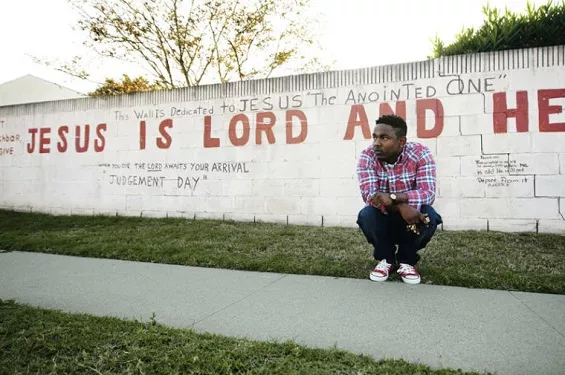
    Press photo via official website

    Kendrick Lamar

    Rapper Kendrick Lamar released a new track this week from his hotly anticipated followup to 2012’s Good Kid, M.A.A.D. City. The song, titled “The Blacker the Berry,” was dropped the day after the Compton native took home two Grammy wins for Best Rap Performance and Best Rap Song for his song “i,” also expected to appear on the forthcoming album.

    Whereas “i” is a deeply introspective, life-affirming song, “The Blacker the Berry” is a racially charged call to arms. And in many ways, it appears to confront the criticism he faced for his remarks on the shooting of Mike Brown in Ferguson.

    See also: Kendrick Lamar’s Debut is One of the Most Important Hip-Hop Albums of Our Era

    Lamar drew widespread ire from activists and fellow hip-hop artists owing to an interview he did with Billboard in early January. Specifically:

    Lamar spent much of his childhood on the streets, and he’s cagey about the trouble he might’ve gotten into. “Oh, man, I won’t be able to say that on record. I got into some things, but God willing, he had favoritism over me and my spirit.” He also has been treated unfairly by the cops — “plenty of times. All the time.” Asked about the high-profile killings of African-Americans by police in 2014, from Ferguson, Mo., to Staten Island, he says, “I wish somebody would look in our neighborhood knowing that it’s already a situation, mentally, where it’s f—ked up. What happened to [Michael Brown] should’ve never happened. Never. But when we don’t have respect for ourselves, how do we expect them to respect us? It starts from within. Don’t start with just a rally, don’t start from looting — it starts from within.”

    The backlash was immediate, with fellow hip-hop artists Azealia Banks and Kid Cudi leading the charge.

    Lamar’s sentiment wasn’t a new one. The entirety of Good Kid, M.A.A.D. City — a concept album whose tracks tell an unbroken narrative when taken as a whole — essentially offered the same message. But critics of his remarks felt Lamar was playing respectability politics — ground tread more often by the likes of Bill Cosby and Steve Harvey than that of Kendrick’s hero and supposed musical ancestor, Tupac.

    The opening lines of “The Blacker the Berry” seem to address the unrest in Ferguson directly:

    Continue to page two.

  • The “Save Big Money at Menards” Jingle: A History

    The “Save Big Money at Menards” Jingle: A History


    Menards_Guy_Ray.jpg
    Screengrab via YouTube
    “Menards Guy” Ray Szmanda


    Certain homegrown songs get played quite a bit in the Midwest, but there’s one song that seems to explode across our airwaves more than any other. It’s been a hit on every terrestrial radio station within the state’s limits and is instantly identifiable by anyone who has ever spent time with their television or radio on.

    Of course, I’m talking about the Menards Jingle.

    Most of us remember it for the eleven months out of the year that the infectious staccato banjo instrumental beneath “Menards Man” Ray Szmanda’s irresistible pitch for us to “Save Big Money at Menards” comforts us as only advertising can.

    But the holiday season has always been signified by the jingle’s winter remix. Those plucked high strings and rapturous sleigh bells transport us to the mystical Decembers of our youth. After being made aware of their annual “Home for Christmas” sale, often including faucets and phones, we’re met under the mistletoe with the timeless carol “Warm season’s greetings to you all from Menards!”

    In a world where jingles often change and even the most longstanding of standards become altered or updated, Menards has boldly stuck to its guns. Since the store has used the jingle for literally decades, we decided to reach out to Menards’ corporate offices to get the full story on the song. After checking around, we were told that nobody currently working for Menards was even around when the jingle was put into use, and that they’ve just kept using it.

    While “it’s just always existed” would be a compelling mythology for the Menards jingle, the Internet reveals something of a dispute as to where it originally came from. While there’s no real way to hold blog posts and their subsequent comments to any sort of accountability, here are the facts we know for sure:

    *Menards was founded in 1960 by John Menard Jr.
    *The jingle was recorded at Irish Saxe Studios.
    *The current particular recordings we hear were recorded in the early ’80s.
    *You’ll save big money at Menards.

    Outside of this, things get tricky. While the popular feel-good urban legend is that the jingle’s music and lyrics were created by John Menard Jr.’s wife as something of a home improvement theme-music Betsy Ross, most accounts attribute the song’s origins to studio musicians and the competitive nature of the jingle era.

    Irish Saxe Studios, Appleton, Wisconsin’s jingle mothership, is the likely spot of the Menards jingle event horizon. In 1972, Eau Claire WAXX/WAYY station manager and friend to Menard Bob Holton wrote the lyrics over some stock music, selling it to Menard on the cheap.

    The track was used for about a decade and then composer Mitch Irish rearranged it in 1982. Irish, who is also known for the music from Troma Studio’s cult classic The Capture of Bigfoot (directed by former Reform Party candidate for governor of Wisconsin Bill Rebane), also recorded this new version at Irish Saxe, known today as Saxe Productions.

    While the Menards Christmas jingle remains a complete mystery to us, we can at least live with the knowledge that the original jingle was made by mere mortals.

    But as the seasons change, friends come and go, and neighborhoods evolve, every year our lives will have one constant: those warm banjos and the comfort of being told we’ll “save big money at Menards.”

    RFT MUSIC’S GREATEST HITS

    The 15 Most Ridiculous Band Promo Photos Ever
    “Where Did My Dick Go?” The Gathering of the Juggalos’ Best Overheard Quotations
    I Pissed Off Megadeth This Week, My (Former) Favorite Band
    The Top Ten Ways to Piss Off Your Bartender at a Music Venue


  • Why Ariana Grande Is Terrifying

    Why Ariana Grande Is Terrifying

    Melissa Rose via Wikipedia

    Behold the face of pure evil.

    I feel the same way about pop star Ariana Grande as I do about kittens. Like a kitten, she is small, manic and often has furry ears. Like a kitten, everyone in the world loves her. And, like a kitten, she fills me with deep, untenable terror.

    This is not a reason to grin. It’s a reason to lock your doors.

    News reports have done nothing to quiet my petrifying fear of demon-plagued potential serial killer Ariana Grande. If she turns out to be a sociopath who takes over the world and destroys us, don’t act like I didn’t warn you in a completely reasoned way.

    Let’s survey the evidence:

    Her Family
    Psychologists generally agree that sociopathy runs in families. One memory Grande has of her mother seems a little different from the typical nurturing: “When I was a little kid she smeared blood all over the walls in our new house and said O.J. did it.” And then there’s her brother, who detailed his fantasies for an elaborate killing of one of his housemates on Big Brother 16. So, OK then.

    Her Mutability
    The ability to change one’s emotions at the blink of an eye is a classic trait of sociopathy. Take a look at the footage of this conversation with the hosts of Good Morning America on the topic of Ariana’s recently deceased grandfather:

    For a second Ariana looks like she’s going to cry. Then, everyone looks away and — snap, nod, drop. If there’s anything left on her face, it’s cold, undiluted malice. This is the part when Ryan Seacrest wakes up in the middle of the night with “U DIE ALIVE LOL” written in blood across his chest.

    Her Accent
    Speaking of abrupt shifts, observe the progression of Ariana’s public persona. During an inane interview featuring questions inside of balloons, she sounds essentially the same as her character on the brain-meltingly idiotic teen sitcom Victorious, her sole source of fame at the time. Now compare this to an interview six months later after the release of her hit debut single, “The Way.”

    Asthmatic white girl to super-down and borderline ratchet over the course of a semester? You don’t go from teen idiot to “urban cool” that convincingly unless you’ve got a Ted Bundy-esque eye for interpersonal control.

    Continue to page two for more proof that Ariana Grande is to be feared.

  • The 100 Greatest St. Louis Songs

    The 100 Greatest St. Louis Songs

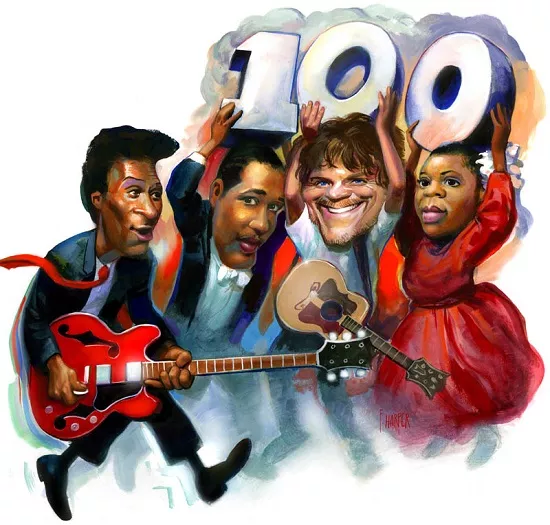
    Illustration by Fred Harper

    This is the story of St. Louis, as told by the musicians and artists who have glimpsed its complicated beauty.

    By Roy Kasten, Christian Schaeffer and RFT Music

    St. Louis isn’t just a city. It’s a song. Or rather songs, hundreds, thousands and more. Don’t bother counting. We tried.

    In back rooms and basements, on stages and streets, musicians have paid tribute to St. Louis again and again. Place matters. St. Louis doesn’t define artists like Chuck Berry or Scott Joplin or Nelly. On the contrary, those performers helped define the city by producing music that reflects its depth and variety. Their songs, and those of countless other musicians, tell the city’s story and represent it to the world.

    This is a list of 100 of the greatest songs about, for and of St. Louis. It’s not a roundup of our greatest musicians (though many are here), nor is it a catalog of influential tunes (though they’re here, too), or a compendium of songs that namedrop St. Louis. Rather, this is a list about what it means to invoke St. Louis in song.

    Many of the artists on this list (and we limited ourselves to one song per artist) are St. Louisans. Some never lived here but were inspired by this town. Just ask 1920s chanteuse Bessie Smith (“St. Louis Blues”) or R&B crooner Lloyd Price (“Stagger Lee”): Summon St. Louis, and you scratch a touchstone. The city is home to the father of rock & roll; it’s also a homeland for anyone who loves music.

    Some songs use St. Louis to evoke a feeling — be it the gritty blues of the city’s 20th-century industrialism or the earthy twang of its frontier heritage. Others look unflinchingly at the region’s fault lines of race, class and opportunity. One proclaims pride for the Lou; the next wonders what the hell happened. Every song, however, is rooted in a love for St. Louis.

    Can a city enriched by the confluence of major rivers and complex cultures be reduced to a playlist? Not likely. These 100 songs, spanning three centuries, are not a reduction. In words and music, they expand the story of a St. Louis both real and imagined. Nearly every style of American music has emerged from or passed through this place and come out changed. When musicians pay tribute to St. Louis, they are joining our deep musical streams.

    We’d like to acknowledge some very kind music lovers who made valuable suggestions for this list: Ed Becker, Michael Bishop, Art Dwyer, Ron Edwards, Bil Gelb, Matt Harnish, Chris King, Mark Mason, Dean Minderman, Jim Nelson, Jack Petracek, Tom Ray, René Spencer Saller, Dennis Stegmann, Josh Weinstein and Toby Weiss. Thanks also to Nick Lucchesi and Kiernan Maletsky, who first suggested this project years ago. Extra special thanks to Dennis Owsley, whose book City of Gabriels: The History of Jazz in St. Louis, 1895-1973 was beyond helpful, and Kevin Belford, who offered generous advice and insight. Belford’s book (and blog) Devil at the Confluence is an inspiration.


    100. Emmett Miller – “The Ghost of the St. Louis Blues” (1929)

    This countdown of 100 songs begins where it ends (or vice versa, if you prefer), with “The St. Louis Blues,” or rather with the ghost of that song — and the specter of the trickster to end all musical tricksters, Emmett Miller. So much more than just a minstrel performer, Miller is like the missing link between blues, jazz, country and even rock & roll. On this parody, he and his band the Georgia Crackers have a comedic ball with W. C. Handy’s immortal song, turning it into a politically incorrect séance, with his piercing yodel all but mocking the sound of Louis Armstrong’s coronet, as recorded four years earlier. Miller (and composers Billy Curtis and J. Russell Robinson) had one thing right: You can’t escape an earworm like “The St. Louis Blues.” But you’d have to be as insane as Miller sounds to even try. -Roy Kasten

    99. Bottoms Up Blues Gang – “South Broadway Blues” (2002)

    A good blues song needn’t have flashy solos or hellhounds on its trail; sometimes it can be simple celebration of where you come from and where you’ll always return. The acoustic-blues minimalists (at least when performing as a trio or even as the core duo of Kari Liston and Jeremy Segel-Moss) of Bottoms Up Blues Gang know that all roads lead back to the Arch and the stomping grounds of Benton Park and Soulard, where the legends before them — Tommy Bankhead and Oliver Sain, to mention just two named in this song — set the tone for sharing life-affirming music in small clubs you wouldn’t want to live without. -RK

    98. Oliver Cobb & His Rhythm Kings – “The Duck’s Yas Yas Yas” (1929)

    The original version of this party tune was recorded by piano player James “Stump” Johnson in early 1929, though fellow St. Louisan Oliver Cobb gave it a hot big-band arrangement that surely widened its appeal into the ’30s, and remains the one you gotta hear (though don’t miss Johnson’s original, with expanded lyrics and bonus local color). When he scats, Cobb isn’t shy about letting his Satchmo influences show, and he’s also not shy about giving every musician (down to the banjo and doghouse bass) a few seconds in the spotlight as they all march down to Market Street “where the women all meet.” “Yas yas,” of course, is slang for hind parts, and we’re not talking about a duck’s tail feathers. -RK

    97. Bessie Mae Smith and Wesley Wallace – “St. Louis Daddy” (1929)

    We know all about the St. Louis women, with their diamond rings, apron strings, makeup and “store-bought hair.” In 1929, Bessie Mae Smith (who recorded under various names, including Mae Belle Miller) sounds like she has just about had enough. She pleads with accompanist Wesley Wallace to cut the crap, and over some easy-striding piano he keeps dishing it out. Smith’s voice has a creaky, sexy, smoky quality to it that must have driven Wallace (not to mention husband Big Joe Williams) crazy; it would have done the same for pre-Depression barrelhouses all over town. -RK

    96. Erin Bode – “St. Louis Song” (2006)

    As a singer comfortable moving between the jazz and folk worlds, Erin Bode has often been hailed as St. Louis’ answer to Norah Jones. Her talent has taken her far and wide, but on “St. Louis Song” she plants her feet in her hometown. The track, from Bode’s 2006 release Over and Over from the Webster Groves-based MAXJAZZ label, could be set in any city where two lovers part ways, but something about Bode’s lyrics fits our city like a glove. Her man wants to leave St. Louis, but she wants to stay, though she sounds confident that he’ll return home someday. Any outsider who has ever fallen in love with a Mound City native probably knows the feeling, and as Bode glides through the delicate guitar figure and sonorous bass runs, she tells of a love for her city that, at least this time, trumps romance. -Christian Schaeffer

    95. Johnny Paycheck – “The Spirits of St. Louis” (1977)

    Leave it to Johnny Paycheck to record one of the all-time great drinking songs (written by Roger Bowling and R.J. Jones) for a town that loves a good drinking song. Paycheck sings the hell out of the chorus — “I’ve sipped Tennessee’s best whiskey / Drank every bar dry in this old city / But all the spirits in St. Louis can’t get you off my mind” — and the band (flush with dobro, harmonica and a rhythm section that ticks steady as a clock hand headed to closing time) matches him phrase for set-’em-up-knock-’em-down phrase. If this song isn’t on the jukebox, you’re in the wrong honky-tonk. -RK

    94. Dave Van Ronk – “Duncan and Brady” (1959)

    When it comes to the rabbit holes of American murder ballads, few are as deep and labyrinthine as “Duncan and Brady.” Based on a murder in St. Louis (Eleventh Street and Lucas Avenue, to be exact) on October 6, 1890, the song has traveled under various names (the first recording, by the string band Wilmer Watts & the Lonely Eagles, bore the title “Been on the Job Too Long”) and accrued details that don’t match up to history. Go figure. What we do know is James Brady was the police officer slain at the rowdy tavern, and Harry Duncan, a black man and local singer, was the accused. Despite numerous appeals, Duncan would hang for the crime, though the saloon’s owner, Charles Starkes, ultimately copped to the murder in a deathbed confession. Just about everybody who’s anybody in folk music (Lead Belly, Judy Henske, Bob Dylan) has recorded this bad-man ballad. Dave Van Ronk’s interpretation from 1959 deserves special notice for its crisp, growling soul. -RK

    93. Signifying Mary Johnson – “Delmar Avenue” (1936)

    The disparity between rich and poor, and often between black and white, in the city of St. Louis has often been typified by what is called “the Delmar Divide”: great wealth, infrastructure and opportunity on the south side of Delmar Boulevard, great poverty on the north. Listen to enough blues music, and you’ll find that the street was the setting for a different kind of pain. In this 1936 recording, slide guitarist James “Kokomo” Arnold and singer Mary Johnson tell of empty streets, rain clouds and “ragged daddies.” It’s desolate and dark, and while Johnson sings of wanting to cry, Arnold’s bottleneck runs feel one step ahead of her. -CS

    92. DJ Quik – “Jus Lyke Compton” (1992)

    It’s one thing to rap about street life but quite another to witness the consequences. On tour to promote his first album, rapper/producer DJ Quik was surprised to see LA-style gang culture spread across America. He recounted some of his experiences in “Jus Lyke Compton.” In St. Louis, “where they country as fuck,” Quik and his entourage rolled in on a typical hot summer day. They met some friendly locals who showed them some local spots, including the Smith Center and Gus’s Fashions. After the show, however, there was a shootout between local gangs who had adopted the Blood and Crip symbols they’d seen in movies and heard in records. Quik was left shaking his head: “In Missouri?” he raps. “Damn, how could this happen?” -Mike Appelstein

    91. Henry Brown – “Deep Morgan Blues” (1929)

    The area known as Deep Morgan appears elsewhere on this list of songs, either in spirit or in location. Located on Biddle Street in what was known as north St. Louis’ “Bloody 3rd Ward” at the turn of the century, Deep Morgan was where “Stack” Lee Shelton shot William Lyons, but it was also a red-light district that was home to the city’s music clubs. As such, the neighborhood offered fertile ground for the evolution of ragtime, blues and jazz, and it’s that history that piano player Henry Brown channels in “Deep Morgan Blues.” The Tennessee-born Brown moved to St. Louis at age twelve and came to be known as a barrelhouse piano player with few peers; you can hear him exemplify the form on this track, with its stately walking bass line keeping time for Brown’s more emphatic right hand. Listen closely and you can hear elements of Deep Morgan’s musical contributions to American music in this three-minute rag. -CS

  • Please Familiarize Yourself With Rebbie Jackson’s “Centipede”

    Please Familiarize Yourself With Rebbie Jackson’s “Centipede”

    Which, of course, is why they called it Centipede.

    Beloit’s annual college mindset thing is out this week and making the Facebook rounds, performing its yearly task of making everyone over the age of fifteen feel super old. Most of its findings hit the mark — Robert De Niro is from Meet the Parents, Bill Clinton is an elder statesman, CDs are something your parents had — but I was a little confused to learn that “Michael Jackson’s family, not the Kennedys, constitutes ‘American Royalty.’” If this is really the case — for me, the appeal vanished once his kids were no longer reclusive children who appeared oddly eloquent on TV but hyperactive tweeters who sound like every other hyperactive tweeter — then as an Old Man at 25 I have only one thing to offer the Class of 2016: Rebbie Jackson, performing “Centipede.”

    Before she was an aging Princess of America, involved in the weird pseudo-kidnapping of the Queen of America, she had this hit song. Spoiler alert: It’s called “Centipede,” and it’s about a woman in a painting and then on the set of Ghostbusters who shoots lightning out of her hands (with a snake that also shoots lightning) and is maybe singing to or about a tiger, and she can turn into lightning, and it’s called “Centipede,” of course, and then she lightnings out of the painting, kind of, and murders a security guard. Centipede.

    Finally: A sexy song about centipedes.

    I think most students of “Centipede” are basically happy to giggle about the competing phallic-animal images in the lyric, but I’m more into the way that Rebbie Jackson appears to be an ageless, omnipotent God-queen surrounded by mistreated consorts who all dress and dance like her brother Michael, who is singing the disembodied chorus. If you were looking for a Jackson song you could write into your Game of Thrones crossover fanfiction, this is it, you guys.

    Which means there are really two objections to Beloit College’s insistence that the Jacksons are a reasonable approximation of royalty in 2012.

  • Chuck Berry’s St. Louis Homes and Properties Before He Was Rich and Famous [Photos]

    Chuck Berry’s St. Louis Homes and Properties Before He Was Rich and Famous [Photos]

    Chris Naffziger

    Berry and his family would live here for two short years before moving again.

    In the late 1950s Chuck Berry purchased a 35-acre plot in rural St. Charles County where he dreamed of creating a lavish property to rival those of the segregated country clubs he’d seen growing up in St. Louis. The result was “Berry Park,” a sprawling compound complete with guest cottages, a nightclub and guitar-shaped swimming pool. Today the 17,000-square-foot mansion he built at Berry Park remains the rock & roll legend’s primary residence. He also keeps a second home in the affluent suburb of Ladue.

    It wasn’t always this way.

    See also: Chuck Berry Reviews Classic Punk Records In Unearthed Jet Lag Zine From 1980

    Click on the pin drops for a tour of Berry’s early homes and businesses.

    For the first 30 years of his life (minus a short stint in prison), Berry lived in essentially the same black, working-class neighborhood of north St. Louis. Here is a look at those first St. Louis properties owned or occupied by Chuck Berry — before all those music royalties came rolling in.

    Up first: The site of Chuck Berry’s birth — the home where he got his first taste of music.


    Homer G. Phillips Hospital now sits on the site of Chuck Berry's birthplace. - Chris Naffziger

    Chris Naffziger

    Homer G. Phillips Hospital now sits on the site of Chuck Berry’s birthplace.

    2520 Goode Avenue
    Chuck Berry was born October 18, 1926, at 6:59 a.m. inside a small home at 2520 Goode Avenue, now known as Annie Malone Drive. The family moved a few years after Berry’s birth, and the home was soon torn down for construction of Homer G. Phillips Hospital, which served for decades as the city’s only medical center for blacks. Although his time at the Goode home was short, it was here that a young Chuck Berry was first introduced to music. As he writes in his autobiography:

    Mother and daddy were of the Baptist faith and sang in the Antioch Church choir. The choir rehearsed in our home around the upright piano in the front room. My very first memories, while still in my baby crib, are of musical sounds — the assembled pure harmonies of the Baptist hymns, dominated by my mother’s soprano and supported by my father’s bass blending with the stirring rhythms of true Baptist soul. I was always trying to crawl out of my crib and into the front room to where the rhythm came from. Long before I learned to walk I was patting my foot to those Baptist beats, rocked by the rhythm of the deacons’ feet focused on the tempo of the times. Oh! But the feeling it generated still stirs my memory of back when. Hallelujah!

    Next: The Berrys move to a home with modern luxuries such as a telephone.


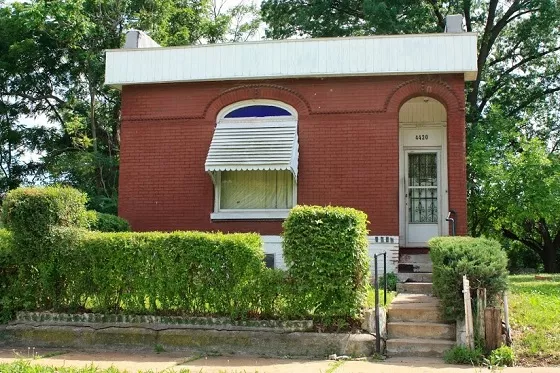
    Berry and his family would live here for two short years before moving again. - Chris Naffziger

    Chris Naffziger

    Berry and his family would live here for two short years before moving again.

    4420 Cottage Avenue
    After briefly moving to a home across the street from Berry’s birthplace on Goode Avenue, the Berry family settled at 4420 Cottage Avenue, also in the Ville neighborhood. They would stay at this location for just about two years. Recalls Berry of the 4420 Cottage home:

    Late in the second grade our family moved again. Daddy found a five-room brick bungalow with full bath, full basement, central heating, and a front and backyard just two blocks away at 4420 Cottage Avenue. We thought it was a palace to have closets and front and back porches. The rent was $25 a month. Mother dug in her savings and added new pieces of furniture that included a new Whirlpool washing machine and a pedal Singer sewing machine that (to my delight) I was invited to pedal while mother sewed. Daddy had some white people install a telephone which brought a million questions from me about its function.

    Next: The Berrys move to a home that Chuck will return to time and time again as a teen and young adult.


    The empty lot to the left is all that remains of the Berry property on Labadie Avenue. - Chris Naffziger

    Chris Naffziger

    The empty lot to the left is all that remains of the Berry property on Labadie Avenue.

    4319 Labadie
    While Berry was in fourth grade, his family moved again to a duplex on Labadie Street. The Berry family (which in addition to Chuck included his parents, Henry and Martha, and five siblings) would stay at this home for years with Berry returning to the home at the age of 21 (after serving four years in a juvenile center for a carjacking) and, again, a few years later with his new bride, Themetta. The Labadie home has since been torn down, but the property is still owned by Chuck Berry. In his autobiography Berry recalls that the duplex had four rooms with bath and basement and a second floor with the same number of rooms. And it was at this home that Berry first developed his infamous kink. He writes:

    One evening I came through the gangway of home and heard water running in the bathroom on the second floor next door. The light from the window was casting down on the roof of our porch. Temptation told me I might finally see a girl’s parts, so I hurried to the room and creeped toward the open window to redeem my dream. There, through six inches of raised shade, I saw — for the first time in my life — the bare buttocks of a woman about to step into the bathtub. I froze, instantly excited, and crouched stunned and amazed at my long-awaited view of the opposite sex. She even turned around momentarily and allowed a direct view of the front part as she came over to pull the down the shade.

    Next: Chuck Berry and his young wife, Themetta, get their first place on Delmar Boulevard.


    This former boarding house, once owned by Berry's uncle, served as the first home to a newly married Chuck and Themetta. - Chris Naffziger

    Chris Naffziger

    This former boarding house, once owned by Berry’s uncle, served as the first home to a newly married Chuck and Themetta.

    4352 Delmar Boulevard
    Chuck and Themetta Berry have been married now for 66 years. But in early 1949 the couple was newly hitched and looking for a place to call their own. They found that first spot in a rooming house owned by Berry’s maternal uncle at 4352 Delmar. The couple would stay there for less than a year — eventually moving back in with Berry’s family at 4319 Labadie. Still for a short while, the happy newlyweds had a place of their own and felt that they were really making it — even if they were not. During this time, Berry was earning $80 a week at an auto assembly plant and another $35 a week doing handyman work with his father. Themetta, meanwhile, brought in another $20 a week working at a cleaners. Writes Berry of their short stint at 4352 Delmar:

    We had a 1941 Buick, a refrigerator and were on our way to riches. We were living like the best of the white folks until one evening we were dressed in our “Sunday clothes” on our way to a movie. All the tenants were on the porch chatting as we noticed our parking space. There was no ’41 Buick parked where we’d left it at the curb. I boasted about calling the police but knew it had been repossessed by the finance company.

    Up next: Berry moves to the home where he’d pen his greatest hits. The now-vacant building was recently placed on the National Register of Historic Places.

  • Here Are Some Terrible Pickup Lines From Hilarious Comedians

    Here Are Some Terrible Pickup Lines From Hilarious Comedians

    Chris Neff: If I could rearrange the alphabet I’d stick my dick in your mouth.

    Smooth talking the opposite sex is a mysterious art form deserving of a master class. Still, any idiot knows that cheesy pick-up lines are never the way to go. We’ve all heard them, laughed at them, and if one of them actually worked for you, well…more power to your genitals.

    The general rule when it comes to the “pick-up line” is to actually treat it as an icebreaker that will make the other person smile which, if you’re lucky, will lead to conversation. And if you are really, really lucky, it’ll lead to you sealing the deal.

    We’ve heard some pretty cheesetastic pick-up lines ourselves over the years such as, “Girl, I’d eat you like a Denny’s Grand Slam. For breakfast, lunch, and dinner.” (FYI-it did NOT work) so we decided to compile a list filled with “do not even try” lines just for you. We went straight to the some of the funniest standups we know for some of the corniest lines they have ever heard (or in some cases, even said themselves).

    Brandon “Gooch” Hahn: Did my brain just put its dick in your mouth because you just blew my mind!

    Brad Williams: You remind me of a bottle of Snapple because you’re made from the best stuff on earth.

    Virginia Collins: Oh you like 2 Chainz? I’m his manager.

    Colin Quinn: Hey miss. Sit on my face and I’ll guess your weight.

    Mark Gonzales: You’re like my iPhone, I want to rub my cock all over it.

    Suli McCullough: “Are you religious? Because seeing you is a come to Jesus moment!” Also there is always the classic, “You must be a fan of martial arts because Jean-Claude Van Dammmmmn you’re fine!”

    Keith Robinson: What I used to when I was driving was, when I was stopped at a light and I’d see a good looking lady, I’d beep and when they’d roll their window down I’d say, “I’m little lost. Do you happen to have directions to your heart?”

    Mariya Alexander: Damn boy, are you my parents approval? Because I’m starving for you.

    Jen Murphy: Can you make like baby Jessica and fall into my hole?

    Chris Neff: If I could rearrange the alphabet I’d stick my dick in your mouth.

    Shaun Latham: I just drop a sugar packet and then say, “Hey. You dropped your name tag.” Then I pick up the sugar packet and give it to her.

    Rich Vos: Do you know what I can do to you before I smash you in the head with a shovel?

    Grant Cotter: If we went on a date I’d eat mothballs before I picked you up because I know you’d be giving me butterflies in my stomach.

    Sharon Barragan: You busy? You wanna get busy?

    Continue to page two for more.

  • The Ten Best St. Louis Metal Bands

    The Ten Best St. Louis Metal Bands

    It’s a good time to be a metal fan in St. Louis. No, not because of the corporate metal shows that roll through Verizon Wireless Amphitheater each summer (although Iron Maiden is welcome here any time), but because of the breadth of local musicians who are forming bands and playing songs right here. Some of the best metal shows of 2013 have been filled top-to-bottom with locals, and while nights like the one recently when St. Vitus (out of California) played the Firebird and Antichrist (Sweden) played Fubar still piss excellence, local heavy metal is what should get you out of the house. This year, the RFT named Black Fast as the best St. Louis metal band, but there are more bands you should check out, too. So here’s our rundown — in no particular order — of nine other St. Louis metal bands to watch.

    See also: St. Louis concert calendar


    The Ten Best St. Louis Metal Bands

    THE GORGE

    The Gorge is one of the Midwest’s best metal bands. Whereas Meshuggah clones and djent worshippers try to sweep their way over 5/4 time signatures, the Gorge uses technical complexity to actually write songs. Few in the genre match its songwriting ability, due to the fact that the band is filled with educated musicians, not twenty-year-old kids with swoopy hair and eleven-string Schecter guitars. Having just returned from tour, the band is tighter and heavier than ever. The Gorge isn’t just a good metal band — it is a great band regardless of what label you affix to it.
    — Kenny Snarzyk


    The Ten Best St. Louis Metal Bands

    BASTARD

    Satan-worshipping, blackened thrash metal. That’s all that really needs to be said about St. Louis’ Bastard. Formed in 2012 out of the now-defunct Harkonin, and featuring members of Tyranny Enthroned and the Lion’s Daughter, Bastard has quickly become a favorite among metal enthusiasts and musicians alike. Bastard, too, is a suitable moniker for this hell-child of Bathory and Motörhead; this is the audio equivalent to cutting your whiskey with the blood of a two-headed black ram and then mainlining it. Watch these gentlemen steal the spotlight at nearly any show they play. All hail Bastard!
    — Kenny Snarzyk


    The Ten Best St. Louis Metal Bands

    TERRA CAPUT MUNDI

    Terra Caput Mundi bangs out midtempo speed metal from a distant north-county galaxy. One can only assume that the band was formed two days into a malt-liquor-fueled game of Warhammer 40k while listening to Port Royal and Don’t Break the Oath. Great riffs are played loosely under ambitious vocals that are reminiscent of a slightly inebriated King Diamond. This stuff is for metal purists who aren’t looking to be trampled by 300 bpm triggered drums and Cookie Monster vocalists. 2013 saw TCM’s new full-length, Lost in the Warp, which is the band’s best work to date.
    — Kenny Snarzyk

  • My Girlfriend’s Breasts Are Too Small. Help!

    My Girlfriend’s Breasts Are Too Small. Help!

    Welcome to Ask Willie D, where the Geto Boys MC answers reader questions about matters, in his own words, “funny, serious or unpredictable.” Something on your mind? Ask Willie D!


    Photo courtesy of Peter Beste

    Photo courtesy of Peter Beste

    TWO SIDES TO A FRIENDSHIP
    Dear Willie D:

    The other day I decided to call an old friend to catch up. From the moment she said hello she went on a diatribe about how I don’t call her or come to her house anymore since I married my husband. Granted, I don’t call as much and have only been to her house once in the past year, but the coin she’s flipping has two sides. I told her that she didn’t have to wait on my call. If she wanted to talk she could have called me first. And why do I have to be the one driving across town?

    Just thinking about it has my mind going all the way back to the beginning of our friendship. I’ve always been the one to make the first move. Whenever we went anywhere we usually took my car and I drove. If we were shopping and she was short on cash or didn’t have money, I was the one who pitched in. We have 15 years of history and she is the sweetest person, but I’m starting to think she’s a user; at the least she’s taking me for granted. How do I address this issue and remain friends with her?

    Two Sides:

    When people claim to be your friend and the only time you get to speak to them is when you call them first or they need something, that’s code for, “I don’t value your friendship the way you value mine.” It’s also a sign of selfishness. You already addressed the issue when you told her she could have called you first and when you put her on blast about having to drive across town. Now whether she wants to remain friends or not, that’s on her.

    GIRLFRIEND’S BREASTS TOO SMALL


    Dear Willie D:

    My girlfriend is beautiful, smart and fun to be around. But if she had bigger boobs she would be perfect. I told her a few times that I think she should have her breasts augmented but she is afraid of surgery and the possible side effects.

    I told her she has nothing to worry about and that I would even pay for the surgery but she won’t budge. To get back at her I might not call her or answer my phone for three or four days. Then I’ll finally pick up and halfheartedly kick it with her for a few days and start the cycle all over again.

    I really want her to get the surgery. What can I tell her to convince her that she has nothing to be afraid of? Help a brother out, Willie!

    Boobs Man:

    I don’t know what some men’s fascination is with boobs. They don’t do anything. I understand how important they are for women cosmetic-wise and if a woman wants them fondled during foreplay and intercourse because it arouses her, I get that. But implants take the sensation out of breasts so I really don’t see the point in augmentation. That’s like cutting off your hair to wear a wig.

    Kill the sixth-grader games of going days without calling your girl because she won’t let you pressure her into doing something she doesn’t want to do. If you can’t accept her for who she is you’re not seeing the real her. You should be proud to have a girlfriend who refuses to let society dictate her image.

    She sounds like my type: beautiful, smart and fun to be around. Keep playing and the next time you go without calling her for three-four days I might answer her phone while she’s lying next to me… in her birthday suit… exhausted.

  • The Six Best Songs About Murdering A Significant Other

    The Six Best Songs About Murdering A Significant Other

    Ha! You got that song from Psycho stuck in your head now, don’t you?

    Valentine’s Day is upon us, a time to celebrate relationships or hate those celebrating. But for those relationships that don’t end well, here are the six best songs about murdering a significant other. Let us know your favorites in the comments, but we suggest using a public computer with an untraceable IP address.

    6. Wilco – “Via Chicago”

    Jeff Tweedy can make a line like “I dreamed about killing you again last night and it felt alright to me” sound tender. The opening lines of “Via Chicago” outline a murder fantasy, complete with a plan to dispose the body (“Buried you alive in a fireworks display”). This song would probably top this list if it song stayed in premeditation for its entire running time. But as is, it morphs into an ode to homesickness, and that feels alright to me.

    5. The Paper Chase – “A Little Place Called Trust”

    In 2002, The Paper Chase released an album of menacing indie rock entitled Hide The Kitchen Knives, which sounds like the interior monologue of a serial killer. I can’t pick an exact line from “A Little Place Called Trust” that speaks of killing a ladyfriend, but there is plenty of implication from the introductory beat made from knife sharpening sounds and the threatening lyrics (examples: “What do you take me for you motherfucker?” and “You deserve whatever you get because you are not the innocent”). The Paper Chase’s frontman John Congleton is a masterful producer whose credits include Strange Mercy by St. Vincent and Take Care, Take Care, Take Care by Explosions In The Sky, and you can hear his hyperfocusing attention to detail come to the forefront on his own band’s record.

  • The Six Best Songs About Manifest Destiny For Thanksgiving

    The Six Best Songs About Manifest Destiny For Thanksgiving

    Let us reminisce about the first Thanksgiving, when the Native Americans said to the pilgrims, “In exchange for this bountiful feast, you have the rights to all the land and resources of this great country and permission to slaughter any indigenous people who dare stand in your way.” That’s how it went, right? Right? Here are the six best songs about manifest destiny. Let us know your favorite songs about white men unfairly killing Indians in the comments below, and remember the screams of the innocent when dousing your turkey with gravy this Thursday. Gobble gobble!

    6. Neil Young – “Pocahontas”
    “Pocahontas” mentions brutal attacks on Native Americans, the massacre of buffalo, and the practice of trading objects for women. Given the subject matter, it is surprising that Neil Young isn’t more pissed. He instead uses “Pocahontas” to reflect on the chain of events that made this country what it is today. He implies hypocrisy as he speaks of decorating his apartment with an Indian rug and smoking a peace pipe, watching the taxis drive on the land where Native people once lived. Young also name drops Marlon Brando, an avid activist for Native American rights during his lifetime. When he fantasizes about hanging out with Brando and Pocahontas, he doesn’t seem to be particularly putting himself in league with them. Rather, he appears wistful about situations that, for reasons buried in our complicated past and out of his control, can never be.

    5. Anthrax – “Indians”
    Metal bands love the story of early American settlers wiping out the Natives. There’s violence, evil, and the ability to summon the anger of the victims. It’s the same reason they love religion. Anthrax interpreted this wrath in the track “Indians,” a song whose moral is essentially, “we’re being dicks to these guys.” The band gets points for introducing its mid-song breakdown by yelling “War dance!”

  • The Ten Best Music Videos Featuring Zombies

    The Ten Best Music Videos Featuring Zombies

    AMC

    I’m rereading the first 40 or so issues of The Walking Dead comics, since The Walking Dead TV show returns to AMC this Sunday, October 14. I’m super-psyched about the third season — my friends are developing a drinking game around how many times Carl gets lost, and I’m more than ready to see Rick Grimes get even grimier.

    See also:
    Which Song will FOX Ruin During the MLB Playoffs This Year?
    The Ten Worst Music Tattoos
    On Safari at Bass Center VII

    But I can’t concentrate on reading about the zombie apocalypse with all this NOISE. Do you hear it? It’s like deep snarling or something. Wait, now what was THAT? Did something fall over? What’s slamming into the wall repeatedly? And what is all that blasted moaning? Ugh, I bet it’s those two idiots next door bumping uglies again. Excuse me while I give them a piece of my mind.

    [Update: We regret to inform you that our writer’s last words were unwittingly literal. Also, zombies are smelly. Here – enjoy some awesome videos starring the undead while we barricade the doors.]

    10. The Creepshow – “Zombies Ate Her Brain”
    Excuse us while we once again remember poor Allison.

    9. The Misfits – “Scream”
    Dude, don’t wear the band shirt in the video. Jeez.

    8. Rob Zombie – “Living Dead Girl”
    This is likely the best thing to come from the The Crow franchise post-Brandon Lee.